- Home
- “Yes, And…” Improving Math Play with Improv
- Althea’s Math Mysteries
- Avoid Hard Work, the Workshop
- Avoid Hard Work! …And Other Encouraging Problem-Solving Tips for the Young, the Very Young, and the Young at Heart
- Blocks and Modeling: A Do-It-Yourself Guide to Exploring Geometric Objects – Online Workshop
- Blog
- Books and Goods
- Bright, Brave, Open Minds
- Bright, Brave, Open Minds: A Problem Solving Kaleidoscope. Open online course for parents and teachers
- Camp Logic
- Cart
- Checkout
- Citizen Science Station
- Consulting and Tutoring
- Courses
- Download File
- Easy Complexity and Special Snowflakes Online Math Circle
- Empires: Year-long prealgebra program in a game
- Expedition Everest
- Five Fabulous Activities for Your Math Circle
- Funville Adventures: Math Personified!
- Funville Web Tour
- Hacking Math
- Hiding in Plain Sight: Vyshyvanka Secret Codes
- Home
- HOW do they do it? Creating your own math puzzles
- Inspired by Calculus: Online course for parents, teachers, and their children ages 5-12
- Kingdom On A Wall
- Kingdom on the Wall
- Ko’s Journey Is Discontinued
- Lapware
- Math Books
- Math Cafe
- Math Circles
- Math Circles 1001 Leaders Course
- Math Future event registration
- Math Future: come and talk!
- Math Goggles Challenges
- Math Renaissance
- Math Trek
- Mathematics & Poetry for All
- Meet the authors
- MidSchool Math Digital Math Tools
- Moebius Noodles
- mpsMOOC13: Problem Solving for the Young, the Very Young, and the Young at Heart
- Multiplication Explorers FAQ
- Multiplication Explorers LIVE workshop
- Multiplication Explorers Online Course
- Multiplication Explorers Registration
- Multiplication Explorers, the book
- Multiplication Models Poster
- My Account
- Natural Math Multiplication Course
- Online Logic Summer Camp for Kids!
- Online Summer Calculus for Kids Camp!
- Pay Natural Math
- Playing with Math: Stories from Math Circles, Homeschoolers, and Passionate Teachers
- Reviews of the Moebius Noodles book
- September 25: Math Storytelling Day
- Socks Are Like Pants, Cats Are Like Dogs
- Speaking and events
- Start Here!
- test001
- The Art of Factorization Diagrams
- The Iditarod
- The seven principles of Natural Math
- Transformers: Matrices & Graphs!
- Veronica’s Multiplication: a Natural Math circle online
- WOW! Multiplication – an open course in September 2013
- Ying and the Magic Turtle
- About Natural Math
- Contact Us
- Get Involved
A math circle journey, book news, and ways to play: Newsletter December 10, 2015

Subscribe and read archives
Pinterest | Twitter | Facebook
Shelley Nash’s Blog Series: A Math Circle Journey
Meet Shelley Nash, mother of seven, math circle leader, and now Natural Math blogger! In her stories, you will find ideas to try at home or in your group, friendly advice for when things go wrong, and little anecdotes about children to warm your heart.
Love of Learning Math is about a group of young children exploring topics from the Moebius Noodles book such as function machines and mirror books. Download Shelley’s slides if you want to offer these topics to your children, but don’t know where to start.

Shelley also writes about her middle school and high school groups. Here are all the posts in the new series. Shelley would love to see a comment from you. Which activity seems interesting? Is anything unclear? Do you also blog about math circles? Scroll down to the end of the post and drop Shelley a line!

Book News: Socks Are Like Pants Layouts
Our latest book on early algebra, successfully crowdfunded this summer, is almost ready for printing and should be out in January! We are finishing last little details of the playful and bright layout. Click pictures for bigger versions, and try these activities with your children:
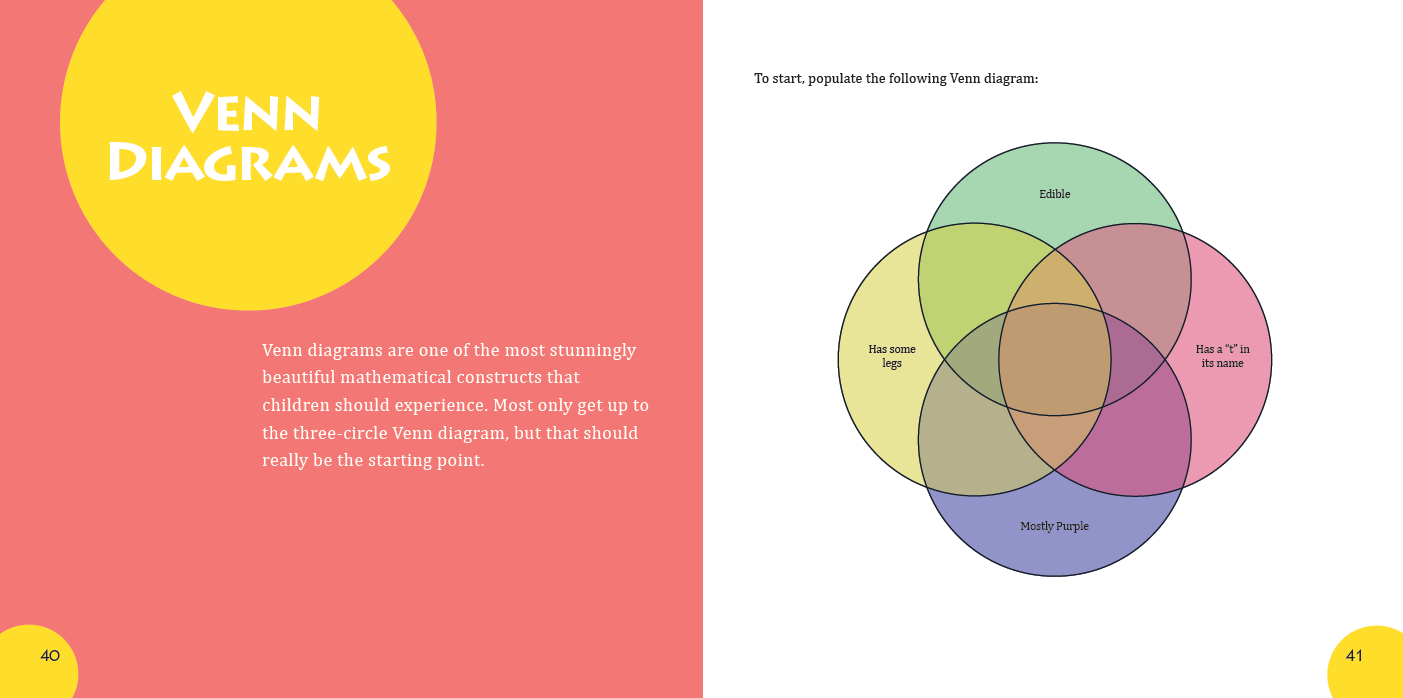
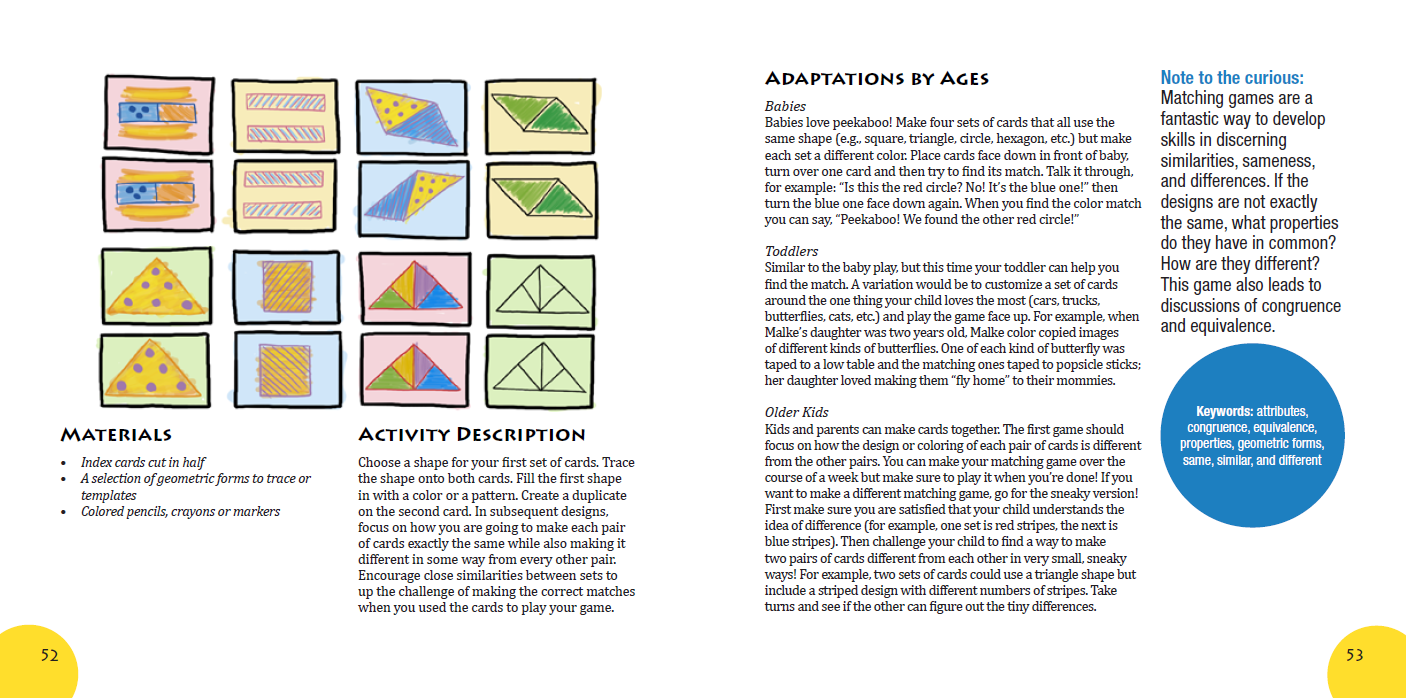
You can see more info about the book and pre-order it on the site.

Ways to Play with Math
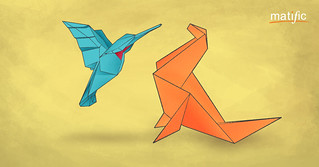
Matific, a site with quick math apps with cute original art, had a blog post about advanced math for young children. A quote:
“Maria Droujkova, a curriculum developer and math education consultant, says the current model of mathematical education focuses on teaching simple ideas the hard way rather than teaching complex ideas the easy way.”
Much like Natural Math, the site advocates plenty of play in learning mathematics. How do you play with math? Here is a brief starter list:
- Building with blocks or Lego
- Origami
- Snowflake cutouts
- Computer games
- Board and card games
- Drama, music and art
Have a question or comment? Reply to this newsletter, and let us can talk!
Dr. Maria Droujkova and the Natural Math crew


Posted in Make, Newsletter
High School Math Circle

Hi it’s Shelley again! I started an online math circle for kids about 8th-12th grade back in September. It has been a learning challenge!. My hope is to share what we did, what worked and what didn’t work so well each week. So as you drop in you’ll be seeing my diary of sorts. I hope it helps others!
We have been using from James Tanton’s introduction to Arithmetic Gateway to All. Since I haven’t posted before, I’ll catch up in this post and then report in weekly as much as I can.
We’ve studied Prime Numbers, Factors, Intersection Math, Catalan Numbers, Number Theory, Triangular Numbers, Square Numbers, Squarangular Numbers and more in just three chapters!
Read more…
Posted in A Math Circle Journey
A Math Circle Journey: Follow the Story of Online Math Circles
“My brother wants to talk to you after class is over.”
“Okay, that would be fine, “ I said. “What’s up Tanner?” I asked as he bumped his sister out of the webcam view.
With a huge grin on his face he said, “I just figured out the formula for 963×2048 in Intersection math!”
I was surprised and thrilled. We’d been working on this problem for 3 weeks of our online math circle. We meet weekly as a group of scholars ages 12-18 and myself, and we struggle together (sometime a lot!) to understand and solve James Tanton’s amazing math challenges.
This particular problem had been annoying all of us for weeks. We could almost taste the formula! We knew we were close, but we were stumped. With one hint from James Tanton himself and some help from Maria Droujkova, I was set to discover the pattern once and for all.
Alas, as a mom to seven kids, I haven’t had as much time as my students. My student had seen a connection from an earlier problem in the chapter and devised a formula that seems to be working!
This experience in my online class or math circle has been deeply satisfying. We have come together as a group of equally motivated learners. My students know I don’t have the answers, so they have quit relying solely on me for solutions. We are struggling and stretching and growing. Our math minds are growing. I see it in my students and myself in those nearly indiscernible ways.
Hi, I’m Shelley Nash and a year ago, I would never have expected to be sharing this kind of math learning with my students and children. I was introduced to natural math about a year ago and began working with Maria Drjoukova on the course Inspired by Calculus. I had many insights and inspirations about myself from that experience. (You can read about them here.)
I really gained a strong desire to help children feel successful at math. It seems that culturally we give a lot of status to those that are “good at” math In order to help my kids and others feel like they could make their own math and find their own interests and strengths in this diverse field, I started doing math circle work online.
Doing hands on, conceptual math online is challenging and rewarding! I still get to see many “aha” moments. I get to hear my students tell me that they are making their own math now. It can be frustrating too because I can’t help with manipulatives; they can turn off their webcam; or they can mute me!
So in an effort to improve as a math circle leader, to learn from other leaders, to encourage other leaders, and to inspire online math circles I’ll be sharing my activities with you. I’ll be honest about what worked and what didn’t, and whether it worked online or only in a physical circle.
Here are my first two posts: Love of Learning Math Circle (ages 8-11), and Middle School Math Circle (ages 12-14). Please comment on the activities, share similar activities or ideas for improvement! I’d love to hear from you.
So how did you get started with math circles? Have you ever led one online?
Posted in A Math Circle Journey
Middle School Math Circle Diary
Hi It’s Shelley here with A Math Circle Journey! I started an online math circle for kids about 6th-8th grade back in September. This has been going remarkably well. My hope is to share what we did, what worked and what didn’t work so well each week. So you as you drop in you’ll be seeing my diary of sorts. I hope it helps others!
We have been using Mathematical Circle Diaries and have also incorporated some famous mathematicians from this book. To start, here is a link to my schedule for our online circle. Since I haven’t posted before, I’ll catch up in this post and then report in weekly.
Introduction
In this class we got to know each other and we talked about math and how it can be so different from what we usually think of for math. We watched bits of a TED Talk by Robert Lang on origami and math. The kids really enjoyed learning that math is more than doing worksheets.
I spent some time emphasizing that there were four different groups of people involved in Mr. Lang’s origami video: 1. those that used math to make patterns, 2. those that teach computers to use the patterns, 3. those that make stuff cooler or better from the computer and patterns, 4. Those that realize the cooler or better stuff can be used for “real life.”
I emphasized that not everyone likes all four parts of the process, but that all four parts are really important and that during this class hopefully they’ll find out which part they like more.
Then we tried a few challenging puzzles from James Tanton’s introduction to Arithmetic Gateway to All. Their homework was to work on the How Many Squares challenge.
All in all, a pretty good class for the first online math circle meeting!
Here are My Slides for our first meeting.
Problem Solver, week 1
This week in math circle, we started out discussing what it means to solve a problem in math. Then we tried out problems from this chapter in the Math Circle Diaries book. The kids did most of these pretty quickly. The challenge was explaining the problems to the others.
Our goal this week was to emphasize being able to explain our reasoning.
Next time, I’ll be using this list of heuristics from the Ohio Resource Center to help the students have more problem solving tools to work with. As the term has gone on, students have asked how to attack a problem and this would have helped.
The Ohio Resource Center also has Stella’s Stunners which is a great resource for problems and challenges based on all kinds of math subjects.
Here are my slides from this week’s circle.
Problem Solver, week 2
We went through the problem set from the book and worked on solving the problems and explaining them.
(No slides this week.)
Math History: A’hmose
This week we learned about A’hmose and the ancient Egyptian mathematicians. I had them google Rhind Papyrus and tell me what they found. Then we discussed it. The book Famous Problems and Their Mathematicians had some of the problems from the papyrus (you can probably google them too), so we attempted a few.
I actually expected this to be easier for my students than it was. They were rather confused and we ended up drawing lots of diagrams and building up their confidence in their math skills on this one!
The slide include some problems from Vardapet of Persia, but we didn’t get to those!
I also have my students reading Number Stories from Long Ago. This adds to our understanding of the history of math. We read chapters 1 and 2 and briefly discussed them. I plan to do a better job with this in the future weeks. I also plan to include the Question Box from each chapter as “homework.”
Here is a link to my slides for this week.
Knights & Liars
This was a fun week! We made truth tables and tackled the baffling challenges of Knights and Liars island. The students learned how to logically reason through responses based on the parameters set in the problems.

On Knights and Liars island knights must tell the truth and liars must lie. Tourists can do either. Here is a sample question from this class.
While visiting the Knights & Liars Island, you meet a boy who tells you that he is a liar. Does he live on the island or is he a tourist?
The kids loved trying to trip me up on these problems (which they did!) But we drew tables to show how things had to work out. I wouldn’t make any changes to this one. It worked well online and was fun for the kids.
Here are my slides for this week.
Knights & Liars, week 2
This week we went through the problem set with the students. This is always a great chance to review their problem solving strategies and help them explain their answers.
One student asked how to know what type of diagram to draw, so we spent some time drawing diagrams for a problem about koala bears. We drew it several different ways, and I tried to draw out of the students their methods of solving the problem. I really wanted to emphasize that there is more than one way to solve a problem and no “one right way.”
Math History: Meet Thales of Miletus
Since my internet went out one week I combined going through the problems for Knights and Liars and this history lesson. We had to go faster than I like and I talked to much!
We were learning about Thales and some of the stories of his life. We looked at his famous problem of measuring the distance of a ship to shore. Next time I’ll have the students look him up and share what they find out.

I like showing the students how math has practical applications and how ancient cultures thought. I’m not sure they appreciated it as much as me though! In a live setting, we would have done this with string and models. But, we are limited to online for now!
We also went through Chapter 3 and 4 from Number Stories and learned about the development of our writing of the Arabic numbers. It was a quick run through but it was interesting.
Here are my slides for this week.
Posted in A Math Circle Journey


