- Home
- “Yes, And…” Improving Math Play with Improv
- Althea’s Math Mysteries
- Avoid Hard Work, the Workshop
- Avoid Hard Work! …And Other Encouraging Problem-Solving Tips for the Young, the Very Young, and the Young at Heart
- Blocks and Modeling: A Do-It-Yourself Guide to Exploring Geometric Objects – Online Workshop
- Blog
- Books and Goods
- Bright, Brave, Open Minds
- Bright, Brave, Open Minds: A Problem Solving Kaleidoscope. Open online course for parents and teachers
- Camp Logic
- Cart
- Checkout
- Citizen Science Station
- Consulting and Tutoring
- Courses
- Download File
- Easy Complexity and Special Snowflakes Online Math Circle
- Empires: Year-long prealgebra program in a game
- Expedition Everest
- Five Fabulous Activities for Your Math Circle
- Funville Adventures: Math Personified!
- Funville Web Tour
- Hacking Math
- Hiding in Plain Sight: Vyshyvanka Secret Codes
- Home
- HOW do they do it? Creating your own math puzzles
- Inspired by Calculus: Online course for parents, teachers, and their children ages 5-12
- Kingdom On A Wall
- Kingdom on the Wall
- Ko’s Journey Is Discontinued
- Lapware
- Math Books
- Math Cafe
- Math Circles
- Math Circles 1001 Leaders Course
- Math Future event registration
- Math Future: come and talk!
- Math Goggles Challenges
- Math Renaissance
- Math Trek
- Mathematics & Poetry for All
- Meet the authors
- MidSchool Math Digital Math Tools
- Moebius Noodles
- mpsMOOC13: Problem Solving for the Young, the Very Young, and the Young at Heart
- Multiplication Explorers FAQ
- Multiplication Explorers LIVE workshop
- Multiplication Explorers Online Course
- Multiplication Explorers Registration
- Multiplication Explorers, the book
- Multiplication Models Poster
- My Account
- Natural Math Multiplication Course
- Online Logic Summer Camp for Kids!
- Online Summer Calculus for Kids Camp!
- Pay Natural Math
- Playing with Math: Stories from Math Circles, Homeschoolers, and Passionate Teachers
- Reviews of the Moebius Noodles book
- September 25: Math Storytelling Day
- Socks Are Like Pants, Cats Are Like Dogs
- Speaking and events
- Start Here!
- test001
- The Art of Factorization Diagrams
- The Iditarod
- The seven principles of Natural Math
- Transformers: Matrices & Graphs!
- Veronica’s Multiplication: a Natural Math circle online
- WOW! Multiplication – an open course in September 2013
- Ying and the Magic Turtle
- About Natural Math
- Contact Us
- Get Involved
Online conference, BugFest, and Sculpture Scavenger Hunt: Newsletter September 5, 2015

Subscribe and read archives
Pinterest | Twitter | Facebook
In this newsletter:
- Join us at an online parenting and homeschool conference on September 8
- Free science-math-art family events in Raleigh and Cary, September 19 and 26
- Preserve the summer feeling: an article about Natural Math at home and outdoors
- Join the crew as an event volunteer
Free online parenting conference presentation: math is what you make of it
On September 8th at 2 PM Eastern time, Dr. Maria Droujkova will present online at one of the largest parenting and homeschool conferences. HECOA is inclusive of different kinds of families; read descriptions to see what does and does not fit with your views. To join, enter your name and email at the summit page: http://hecoa.com/nbts-speakers-and-workshops

Math is what you make of it: Designing, building, and modeling with Natural Math
You probably know at least one “Johnny who can’t count” – but overall people do more incredible science, technology, engineering, and mathematics than ever before in history. In the big scheme of things, we are doing great in math. But still there is a lot of pain and suffering.
As parents, how do we help our children grow their mathematical understanding, and see the beauty and joy of math? How do we use math as a source of freedom and power in our communities? How can we work through out own math grief? Let us figure it out, together.

BugFest free science and math event: September 19 all day in Raleigh, NC
Mark your calendars! Natural Math will be one of more than 100 local organizations and groups hosting activities at BugFest, the popular annual event at the North Carolina Museum of Natural Sciences in Raleigh. More info: http://bugfest.org/index.html
Bring your family to play with all the bugs, design insect fractals, and explore bridges between mathematics, arts, and sciences.
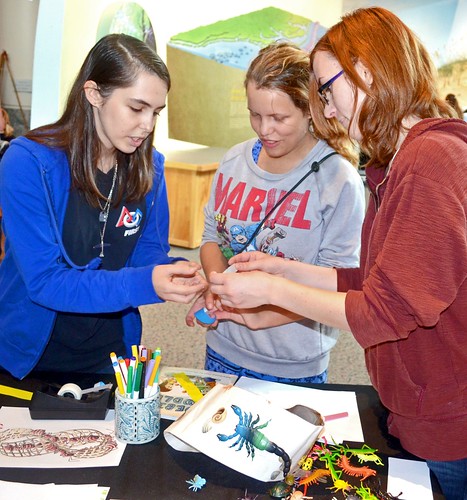
Here we are making origami butterflies at BugFest 2014:

Playing with math jokes at BugFest 2013: “Why did the ant cross the Mobius strip? To get to the same side!”
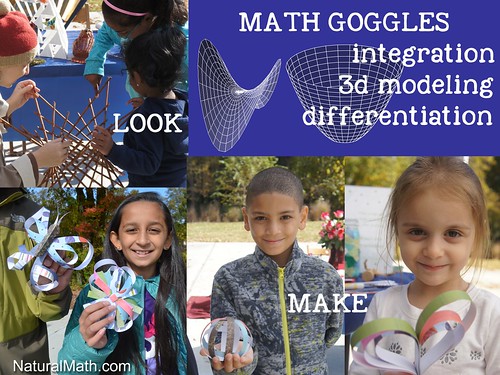
Second annual Sculpture Scavenger Hunt with Cary Arts on September 26
On Saturday, September 26, 10 AM to noon, visit downtown Cary, NC! Cary Visual Art and Natural Math welcome families with children of all ages for a fun and thoughtful scavenger hunt, observing the sculptures on exhibit as part of our Outdoor Sculpture Exhibition. Explore physical and virtual modeling techniques, enjoy the sculptures, and take guided tours.
Here is one of our Look and Make mini-posters with children’s creations at the Sculpture Scavenger Hunt 2014:
RSVP to reach.out@naturalmath.com to participate in the event.
Preserve the summer feeling with these playful activities
Several of our activities and principles were featured in the Noodle.com article Your Kids Will Love Doing Math This Summer (If You Do Too) by AK Whitney. From the article:
There’s no question that kids can be a tough audience and will quickly catch on to your attempts to educate them during their precious vacation. So don’t. Or at least, don’t seem like you are. Try the time-tested Socratic method. Instead of lecturing them, ask a question about the activity you are doing to encourage them to think about math.
“Ask, don’t show or tell,” Droujkova says.
You’ll be surprised to find that once you’ve gotten out of that show-and-tell mode, you’re more comfortable noticing how much math is out there, whether you’re shopping, planning a trip, or trying to stay on schedule.
Do you want to volunteer at Natural Math events, online or in the Research Triangle, North Carolina, and work with us to make math adventures happen? Write us at reach.out@naturalmath.com to talk! Children and grown-ups are welcome.
Dr. Maria Droujkova and the Natural Math crew


Posted in Newsletter
Playing 9 Apples with some boys!


Our family received the 9 Apples card game from Discovery Express Kids to try out. There are a lot of cards and the goal is to reach a target number each round. The cards are positive or negative, and there are also cards that allow you to switch the sign of a card. The rules reward you for using more cards to reach the target number. On the first round, you try to use cards to reach the number 9. Each round you work your way down until you have a target number of zero. The game ends when someone reaches zero.

First I tried out 9 Apples with my nearly seven year old daughter. She is my math lover! She enjoyed the game, but it was really the two of us working together to get the answers. She wasn’t able to do the multi-step addition and subtraction in order to reach the target number. She also struggled to switch the signs. But we enjoyed working together to make the longest row of cards possible. Next time, we’ll put a number line out and actually jump around with our finger using the cards to see how close we can get to our target number. I think this will help her practice the math and visually see what she is doing with each card. It would be even nicer if the card deck had a sturdy fold up number line in the box already. Using a number line would help kids of all ages see relationships and patterns in math more easily.
A few weeks after working with my daughter, I tried it out with my sons and some neighbors. I was a little nervous that my home-schooled boys wouldn’t be able to do the multi-step math as fast as their public-schooled friends. I needn’t have worried. All the boys did fine. The older boys were able to use more cards than the youngest (8 years old), but they all understood the game really quickly. They weren’t feeling competitive so I heard them giving each other ideas and suggestions about how to make the number they needed for the round. Things like, “Can I give him my change sign card? Then he can just add the six and four together and subtract the three so he gets seven.” It is nice to hear the thought processes going on in your kids’ minds! I was gratified to see my own sons’ math thinking ability, and their intuitive understanding of math.
I asked the kids for their likes and dislikes (in exchange for the cookies you see in the picture). They said it was “funner” than they thought, and that it was harder than they thought. The public-schooled kids said it was a lot more fun than worksheets!
I liked that it was a lot of math in a simple and fun way. I liked that the change sign cards gave it a lot of variety and dynamics. One drawback is the sheer number of cards. It’s a pretty fat deck of cards! I told the boys today that we’ll play it again with the booster pack of division and multiplication cards. Should have seen their faces!
Posted in Grow
Veronica’s multiplication online Thursday August 13, and big discount for small groups: Newsletter August 11
Subscribe and read archives
Pinterest | Twitter | YouTube | Facebook
Big discount for small groups

Mathematics works so much better when colleagues, friends, and family support one another! We want to help people do math together in local classes, groups of parents, and math circles. That’s why you now get big discounts for small bundles of paperback books, plus savings on shipping. This is also perfect for larger groups, fundraisers, and small bookstores, and you can resell the books at full price. Or buy five books and give four to friends as gifts.
You get a third of the price off if you buy 5 copies or more of each of our book titles.

Veronica’s multiplication
If your 6-10 year old children understand what multiplication is, but want to become more fluent, this math circle is for you! Veronica will lead a math circle meeting to help each participant make games. The goal of the games is to learn a family of facts (patterns) from the times table. Children will remix games and patterns for math variety, and play by themselves or with friends to become fluent. When you sign up for this math circle, you will get access to Multiplication Explorers materials that explain patterns in time tables. Veronica’s games take these ideas to the next level.

- What: Live meeting with Veronica and friends to make and remix games about families of multiplication facts.
- When: Thursday, August 13 from 4-5 PM (New York time) in a Google Hangout, plus conversations at your convenience in an online forum.
- Who: Children ages 6-10 with parents or teachers. Your registration covers your family or small group using one computer. We will have 8 participating families or groups.
- How: Children will make and test their games; adults will observe at the side, play Parent Bingo, and help if their children ask.

Hi, my name is Veronica and I love Math and Science!
I just finished 3d grade math and I can’t wait to learn more. I love playing with my cat and watching him do funny things like chase his tail! In my free time, I usually call my friends, play outside, or draw. My most favorite thing to do is read.
Have a nice day!!
Do you or your child want to design an online math circle at Natural Math? Write us!
Dr. Maria Droujkova and the Natural Math crew
Posted in Newsletter
Root differences: a little exploration of patterns
 This is a guest blog post by Danny Phelan, who is a student at Wake Technical Community College in Raleigh, NC, studying for an Associates Degree in Arts. Danny’s eventual goal is becoming a novelist and screenwriter, as well as editor for fantasy, science fiction, and horror novels.
When I was in high school, I noticed a curious pattern: one plus three equals four, plus five equals nine, plus seven equals sixteen, and so on. Each whole square was a certain number greater than the next, and the difference between the squares would increase by two every time. When I mentioned this to a math teacher, she either did not see it that way or misunderstood my phrasing, for she dismissed it as simple coincidence, not a natural law. After class, however, I was not convinced. Stubbornness is both a vice and a virtue of mine, and I continued to puzzle over how a series of odd numbers, increasing by two each time, connected to the succession of perfect squares.
Eventually, I drew the pattern out on scrap paper and saw something interesting: each square on a grid increases by the addition of new units to a side; being two-dimensional, they increase by two new units each time–one for each dimension.

We came up with an equation that represented the pattern. Since we want to look at the difference between squares (how much you add to get the next whole square), we added 1 to r, which stands for the square root. There’s the 2 pattern!
(r+1)2 = r2+2r+1
But I was still not fully satisfied. Something felt missing. I reasoned that if one could calculate differences between squares, surely a similar pattern might hold true in three dimensions–that is, whole cubes. The formula would be more difficult to visualize, but fortunately, my friend Ray owned a bowl of small cubes which we used to crack this puzzle. Three new squares would need to be added with each successive layer, and by holding cubes together, we discovered that the edges between sides would also need to be accounted for.
We determined that the formula is:
(r+1)3 = r3+3r2+3r+1
Applied fascination, when shared with other curious thinkers, spurs the creation of wonders.
Posted in Grow


