- Home
- “Yes, And…” Improving Math Play with Improv
- Althea’s Math Mysteries
- Avoid Hard Work, the Workshop
- Avoid Hard Work! …And Other Encouraging Problem-Solving Tips for the Young, the Very Young, and the Young at Heart
- Blocks and Modeling: A Do-It-Yourself Guide to Exploring Geometric Objects – Online Workshop
- Blog
- Books and Goods
- Bright, Brave, Open Minds
- Bright, Brave, Open Minds: A Problem Solving Kaleidoscope. Open online course for parents and teachers
- Camp Logic
- Cart
- Checkout
- Citizen Science Station
- Consulting and Tutoring
- Courses
- Download File
- Easy Complexity and Special Snowflakes Online Math Circle
- Empires: Year-long prealgebra program in a game
- Expedition Everest
- Five Fabulous Activities for Your Math Circle
- Funville Adventures: Math Personified!
- Funville Web Tour
- Hacking Math
- Hiding in Plain Sight: Vyshyvanka Secret Codes
- Home
- HOW do they do it? Creating your own math puzzles
- Inspired by Calculus: Online course for parents, teachers, and their children ages 5-12
- Kingdom On A Wall
- Kingdom on the Wall
- Ko’s Journey Is Discontinued
- Lapware
- Math Books
- Math Cafe
- Math Circles
- Math Circles 1001 Leaders Course
- Math Future event registration
- Math Future: come and talk!
- Math Goggles Challenges
- Math Renaissance
- Math Trek
- Mathematics & Poetry for All
- Meet the authors
- MidSchool Math Digital Math Tools
- Moebius Noodles
- mpsMOOC13: Problem Solving for the Young, the Very Young, and the Young at Heart
- Multiplication Explorers FAQ
- Multiplication Explorers LIVE workshop
- Multiplication Explorers Online Course
- Multiplication Explorers Registration
- Multiplication Explorers, the book
- Multiplication Models Poster
- My Account
- Natural Math Multiplication Course
- Online Logic Summer Camp for Kids!
- Online Summer Calculus for Kids Camp!
- Pay Natural Math
- Playing with Math: Stories from Math Circles, Homeschoolers, and Passionate Teachers
- Reviews of the Moebius Noodles book
- September 25: Math Storytelling Day
- Socks Are Like Pants, Cats Are Like Dogs
- Speaking and events
- Start Here!
- test001
- The Art of Factorization Diagrams
- The Iditarod
- The seven principles of Natural Math
- Transformers: Matrices & Graphs!
- Veronica’s Multiplication: a Natural Math circle online
- WOW! Multiplication – an open course in September 2013
- Ying and the Magic Turtle
- About Natural Math
- Contact Us
- Get Involved
Calculus for Kids May 8, 2015 (Fridays)

This is a story about the fifth and final meeting of the Fridays session of our spring math circle. At the previous meetings, children claimed you can’t divide by zero, and Maria promised to show them how next time.
“Wave at me if you have divided by zero!” – several parents did. Then, “Children, wave at me if you believe it’s possible to divide by zero” – some do, some don’t. Hannah: “I believe my mom!” Maria: “And now wave if you think dividing by zero is a bad idea.” Offer people funny or interesting multiple choices, so however they “vote” they feel good about their chosen option.
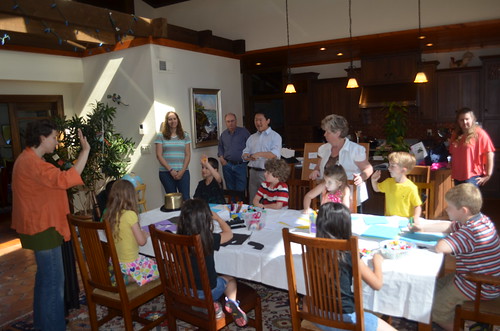
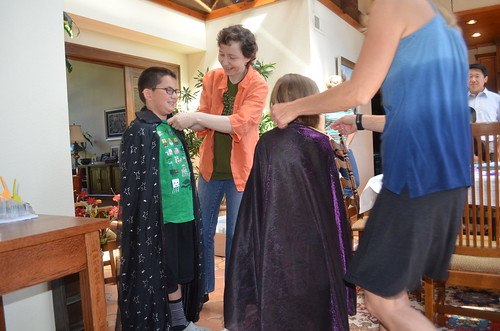
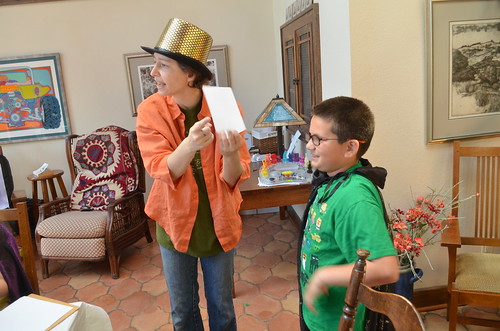
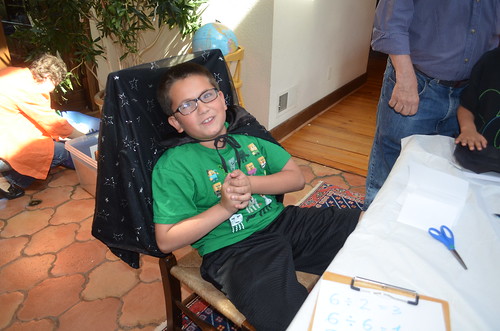
Maria asked 3 children to come forward to be her “math magic” apprentices. But if they aren’t into magic, just calculus apprentices. Maria and Amy are helping them with apprentice capes. Usually we pretend-play without prompts, but we wanted to play this up a bit.
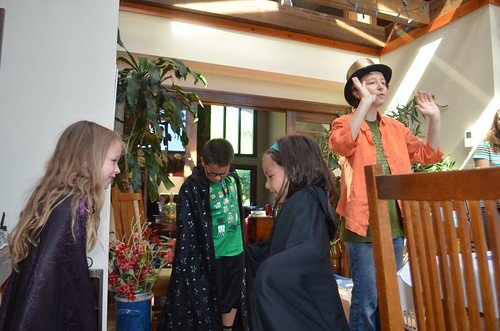
Maria the magician and her three apprentices are warming up for math magic.
First, grab 6 pieces of paper. Let’s think: how many groups of 2 do you have? 6:2 = 3. Children demonstrated, each with 3 stack of papers with 2 pieces in each.
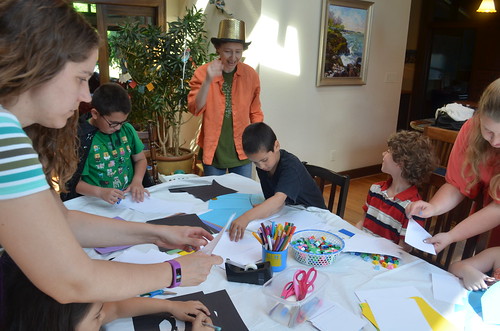
Then we modeled 6:3 (2 stacks of paper with 3 pieces in each) and finally 6:6 (just 1 stack). Note that adding 0, dividing by 1, dividing the number by itself, and other “border cases” should not come as your first example.
Then we modeled the same question about parts (fractions). How many halves are in three pieces of paper? Six. Take one large piece of paper. How many halves are in it? Two.
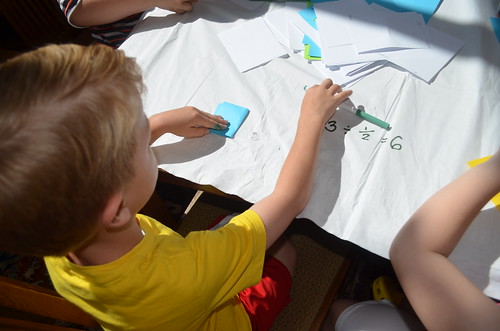
And then we started a series of division, modeled by folding the large piece of paper. When you describe it in words, it’s messy, but imagine words only following the play. Words were only in the background of paper-folding. Even the youngest in the group loved folding their papers again and again.
- How many halves are in it? 2. Dividing 1 by 1/2 gives you 2.
- (Fold again). Now you get 4 parts. That’s because dividing 1 by 1/4 gives 4.
- (Fold again). Now you get… How many parts? (Some thought 5, because it’s the next number after 4, some 6, because we had 2 and 4 before and they skip-counted, and some thought 8.) Count! You get 8 parts. That’s because dividing 1 by 1/8 gives 8.
- (Fold again…)
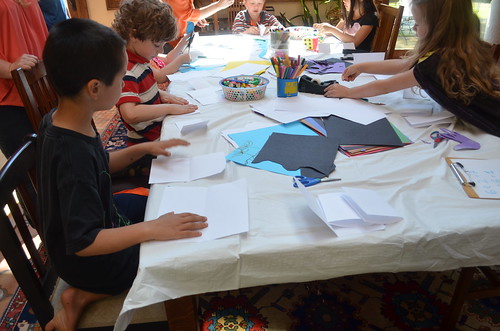
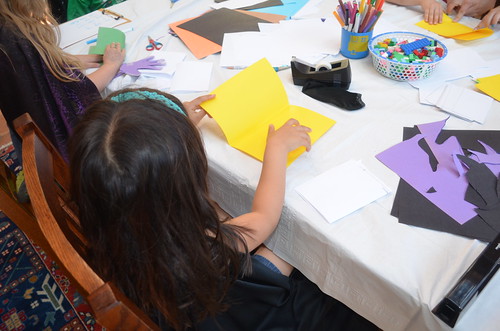
Priyesh: “After 64, you can’t fold the paper anymore; it’s impossible!” Priyesh was squishing the folded paper tight to demonstrate.
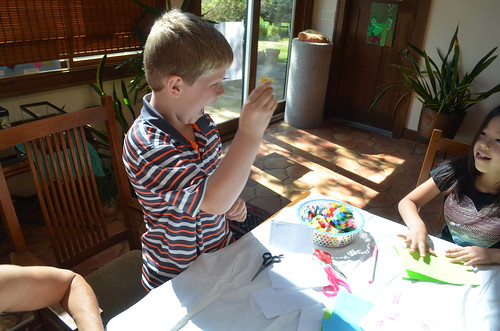
Charlie’s trying to make that last fold happen by using his teeth.
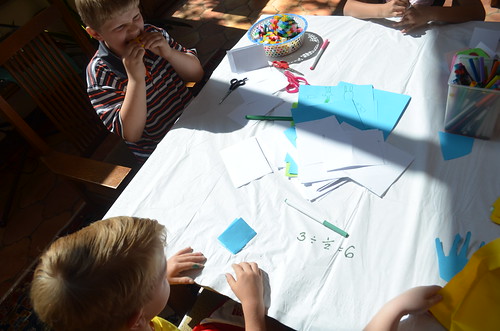
Charlie: “Ah-ha! I did it!”
After the fold, Hannah and Michele are counting the squares together.
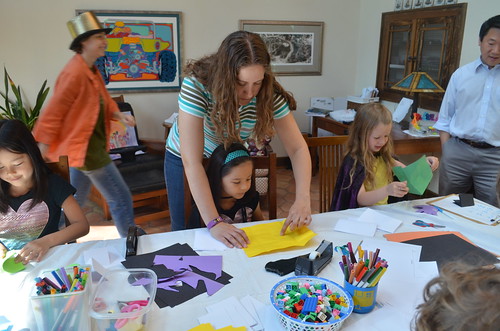
Hannah is tracing the fold lines, while Serrin is numbering parts on her paper.
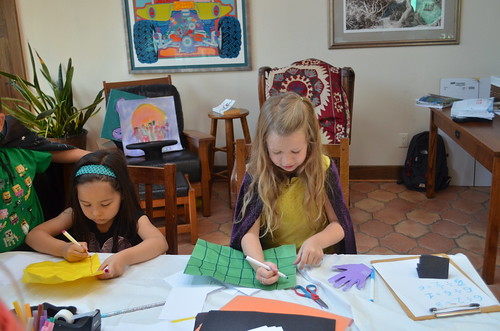
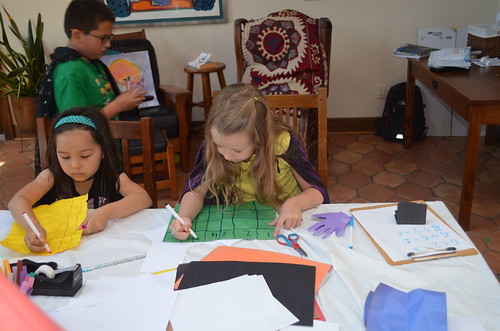

Small circle time. The apprentices are sitting next to each other. Maya joined Priyesh under the same cape, and Serrin is rescuing Maya from the bright sun.

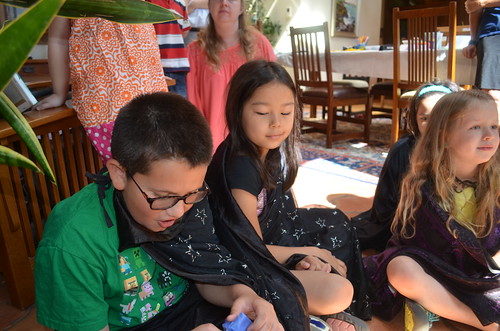
Math faces: children are following along the story of paper-folding and fractions they’ve just experienced for themselves.
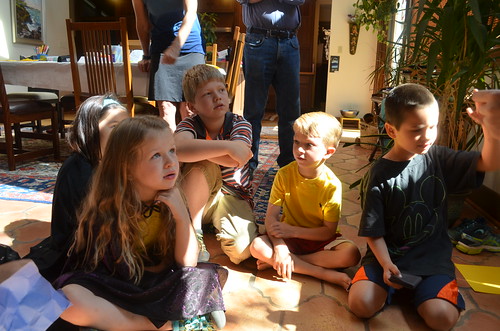
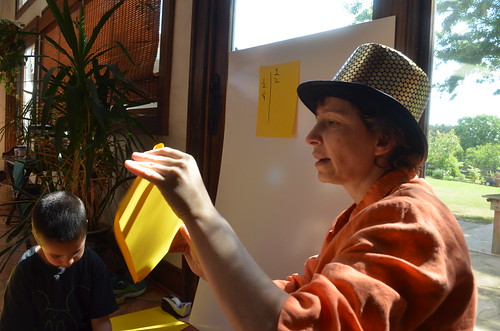
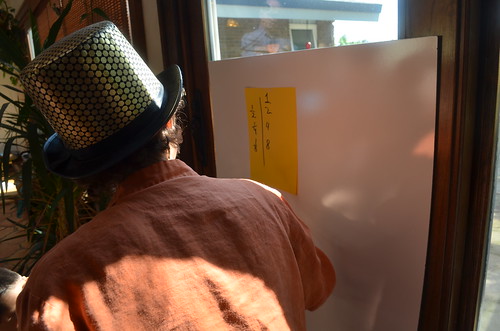
As we fold: 1, 2, 4, 8 pieces… Each 1, 1/2, 1/4, 1/8 as large as the whole paper…
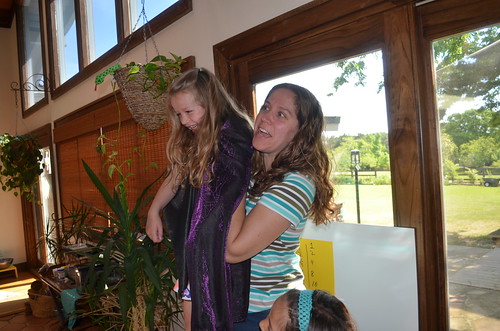
Serrin the apprentice represented the number of pieces (1, 2, 4, 8…) and Hannah represented the size of each piece (1, 1/2, 1/4, 1/8…) As Hannah got down to show pieces getting smaller and smaller, Michele lifted Serrin to show the number of pieces getting larger and larger… “To infinity and beyond” as the saying goes.
“Anthropomorphic personification” is the fancy term for pretend-playing your mathematics with your own body. As you can see, children enjoy it very much. This is also one of the best ways to learn and to remember. Our minds have very powerful mechanisms for dealing with people and relationships.

One enthusiastic and dedicated mom needs to catch her breath after all the heavy lifting! What wouldn’t she do to help children learn?
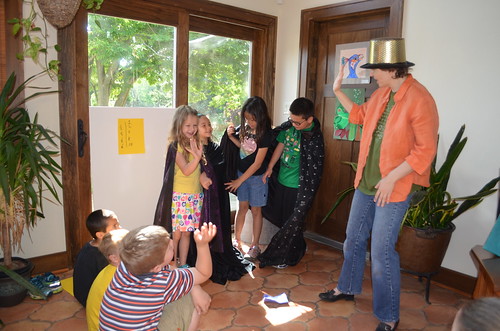
Maria also used her hands to show the ratios and relationships between the size of the fraction you divide by (smaller and smaller) and the result of the division (larger and larger). Note how many ways we used to explore the same thing: paper-folding, heights of children, the distance between hands, words, and written symbols. Three to five different ways work well for new topics. As you explore your topic in depth, create more and more representations!
Next, Maya and Priyesh represented the numerators and denominators of our changing fractions, since they were together under the same cape. A fraction is one number, but it comes in two parts.

Maria is talking with Julianne after the fraction activity. Julianne is telling her own story of the experience.
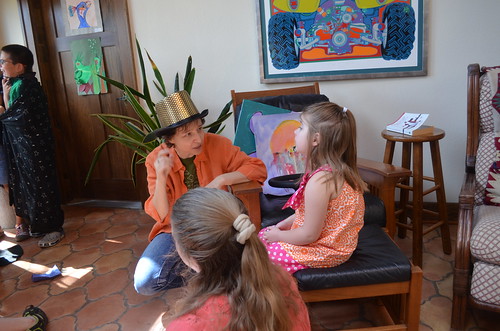
(Mad-Mathematician-Magician) Maria made division by zero madly magical – with much help from the apprentices!

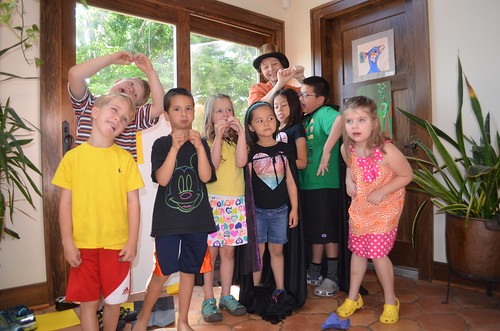
So what do you get when you divide by zero? Children made up their own hand or whole-body symbols for infinity. You can see three or four different versions. Creating symbols is a big part of mathematics. There are usually several different ones, for example, / and : for division.
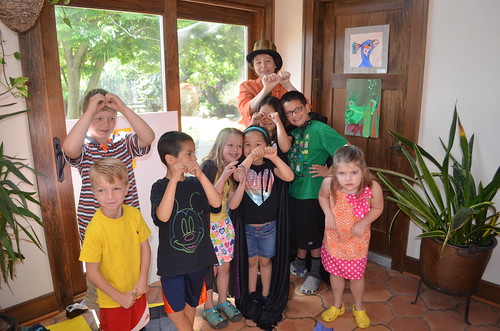
Silly faces and infinity!
Back to the table …
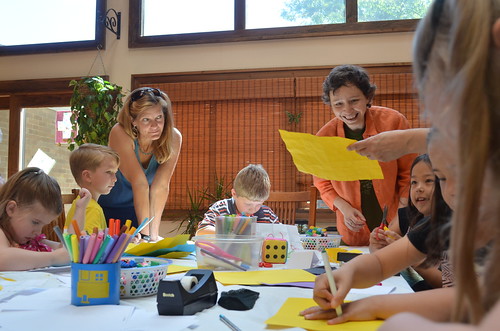
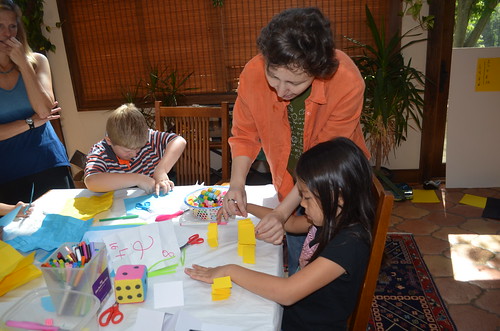
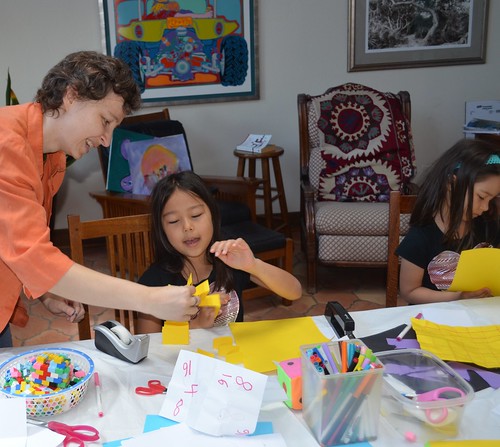
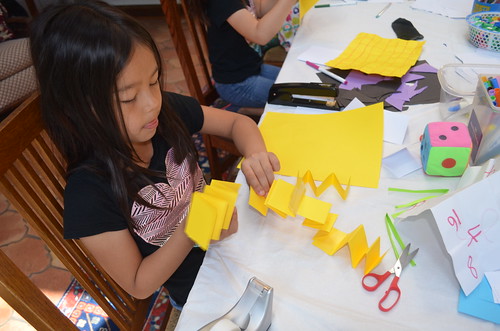
Maria helping Maya with her project: making curves and 3D structures out of fan-folded paper.
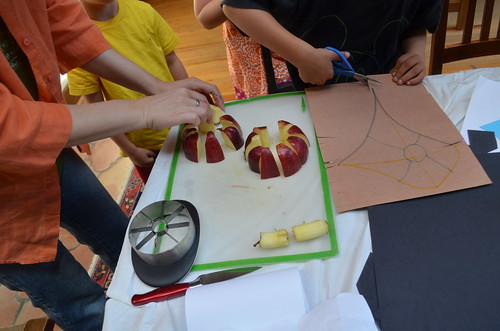
Maria is about to represent derivatives (slices) and differentiation (taking apart) by cutting an apple.
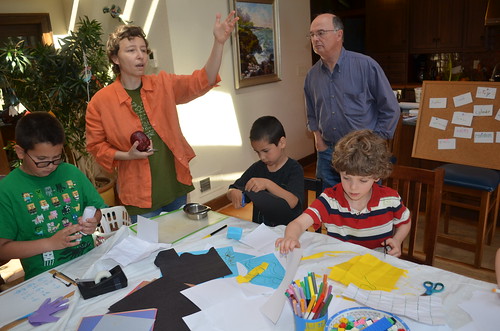
Apple cut in half horizontally in the middle; “What shape would you see? Circle? Cylinder in 2D or 3D? Or an approximate (calculus) circle?
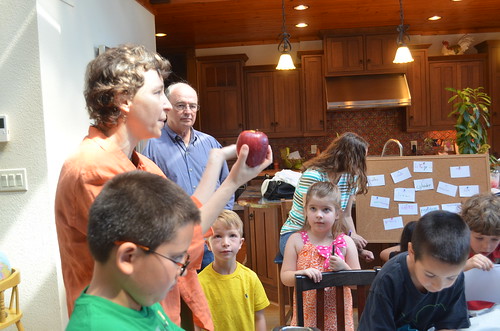
Also, what shape will that center piece of the cutter make? “A cylinder!” – say all children. Then one voice corrects, “Two halves of the cylinder” – someone remembered the apple is already sliced in half.
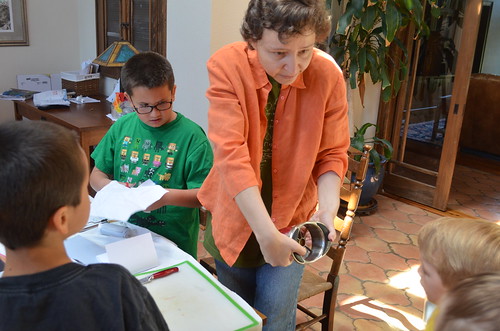
Modeling a cylinder out of paper while we are at it!
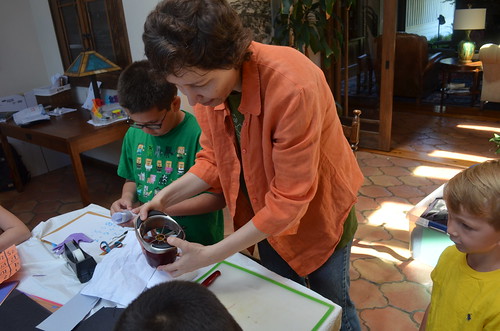
And after we slice (derive), we can assemble (integrate) back again.
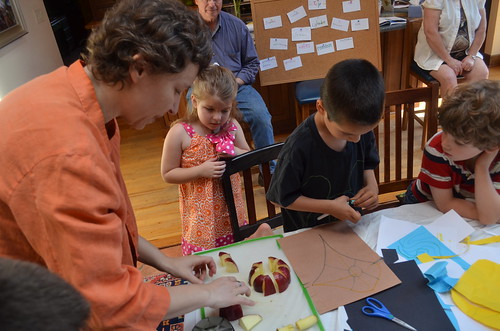
Younger children – Owen, Julienne, Eashan, and Jake – are focusing on the “integration” of the apple. Parents sometimes worry that, to quote a favorite movie, “You keep using that word. I don’t think it means what you think it means!” – that we or the children stretch the meanings of math terms too far, or apply words inappropriately. Owen told Amy he needs to integrate his sock drawer, whatever that means.
But words end up meaning something to children. Five-year-olds have no need for high precision: they are not landing spaceships on Mars or building reliable bridges. They are just exposed to ideas. As a parent said recently about her early math games with her mom, “I don’t remember ever not understanding about negative or complex numbers.” We do want that feeling of happy familiarity. The precision and depth of understanding will grow with time.
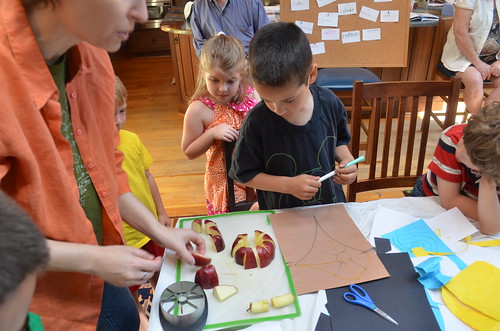
Eashan is modeling the slicer in 2D. Check out the accuracy: there is a circle in the middle and the same number of sections.
Moving onto the next activity. A thread from a yarn is 1D (well, a model of a 1D object – like everything else in the physical world, it’s really a 3D thing).

Meanwhile, Charlie is determined to fold the most squares possible. Children sometimes continue their projects while the group moves on.

The final result: Ta-da! 390 squares! Maria: “That would be an interesting power of 2. But he used different folds.”
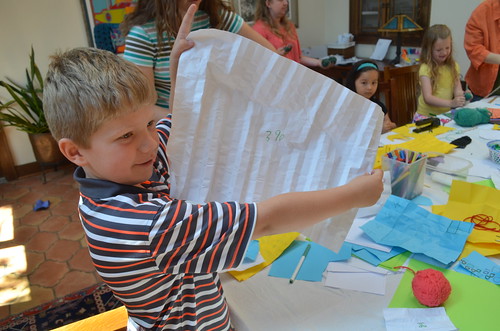
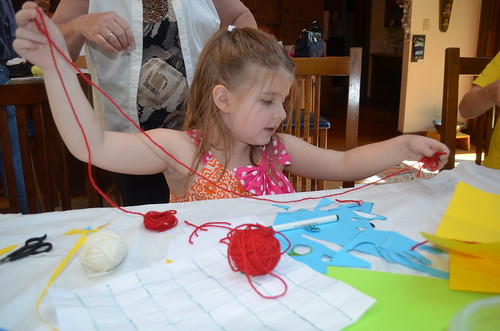
Pom-poms embody the idea of integration. Wrap the yarn at least 30 times around your hand (making a 2D surface out of 1D lines). Then tie it across the lines, cut the lines on the opposite side from the tie, and fluff up into a 3D shape.
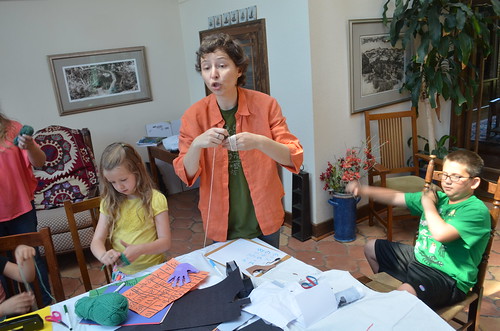
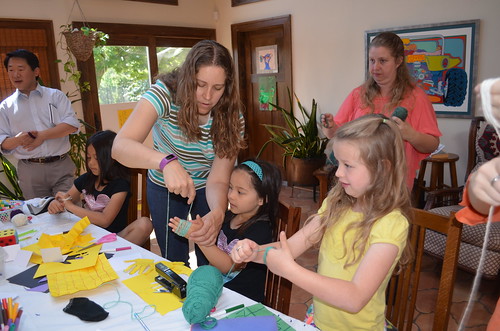

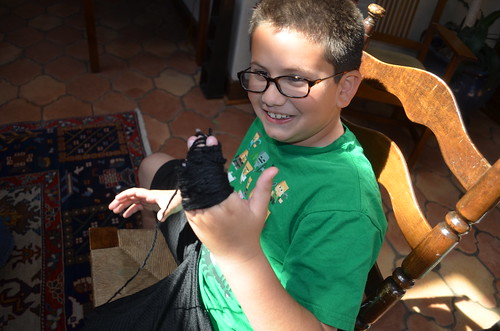

Integrate into a toupee?
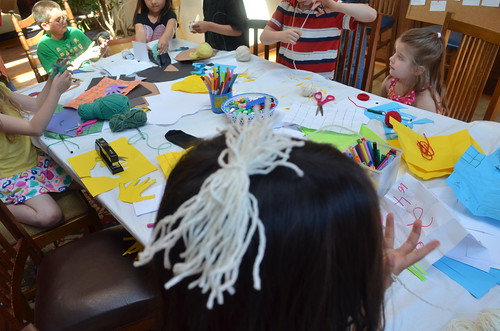
Children are creative: how about a mustache for Hannah?

The Flying Spaghetti Monster lands on Serrin’s head.
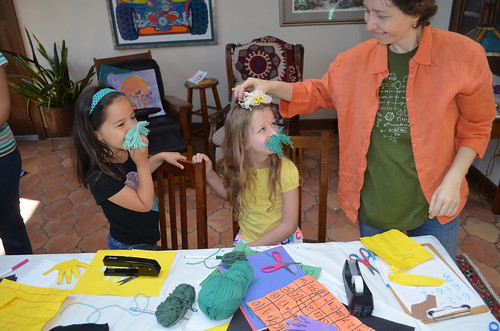
How charming, mustache ladies!

Evil Mustache Priyesh is threatening the Flying Spaghetti Monster.

Meanwhile, Eashan is still at it integrating/deriving in 2D.

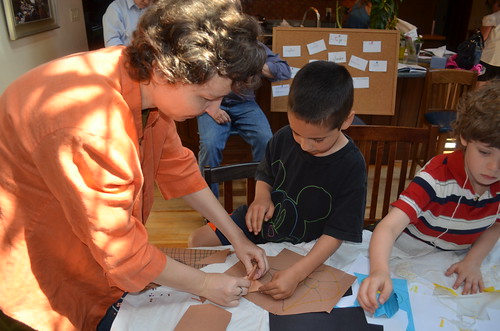
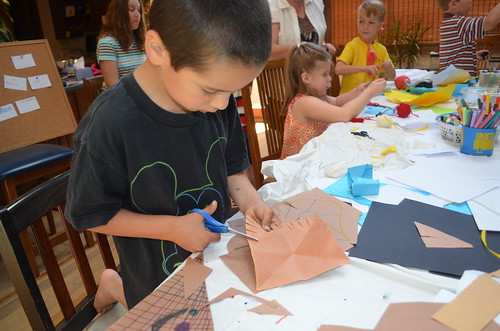
Julienne is making a 3D bird’s nest. She is very much into nature and modeling natural objects. Children often go through periods where everything must be about a single topic: horses, Star Wars, the nature, and so on.
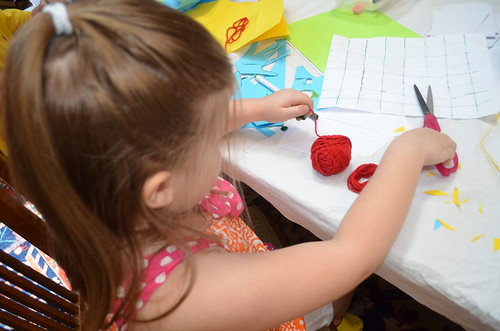
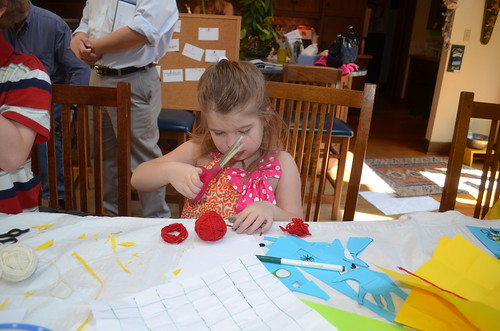
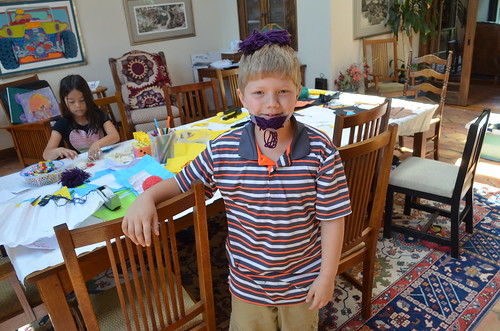
Check out Owen’s 3D mustache…


…And Jake’s 1D looong beard!

…And Charlie’s fancy, mostly flat beard and fluffy toupee.
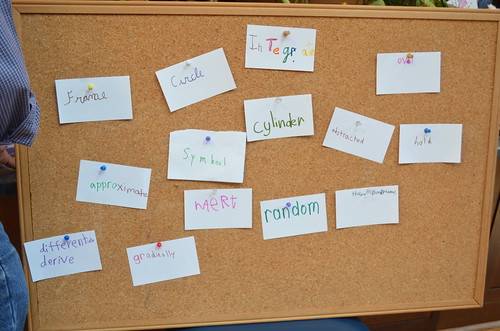
Our final collection of Math Words. Some are made in multiple colors because several children wanted to add the same word. Each child selected a color and wrote a part of that word. “Make math your own!”
Lastly, the group is gathered to watch the trailer of “Flatland.”
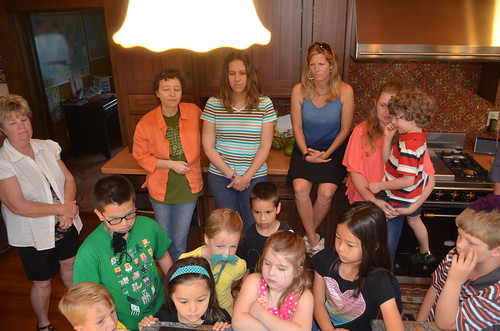
After the video, the grown-ups stayed around for some math talk, while children played outside.
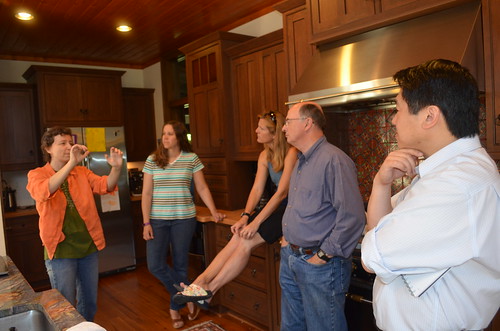
Photos by Erin Song, captions by Erin Song and Maria Droujkova, Math Spark by Kalid Azad, Shelley Nash, and Maria Droujkova, edited by Ray Droujkov.


Posted in Make
Learn & Do Science with Your Children: Newsletter May 19, 2015

Subscribe and read archives
Pinterest | Twitter | YouTube | Facebook | Google+
In this newsletter:
- Become a citizen scientist and do real research with your children.
- That feeling when you first hold a new book!
Learn and Do Research With Your Children
The Boston University Developing Minds Lab and NaturalMath would like to invite you to become a Citizen Scientist at home!

The goal of this project is to bring parents, educators, children, and scientists together to study how children develop math concepts and skills. We are exploring children’s early understanding of algebra before they have significant formal mathematics training in school. We need parents and guardians at home to help us study children’s math intuitions.

When you become a Citizen Scientist, you will do live research in your own home with your children, collecting valuable observations about your children’s responses and their reasoning behind their responses. The studies consist of fun, interactive games that you will play with your child.
Using our online guide, you will read about the background of the study and the study goals, then you’ll watch a few short videos that show you how to do the study. Finally, you’ll do fun experiments with your children and collect live data that we can use to further our understanding of children’s early mathematical reasoning. Preparing for the experiments takes just about an hour, and the studies take just about 30 minutes to complete with your child. Parents or guardians of children ages 4-9 can participate.
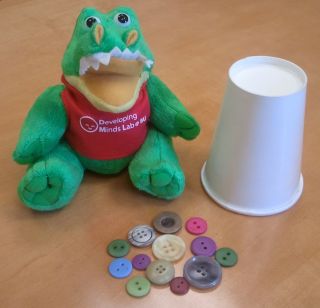
Citizen Scientists who have already participated found it educational, fun, and exciting. And kids really enjoy it! As a thank-you for participating, Citizen Scientists receive a booklet with more fun math activities to do at home.
Learn more and register at http://www.naturalmath.com/citizen-science-station/
P.S. Big thank you to our study’s beta testers. Everything from the reminder system to the training videos is now improved thanks to your feedback.
The Joy of Playing with Math
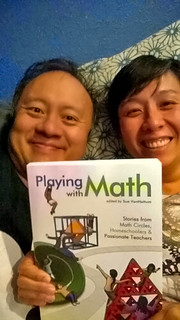
Sue VanHattum, the editor of Playing with Math, writes on her blog:
My book, Playing with Math: Stories from Math Circles, Homeschoolers, and Passionate Teachers, is delighting readers across the U.S. (and hopefully around the world). Here are a few photos of happy readers. Send me a photo of you with the book, and I’ll add it to my collection.
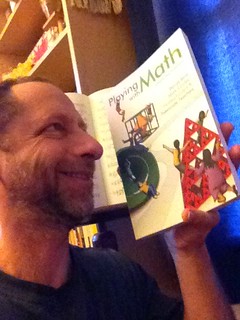
Meanwhile, a book crowdfunder who lives across the ocean from Sue writes at the Living Math forum:
Just wanted to give a shout out to Sue and team publicly on the forum for excellent work on the book, my husband and I really love it – even though we’ve only scratched the surface. And also for the great communication and promptness in delivering the book. We live in India and we received the book soon after we responded with our address. We were quite impressed!
Warmly,
from a really warm tropical part of southern India :)
Padmashree
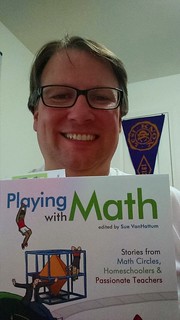
See you online!
Dr. Maria Droujkova and the Natural Math crew

Posted in Newsletter
Calculus for Kids May 3, 2015 (Sundays)
This is a story about the third meeting of a Calculus for Kids math circle. During these meetings, we offer children and their parents prompts, but then follow their ideas to new places. This way, children help us design!
Maria has returned from her trip to the Navajo Nation, and brought this vase. It is decorated with symbolic patterns that remind us of one of our math words: Integration. Maria asked a question about what this symbol might mean, so Allison is examining the vase to search for her own meaning.
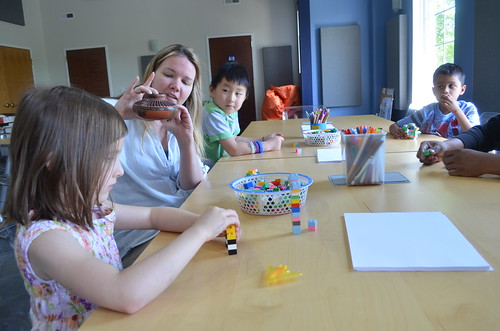
Sometimes children fall into a curious trap; they realize they can give universal answers to many different questions. This is an excellent math principle for children to discover and should be celebrated. For example, on a scavenger hunt for hidden math, children say any object whatsoever has “a pattern” in it. Celebrate by confirming patterns are everywhere and that it’s clever to notice that. If you are looking at shapes in figures of revolution (our previous meeting), instead of seeking cylinders, castles, or flowers, children can say, “Alien spaceship” and it will probably apply to any shape. Again, celebrate children’s ingenuity by saying that alien spaceships come in all sorts of shapes – it’s just like mathematicians saying, “Shape” to mean a large category of objects.
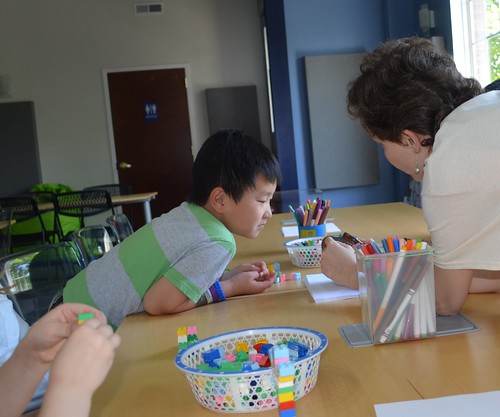
When children overdo this, the activity becomes boring and needs to be rescued. One way to pull children out is to ask for details. What sort of spaceship? What pattern do you see? Here, Maria is leaning forward asking to hear and see Eli’s interpretation of the symbolic pattern circumventing the vase.
Let’s integrate a 3D paper spaceship out of 2D parts. Maria drew an outline of a simple rocket ship to show what we are about to create.

First, take four sheets of paper, fold them in half, and draw only a half of a rocket with the center line along the fold line. This is a nicely challenging task. Why do you draw a half? What happens if you draw the whole ship? What if you draw along the other side, not the fold line? Allison is holding the paper down so Sydney can draw easier.
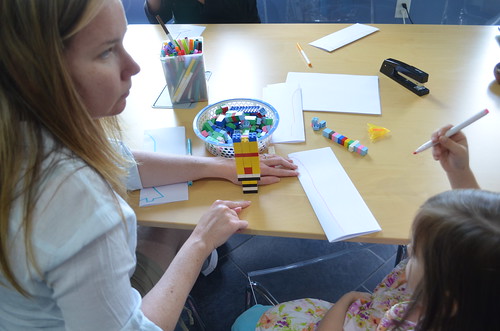
Maria’s showing her rocket drawing as an example.

Then, cut along the outline of the rocket, as Eli is doing.

Maria is holding and turning the paper so Sydney can maneuver the scissors better. These types of assists help children do more with physical objects. Why do we care? Why not just cut for the younger child? Because the connection between the hand and the brain is two-way. By handling paper, children directly teach their brain about shapes and their mathematical properties. In this case, about the slope.

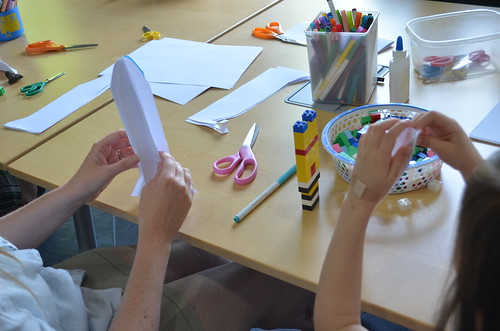
Next, open up the rockets and staple along the fold line. Krishnan is stapling the rocket they are making with Yash.
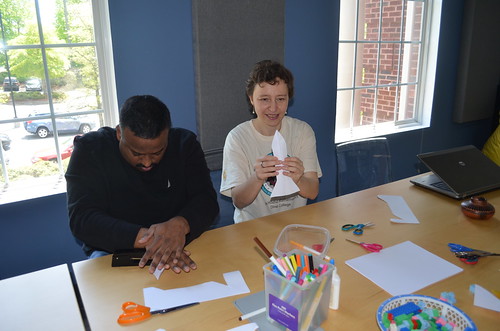
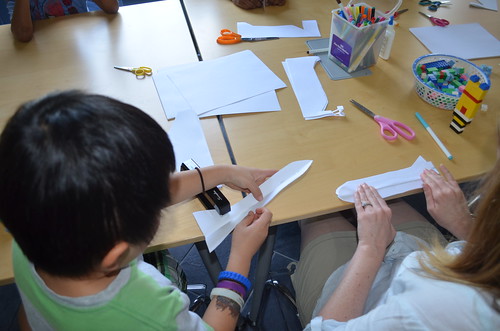
Once it’s securely stapled, spread the layers of paper around. This models disk integration for bodies of revolution.
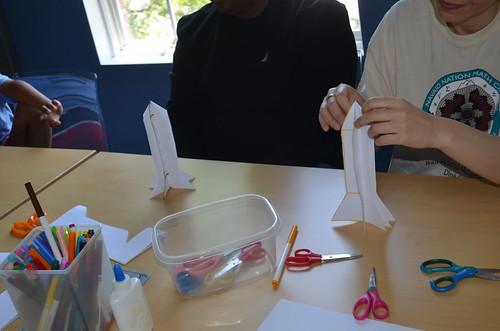

Image from Wikipedia.
Spaceships look realistic enough for the shape, but do they really fly, children ask? They try, and it turns out that no, these models are just for looks.

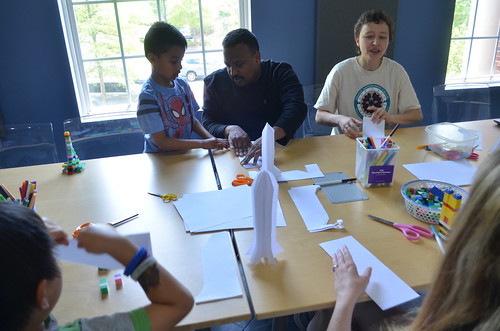
So the group is back to the table, where Maria is about to teach them how to make a 3D paper airplanes that really fly. This is an example of how children help to redesign activities, if we only follow their actions. We did not plan to research which models fly well (and why). But, it’s a rich question that made our activities livelier.
Maria talked through every step. A lot of asides about math terms come up when you do. Here the steps are all in one place, because it’s easier to understand this way if you are reading rather than playing along with someone:
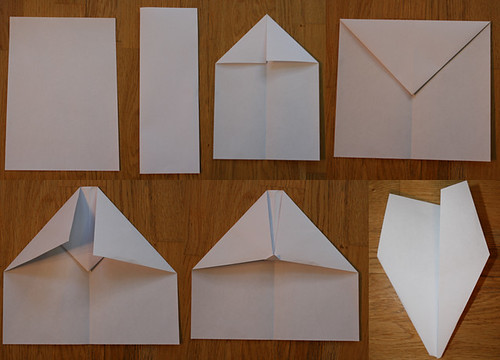
First, fold a sheet of paper in half vertically.
Then fold the top right and left halves along the middle line, forming a triangle.
Observe how children think and do things differently. One triangle is facing upward and the other downward. Which is correct? Even with simple technical tasks, there are many right ways of doing them.
Next, fold the whole triangle down – or up, if you are holding your paper the other way!
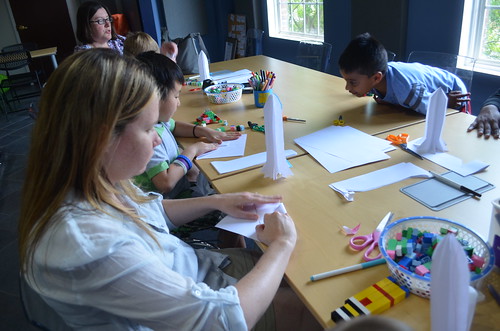
By the way, children tested their planes after each and every step! Eli tried it first as a joke when we first folded the paper in two. Maria kept up the joke and said that this “airplane” does not even fall well. Everybody wanted to try, and then they kept trying with all the intermediate steps.
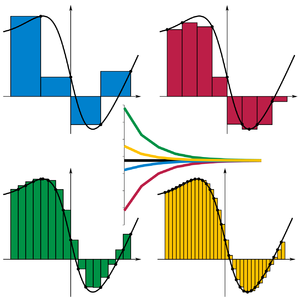
Some modeling techniques create models that get progressively better with each step. Riemann sums (above, from Wikipedia) are this way: the smaller the intervals, the better your approximation, but at each step, the approximation does work. Other modeling techniques are not progressive, and you have to wait till the very end to see any result at all. Children were experiencing that second kind of modeling with paper airplanes. They had a lot of fun with the unfinished models flying so badly that they didn’t even fall well.
Progressive techniques are used in many fields. For example, web design and image coding.
Now, fold in a stabilizer: a tiny triangular tip of the larger triangle. This way, the plane won’t wobble, but have a nice balanced flight.
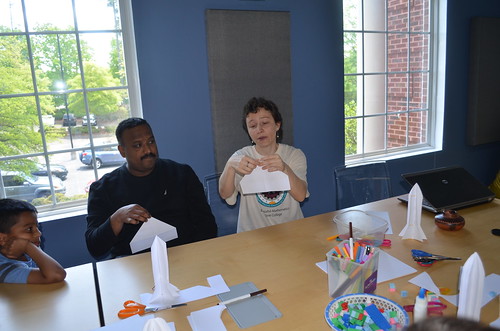
Again, fold it in half symmetrically: here come the wings!
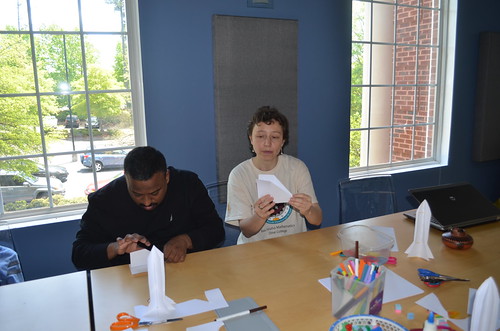
Maria is helping to fold. The next step is tricky.

Yash is about to test-fly his handmade 3D paper airplane. Sydney is still working on decorations for her spaceship. Sometimes children stay with a project longer, but they still observe others – especially their parents – doing the next one.

Maria and Sydney are flying Maria’s paper airplane back and forth and Yash keeps testing his with Krishnan.
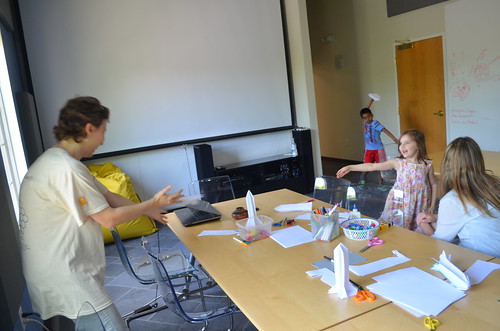
A trick to make the planes fly better: straighten the wings really nicely.

Sydney is ready to test-fly 2 airplanes at the same time, while Maria is watching the circle flying their planes from a cozy cushion.

Sometimes things do not go the way we planned or designed – there was an airplane accident! Accidents happen even in math circles. Leaders need to be prepared to deal with sad or upset children.
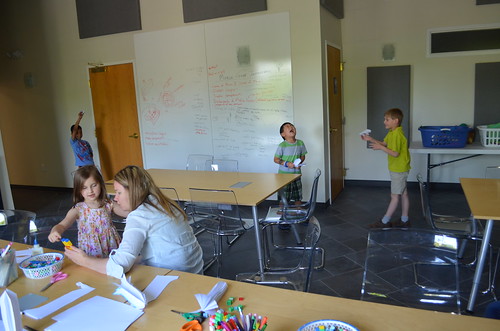
The circle is about to move onto the next calculus activity: making spaceships another way. Maria is handing out packaging foam to model layers.
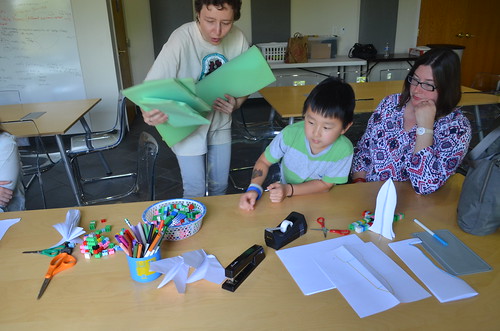
Ah, so soft. Sydney and Yash also assembled spaceships out of LEGO blocks.
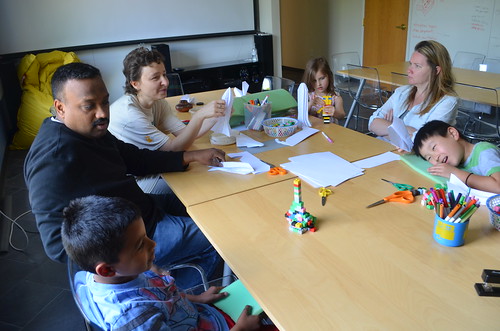
Let’s look at the 3D paper rocket ship from the side, but integrate them from horizontal slices. From the side, the top looks like a triangle, the body like a rectangle, and the thrusters like a trapezoid.
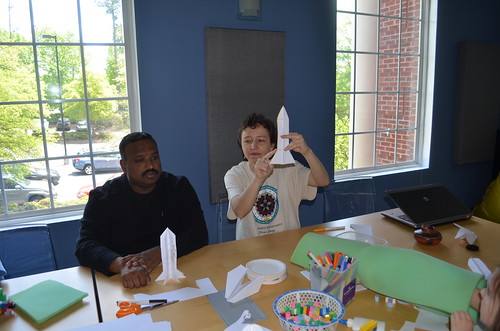
We did not want to slice our models to see how they would look across. But Maria had fruits there. She chopped a pear horizontally (like a Fruit Ninja) and asked, “What will you see when I show you the cut?” Some children answer questions about fruit slices in 3D (a cone, a cylinder), and some in 2D, from different points of view: the side (a triangle) and the top (a circle). This is a good example of how many right answers there are for one simple question!
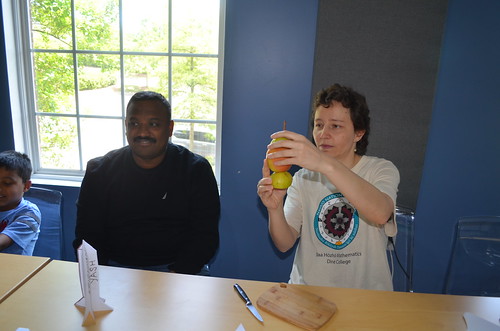
Maria sliced the pear horizontally, then numbered each of the four slices. Except nobody wanted numbers 2 and 3, but two people wanted number 4. We ended up creating our own number system: #1 – Sydney, #infinity – Yash, and #4A and #4B for the two boys who both liked 4.
We had a brief side discussion about naming numbers every which way – how about “cow” as a number name? Children concluded that these funky number names are more like variables than numbers.
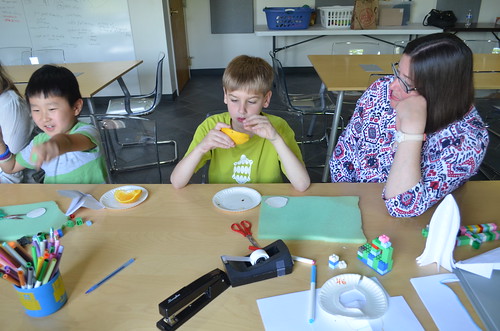
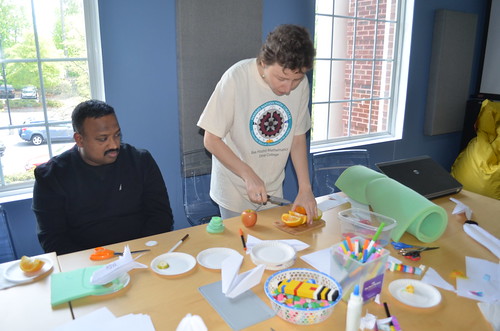
Then children traced their fruit slices onto paper plates, cut them out, traced on the green foam, and cut out foam circles. Snacking on fruit all the way! Food makes people happy. Check out Maria’s face – yep, like a happy fruit ninja. Food makes for smoother, friendlier math circles.
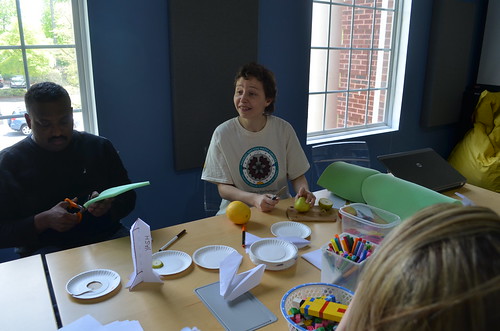

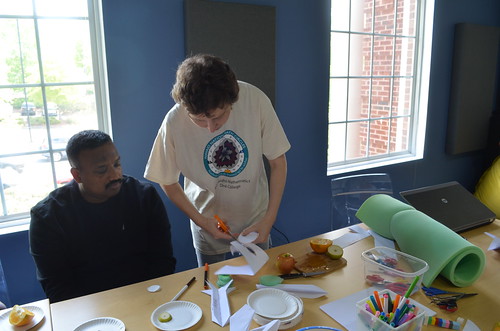
The nosecone is finally integrated out of the four circles.
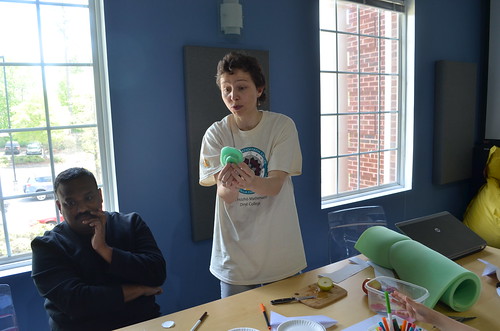
And later, when participants made more circles, we could integrate the whole spaceship.
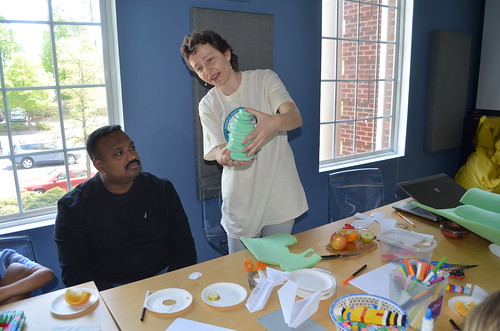
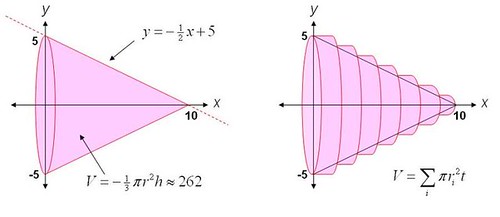
Why do we care? Simpler shapes (like disks) are easier to measure, so we can build more complex shapes (like cones) out of them and measure these more complex shapes too. For example, you can approximate the volumes of cones, spheres, and parabolic antennas by slicing them into disks.
Maria: If I cut this pear vertically what do I get?
Eli: A rocket ship!
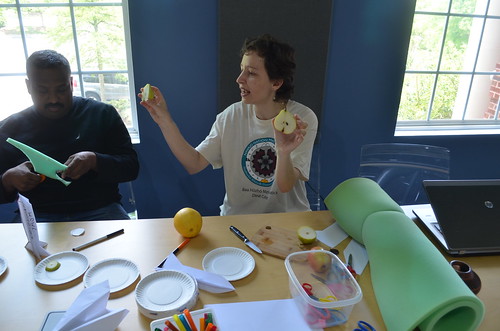
Maria: What shapes would I get when I cut this orange?

What’s the math name of the orange quarter 3D solid?
Ninja chopping continues…
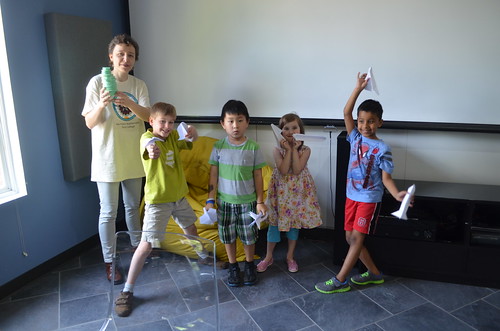
Group photo-op with our 3D rockets!

Photos by Erin Song, captions by Erin Song and Maria Droujkova, Math Spark by Kalid Azad, Shelley Nash, and Maria Droujkova, edited by Ray Droujkov.
Posted in Make
From buttons to the multiplication blind spots


Buttons as a a tangible representation of a set
My kids love playing with our button collection. Who does not? Buttons are colorful, cute, interesting objects. They are also an incredibly useful mathematical manipulative – a tangible representation of a set. Today we have decided to arrange 1, 2, 3, … , 34, 35, 36 buttons into groups. The first task was to divide the 36 buttons among three siblings.

36 is 3 times 12
Without the use of the multiplication table, sharing buttons is a game in its own right: “One for me, one for you, one for our toddler sister.” “I hate pink buttons. Let’s trade.” Surprisingly enough, every single one of them ended up with the exactly the same amount of buttons. So we went on to the next challenge. Can you guess what it was just from looking at the picture?

A new arrangement
One day we will arrange the buttons in a square and add the connection to 6 x 6.
In the good old (hold on, I am undecided on ‘good’, but I am definitely not that old) days, I learned the multiplication table with drills. No visualization, just tons of practice. I can still calculate the answers to mathematical problems in my head, on a piece of paper, or even on a blackboard when I teach. I also love talking to people about education and math teaching, in general. Some believe that today’s kids will live in a world surrounded by technology, thus we should teach them to type, program, and use a calculator as soon as possible. Others are horrified by today’s youth lacking mathematical skills. The rest are busy changing the educational landscape.
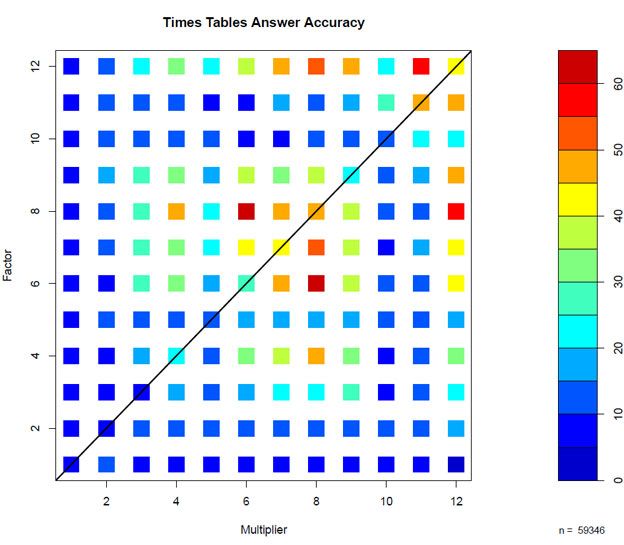
Recently, I have noticed that recalling 7 x 8 = 56 takes me a good deal longer than say, 8 x 3 = 24.
As a very curious person, I took a poll among my friends. Most of them have learned to multiply in a similar manner. :) To my great relief, I am not the only one suffering. Even though the location of the blind spots is individual. So far, I have just colored in the separate responses: 6×9, 7×8, and 8×7 seem to cause most trouble.

Multiplication blind spots
Can you recall all of the facts from the multiplication table equally well or do you suffer from a blind spot? If so, please share its location. I would love to create a more accurate map of multiplication table blind spots, but I need more respondents.
In the meanwhile, check out the Who, What, Why article Why does the sum 7×8 catch people out? about times tables answers accuracy.
Posted in Grow


