- Home
- “Yes, And…” Improving Math Play with Improv
- Althea’s Math Mysteries
- Avoid Hard Work, the Workshop
- Avoid Hard Work! …And Other Encouraging Problem-Solving Tips for the Young, the Very Young, and the Young at Heart
- Blocks and Modeling: A Do-It-Yourself Guide to Exploring Geometric Objects – Online Workshop
- Blog
- Books and Goods
- Bright, Brave, Open Minds
- Bright, Brave, Open Minds: A Problem Solving Kaleidoscope. Open online course for parents and teachers
- Camp Logic
- Cart
- Checkout
- Citizen Science Station
- Consulting and Tutoring
- Courses
- Download File
- Easy Complexity and Special Snowflakes Online Math Circle
- Empires: Year-long prealgebra program in a game
- Expedition Everest
- Five Fabulous Activities for Your Math Circle
- Funville Adventures: Math Personified!
- Funville Web Tour
- Hacking Math
- Hiding in Plain Sight: Vyshyvanka Secret Codes
- Home
- HOW do they do it? Creating your own math puzzles
- Inspired by Calculus: Online course for parents, teachers, and their children ages 5-12
- Kingdom On A Wall
- Kingdom on the Wall
- Ko’s Journey Is Discontinued
- Lapware
- Math Books
- Math Cafe
- Math Circles
- Math Circles 1001 Leaders Course
- Math Future event registration
- Math Future: come and talk!
- Math Goggles Challenges
- Math Renaissance
- Math Trek
- Mathematics & Poetry for All
- Meet the authors
- MidSchool Math Digital Math Tools
- Moebius Noodles
- mpsMOOC13: Problem Solving for the Young, the Very Young, and the Young at Heart
- Multiplication Explorers FAQ
- Multiplication Explorers LIVE workshop
- Multiplication Explorers Online Course
- Multiplication Explorers Registration
- Multiplication Explorers, the book
- Multiplication Models Poster
- My Account
- Natural Math Multiplication Course
- Online Logic Summer Camp for Kids!
- Online Summer Calculus for Kids Camp!
- Pay Natural Math
- Playing with Math: Stories from Math Circles, Homeschoolers, and Passionate Teachers
- Reviews of the Moebius Noodles book
- September 25: Math Storytelling Day
- Socks Are Like Pants, Cats Are Like Dogs
- Speaking and events
- Start Here!
- test001
- The Art of Factorization Diagrams
- The Iditarod
- The seven principles of Natural Math
- Transformers: Matrices & Graphs!
- Veronica’s Multiplication: a Natural Math circle online
- WOW! Multiplication – an open course in September 2013
- Ying and the Magic Turtle
- About Natural Math
- Contact Us
- Get Involved
Calculus for Kids April 19, 2015 (Sundays)

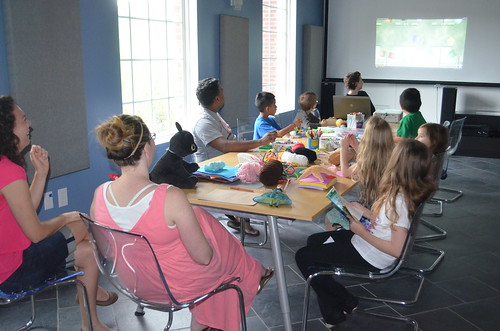
This is a story about the second meeting of a Calculus for Kids math circle. The math circle started off with the class attentively watching the trailer of Flatland. The movie itself is shown on a 2D screen, but it talks about journeys from 0 to 4 dimensions.
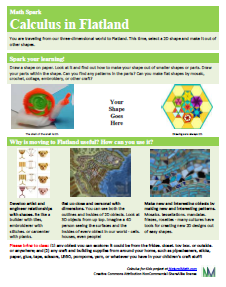
Download the Math Spark that invites you to travel to Flatland with us.
Today’s challenge is making 2D, flat shapes out of other shapes. Maddie and Sydney are discussing and examining how to transform Sydney’s green playdough shape into “what it is about to become” (they don’t know yet).
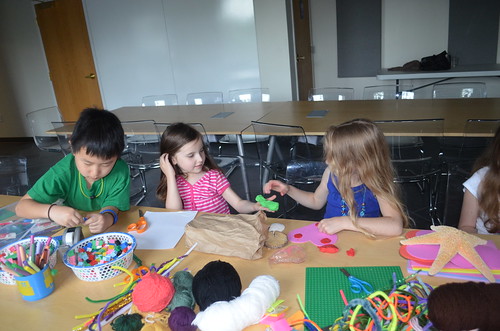
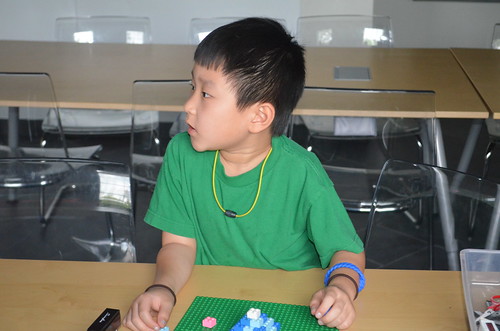
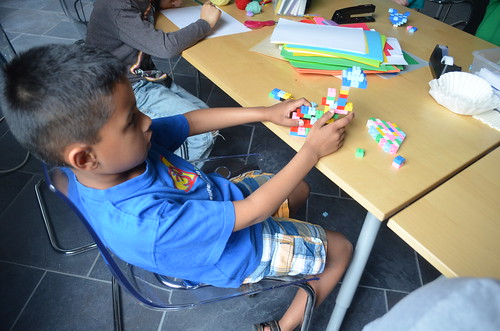
Sometimes, you just have to build something without even naming what it is. Yash built “something” imaginary out of LEGO blocks.
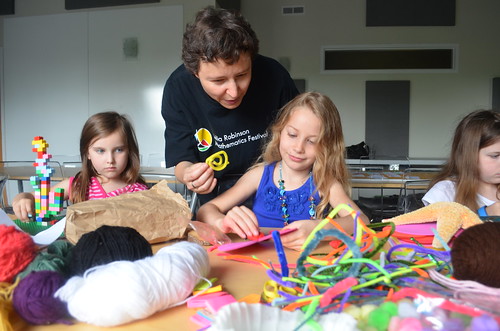
Maddie is making a 2D pair of glasses by coiling 1D pipe cleaners. She also created a 2D half-circle that transformed into a 3D sphere.

“Would you look at this!”

That flat object…
…Transforms into a sphere!

A triangle is not just a triangle, but a slice of pizza (as well as a 2D object).
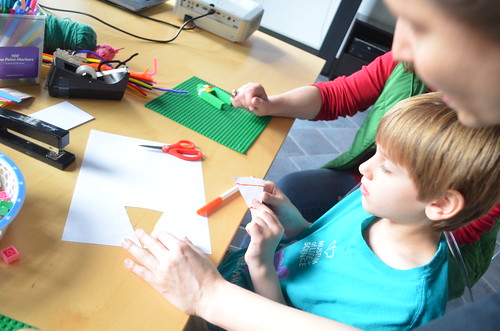
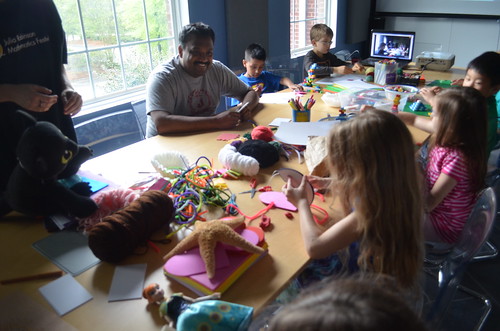
If you make several such shapes, you can arrange them into a whole pizza. Note how the children are building while listening. Doing something with your hands often helps to listen, even if it looks like children’s undivided attention is on their own project.

How do you know they are listening? Try asking a question: “What kind of shape would the slices of pizza make in a row instead of a circle?”
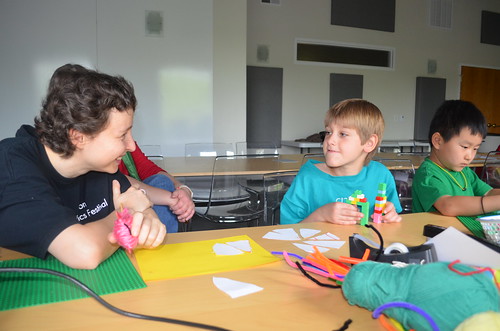
Hmm … let’s see!
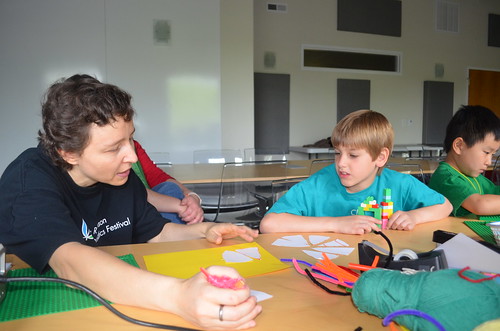
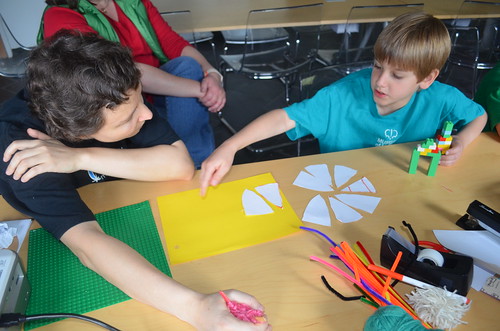
(Spoiler: it makes a rectangle.)

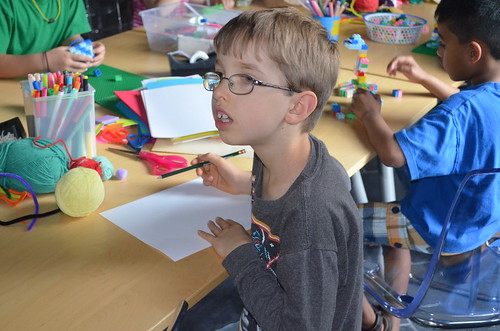
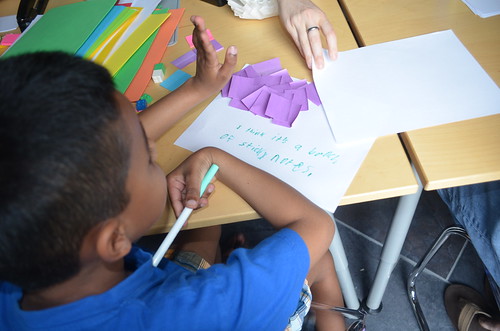
Yash meanwhile finished creating another “something” – many sticky notes reminded grown-ups of the field of math called Chaos Theory. Maria asked him to write out his thoughts on the paper. In return he wrote: “I think it’s a bunch of sticky notes.”
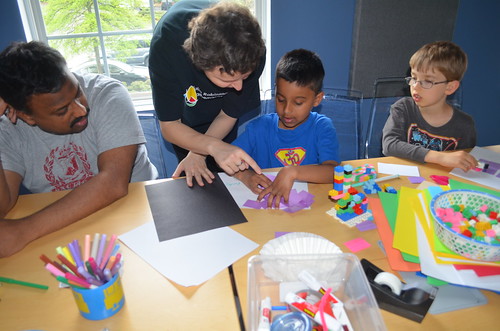
Mark made a rectangle out of six smaller rectangle – order in contrast to chaos.
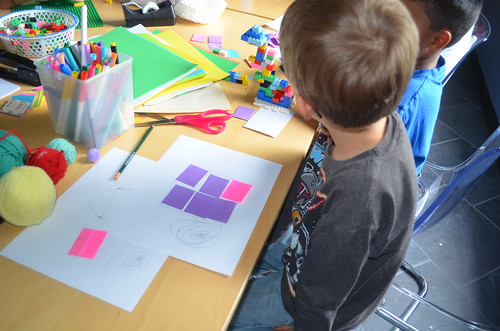
This rectangle, just like the chaotic 2D object Yash made, is abstract (not representing anything). The same technique can be used to model objects. On the other side of the table, Emma is discussing with Maria how to integrate a Minecraft sword out of sticky notes.
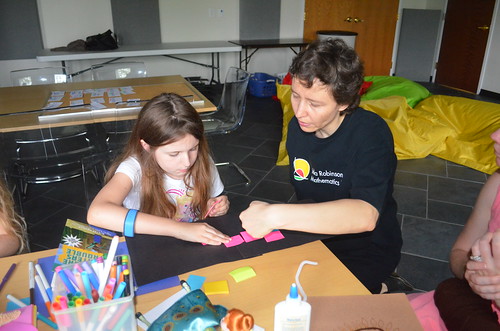
Hmm …

Nearly finished!
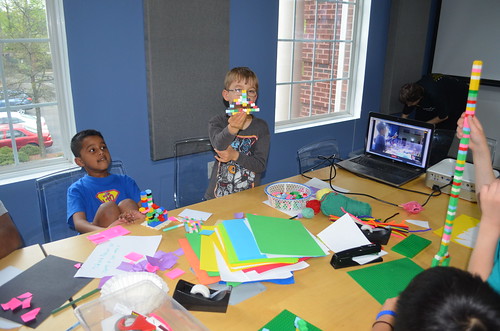
Mark is holding an imaginative 3D bow and arrow he made from LEGO blocks. It’s a flat shape that we can use as a 2D model.
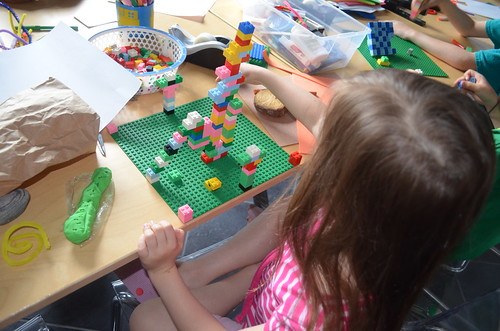
Sydney is making an unknown shape. From blocks and imagination, she bravely creates something totally new. Older children and adults often lose that bravery and become hesitant to build things that don’t look like things. For Sydney, it’s the process of building that matters – and if the end product turns out interesting enough, like this tower, it’s good too, but not a requirement.
Eli just finished making a church. First, he integrated flat squares out of “dots” (LEGO blocks) and then he made the 3D building out of squares, one on top the other.
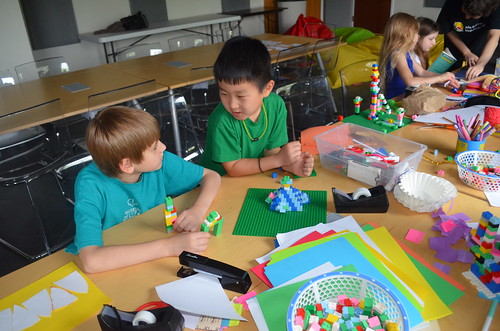
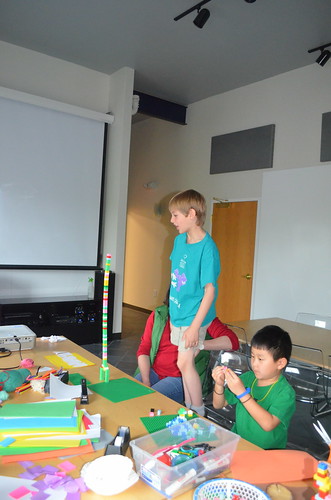
But instead, you can integrate “dots” into a 1D line – a really tall one, taller than you. But what if you got up on the chair?

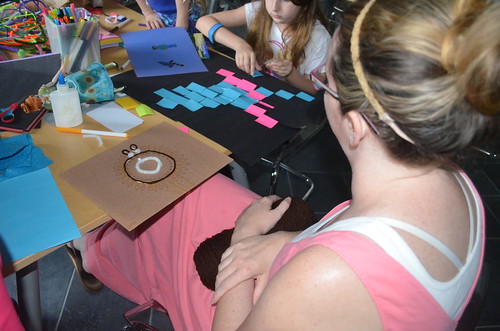
Allison is making a 2D pattern inspired by a doll’s dress. Sydney is getting up to go make her own version of a sword (not shown), using a different grid layout. When children make objects out of rectangles (like sticky notes), different types of grids come up a lot.
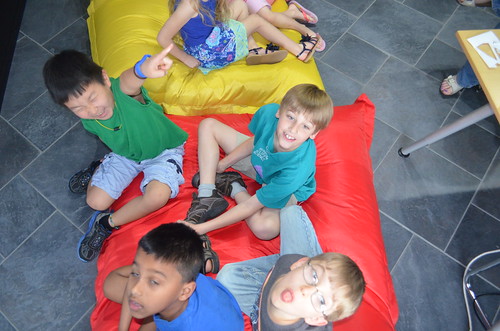
We are about to watch and play with the String Spin interactive, and pose for a picture! “Make very silly faces for the New York Times!”

Mark is experimenting, drawing on the pad to see what kind of shape his string will create.

Sydney is predicting what will come of drawings.
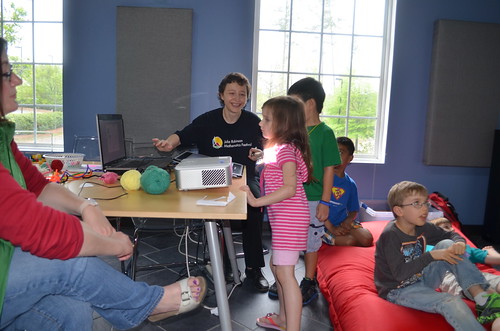
There is a temptation to say everything looks like “a weird shape” – children use a generic word, maybe “alien” or “spaceship” for everything, instead of specifying a cone, a cylinder, or a sphere. But they are not wrong, they are just expressing the fact there are similarities in all the different shapes the toy makes. It’s a mathematical value to see similarities over differences.

You can use the “Yes, and…” improv technique here: “Yes, all these shape look like spaceships. And that’s because they are all figures of revolution, so they all are similar to one another!”
Photos by Erin Song, captions by Erin Song and Maria Droujkova, Math Spark by Kalid Azad, Shelley Nash, and Maria Droujkova, edited by Ray Droujkov.


Posted in Make
Calculus for Kids May 1, 2015 (Fridays)
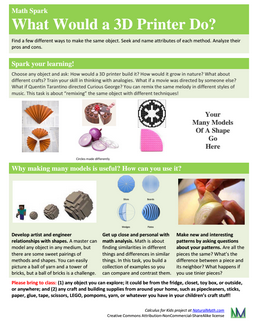
This is the fourth meeting of a math circle inspired by calculus ideas. This week, we continue making an object in different ways. So the same Math Spark applies as last week (PDF).
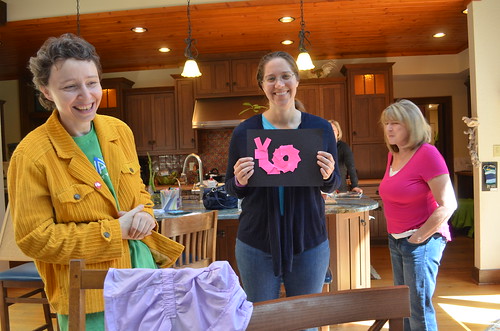
Maria has returned from her trip to the Navajo Nation and brought something for the circle. It resembles one of the Math Words we’ve been talking about, integration. Let’s look at the design on top of the vase. What do you see?

This reminds us of Michele’s snail from last week.
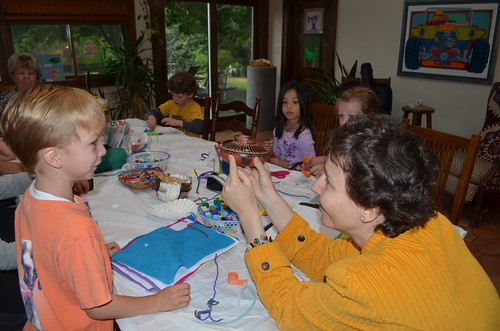
Maria is pointing out a symbol that goes around the circumference of the vase to Owen, and then to each child in turn: “What do you think this is?” Children think it’s a person sitting under the table, two letters L, and more – there are many different ways to read the same symbol! Maria learned from the trader that the original idea was two hands, symbolizing friendship.
What would be an example of 1D? The kids say a string of hair or a pen. Hannah answered by holding a pen up. Invite children to answer in many “languages” – words, gestures, and showing things.
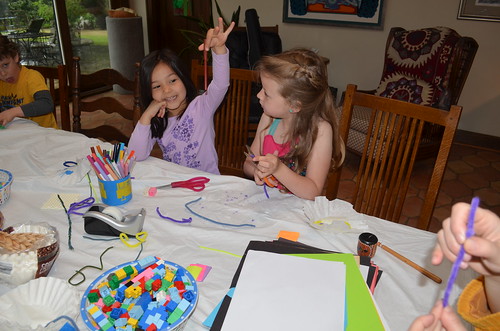
We are brainstorming about dimensions, and seeing many different things again. “What do you see in the 3D LEGO sculpture?” A cow? A bison? A snail? Priyesh says “A mystery!”
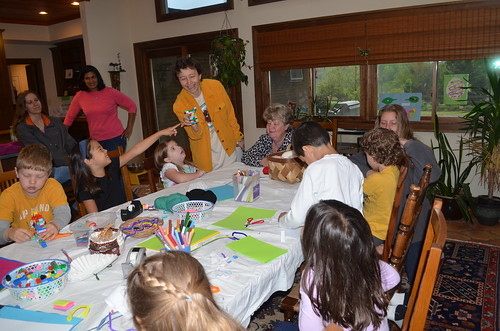
Maria is illustrating dimensions using the pink yarn. Stretching the pink yarn horizontally, it is 3D.
 \
\
Now, squeezing the yarn flat, 2D. Imagine squeezing it into a dot to vanish into 0 dimensions.
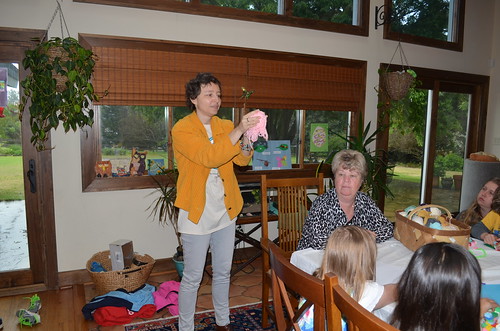
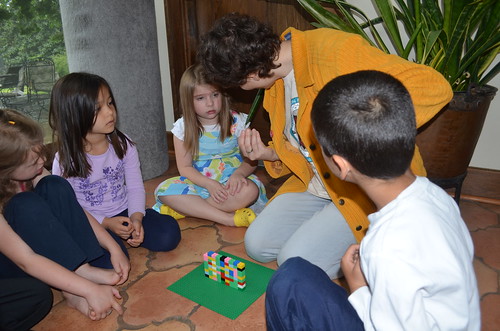
Maria asked the children to take 9 LEGO blocks each (as many as there are people) and come together.
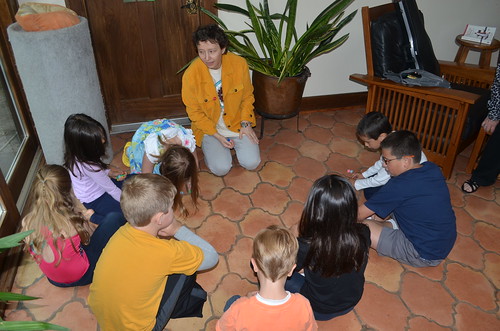
Hold the model of 0 dimensions (a LEGO block) and smile for the picture!

Each child integrated their “dots” into 1D lines. But then they wanted to add up all the lines together into a really tall tower (still a model of 1D though).
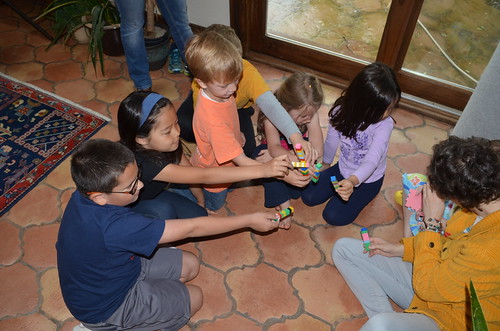

Would it stand by itself? “Abracadabra!” And then children wanted it to fall down, of course! It’s an irresistible desire when you build anything tall and narrow.
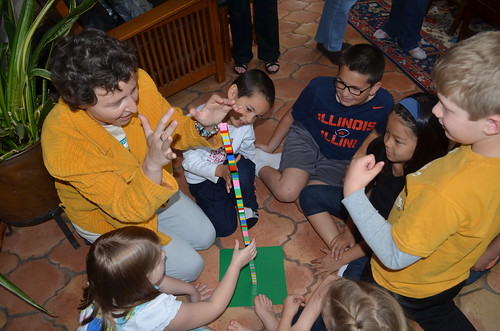
But if you attach the lines side by side, they model a 2D surface.
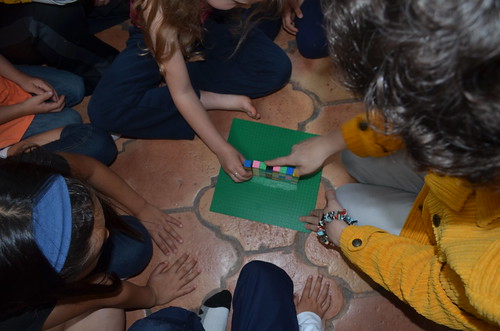
Here is the side view:
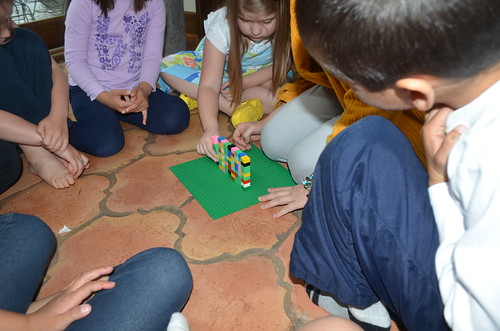
Uh-oh, 1 LEGO is missing! It turned out Julienne’s LEGO was missing, because she didn’t want to use a soiled LEGO piece on her tower (we got it replaced with a clean one). If we listen to kids and their small problems, everybody feels that they have a voice and power in the math circle, and it helps with mathematics.
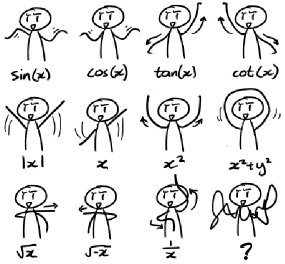
Children brought up multiplication and its symbol, then addition, by using hand gestures. Maria added gestures for integration and infinity
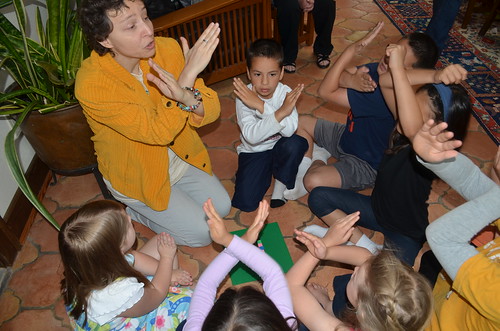
Integration: lift up one hand to your side and make a curve and let the other hand curve down.
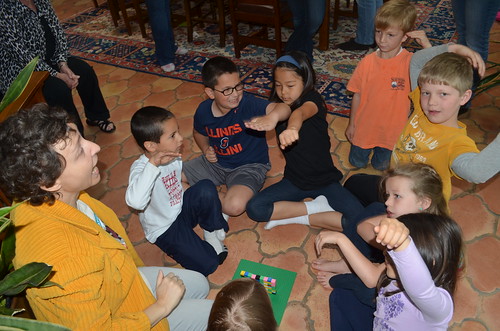
Infinity – hard to explain (hide thumbs in two side-by-side fists). Children said it does not look much like the infinity symbol, anyway.
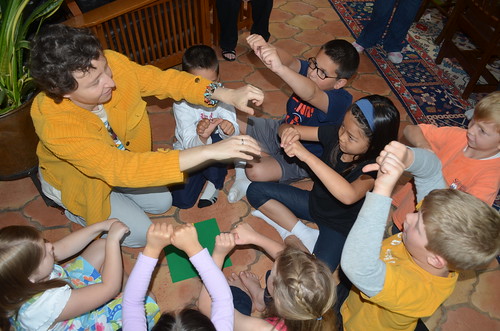
It reminds us of a math dance cartoon:
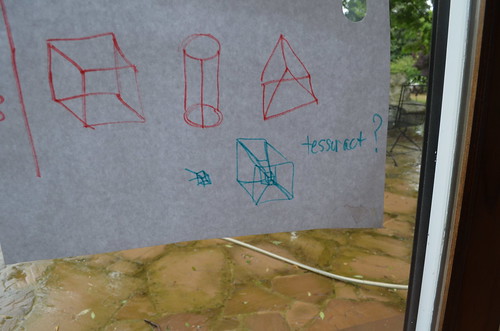
Parents had their own little math circle by the window while the children are working with Maria. They got all the way to the fourth dimension, looking up, discussing, and drawing tesseracts (4D cubes).
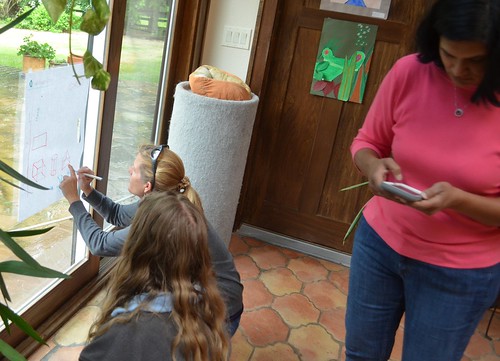
Meanwhile, children wanted to make the top layer pink, to show the 1D line across. It’s nice to see everyone’s working hands together – children in a small math circle, literally!
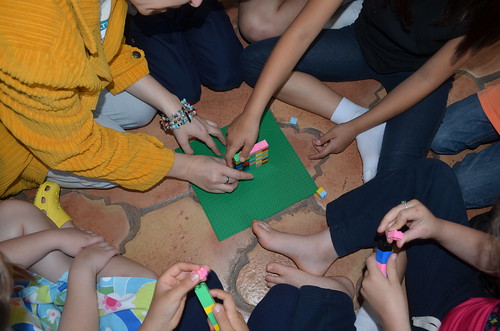
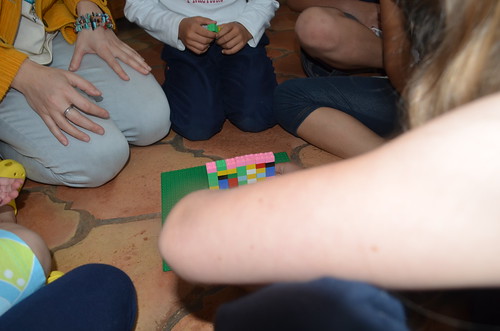
We kept that one green dot to stand for 0 dimensional point that can start a line… Then rebuilt the surface into a 3D cuboid.
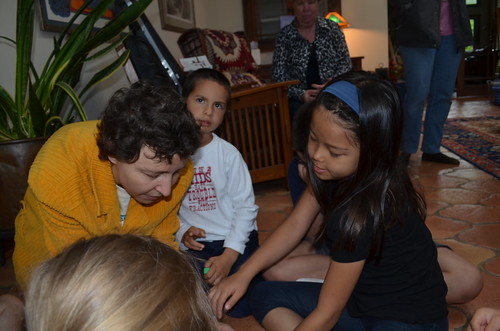
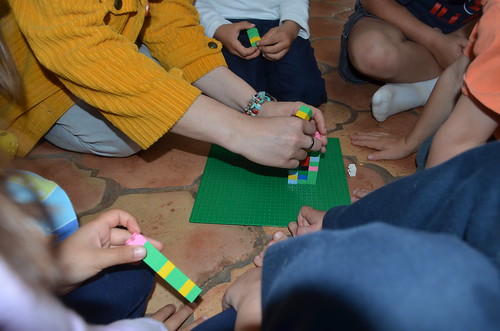
Serrin is trying to make a circle out of towers to integrate in a different way, but the floor is too uneven. We move to the table and everybody works on their circle-integration ideas.
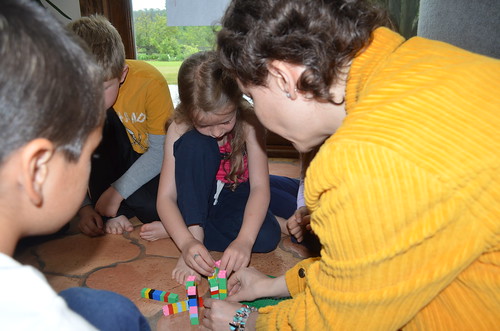
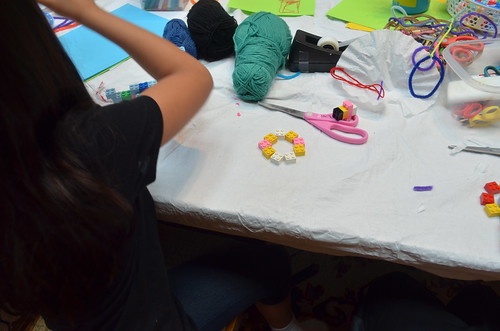
Maya’s circle – a line (1D) integrated out of points (0D).
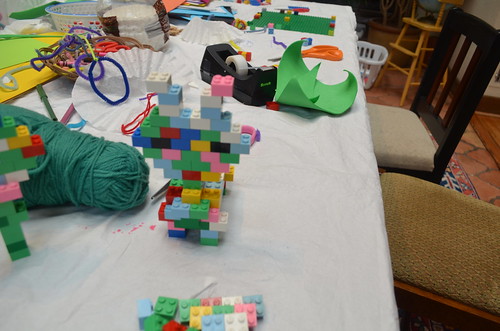
Maya with her 3D LEGO creations: a diamond-shaped flower approximating a circle on the left, a pyramid approximating a cone, and a puppy.

Front and side views of the puppy:

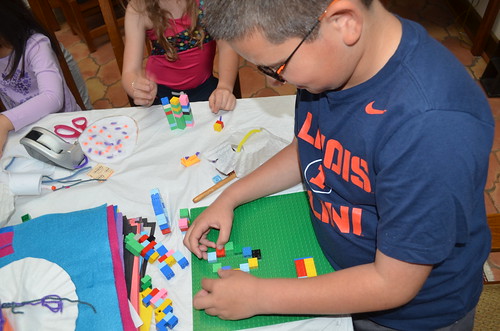
Priyesh is working on a similar diamond approximation of a circle on the LEGO board.
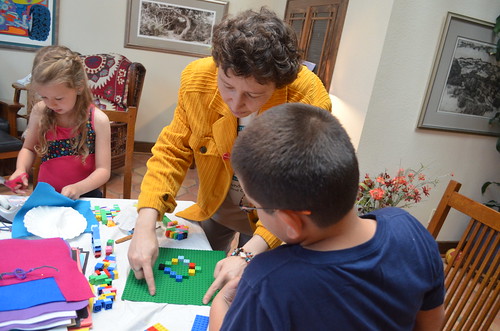
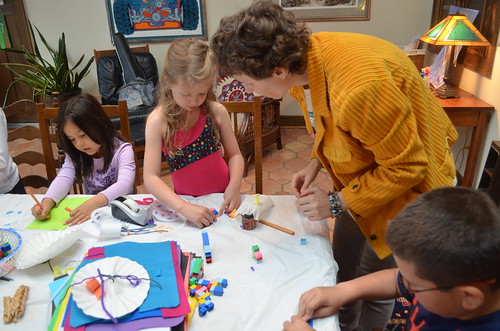
Owen is about to make an abstract imaginative ghost from a 2D surface (coffee filter).
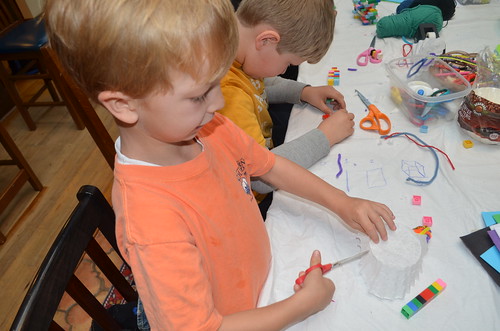
Julienne attached the LEGO blocks by sliding the bottom row half a block sideways.
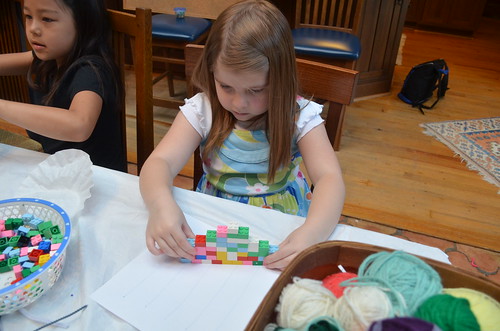
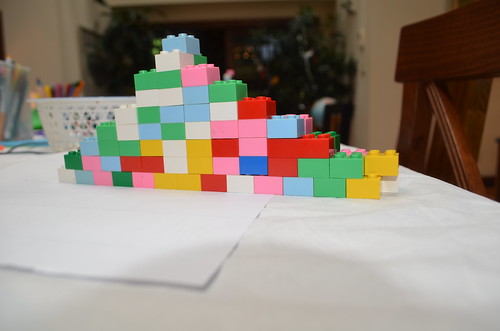
A paper model of our surface out of LEGO lines. This model is easier to roll into a cylinder than actual LEGOs.
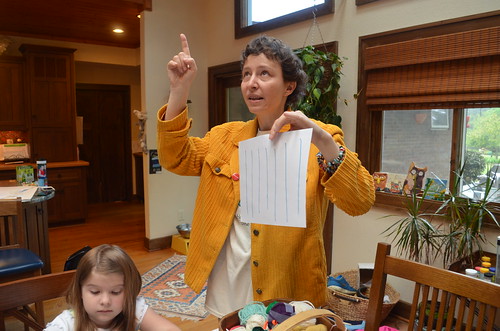

What if we rolled Julienne’s LEGO staircase (approximating a triangle) around like that? What would we get? A pyramid? A cone? A cylinder?
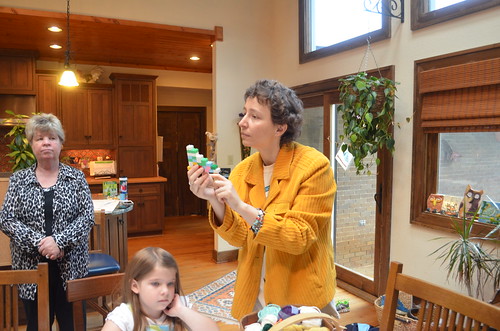
Maria cut a triangle out of orange craft foam to illustrate integration: “What shape would I get when I roll this triangle up?
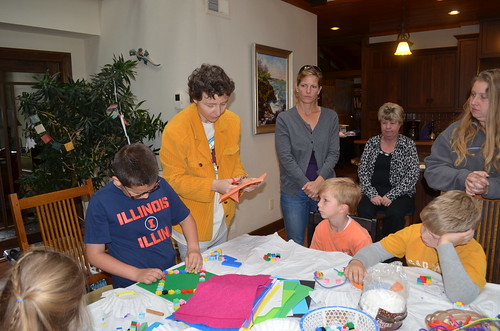
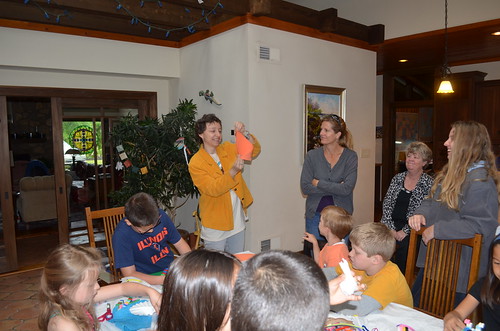
Moms are working on their triangles as well.
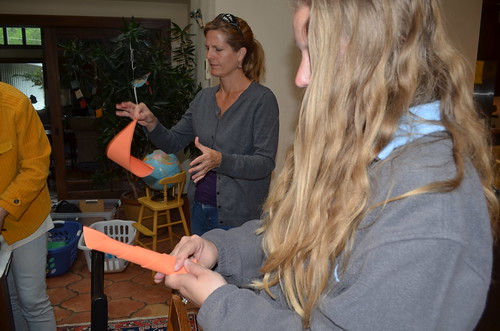
What should we call this shape?
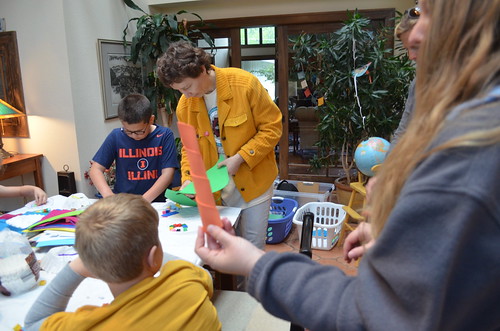
When we try to define something that’s unfamiliar and new it can be both an exciting discovery and a frustrating experience!
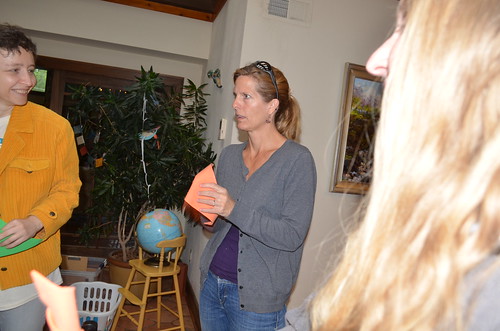
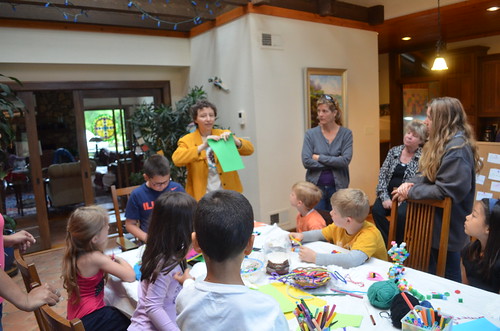
Maria is about to show another example of integration, a cylinder made by rolling up a rectangle of craft foam.
Jake building with LEGO blocks. He worked for a while figuring out the roof’s angle for his house. Slopes!
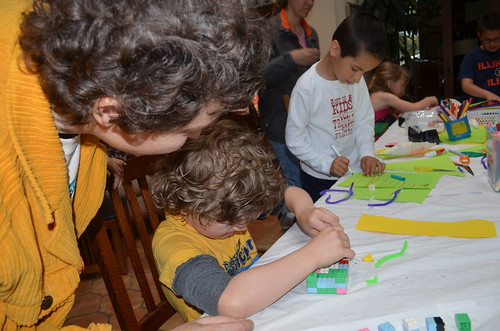
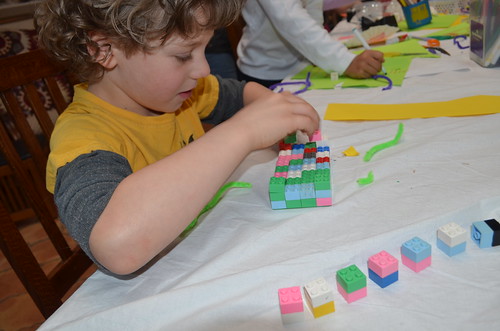
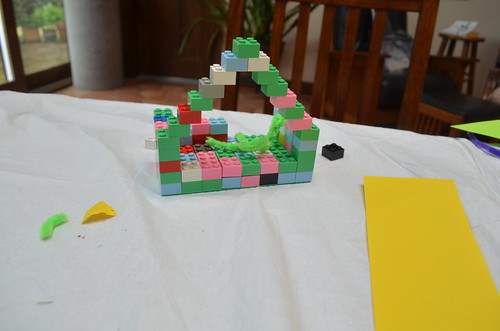
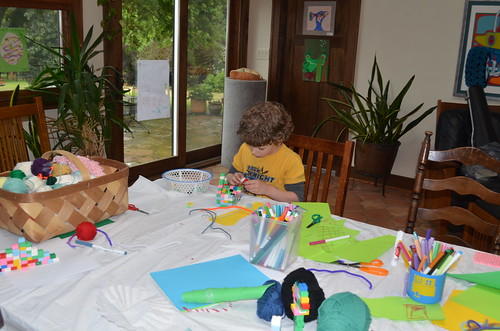
Jake decided to go back and work some more on his LEGO while the circle watched the video at the end. All the activities are voluntary, and sometimes children decide to work on their own projects instead. There are studies that show it does not prevent them from learning the content the rest of the group explores (they absorb it anyway). This ability to choose activities supports ownership and agency in mathematics.
Eashan cut out a triangle and drew straight lines across to show integration of a shape out of lines, then cut out the extras so it looked really neat.

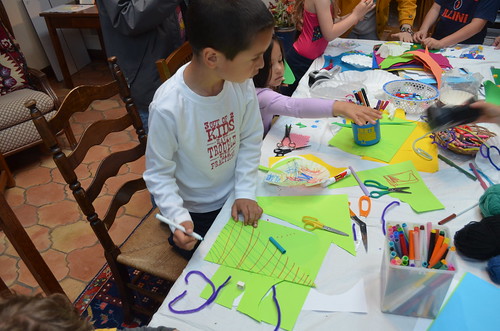

Do you see beautiful mathematics in the chaos of papers and crafts? We do! From Eashan’s table:
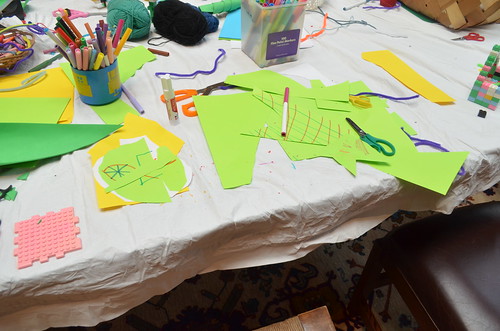
Hannah’s volcanoes, integrated out of lava flow lines:

From Hannah’s table:
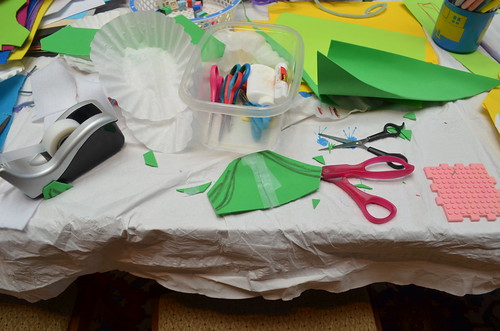
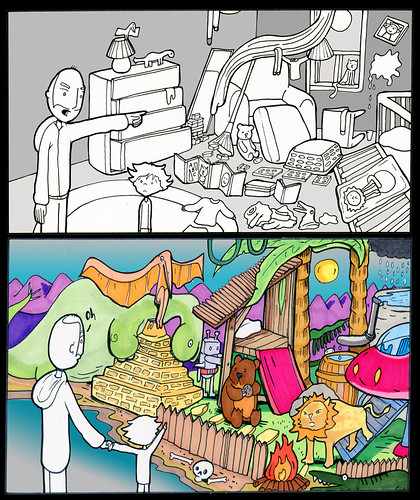
“Mess” by LoonarBaboon.com – believing is seeing in pretend-play and mathematics.
Priyesh and Serrin are trying to make a circle together, by using LEGO blocks on the board. Look at the chaotic busy working table in the background!
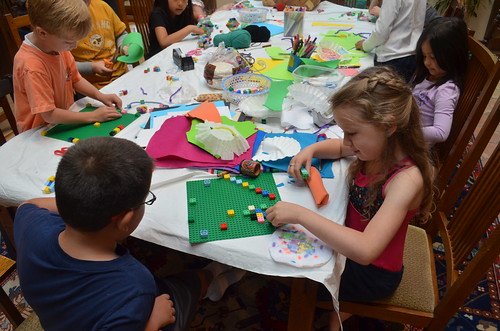
Learning is playing and playing is learning.
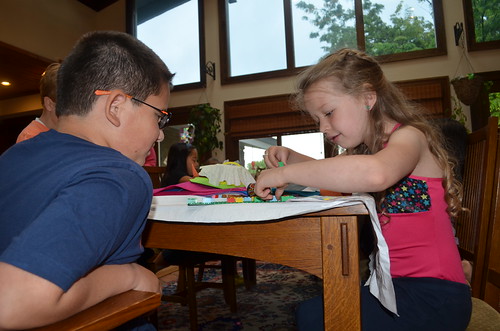
From Priyesh and Serrin’s table:

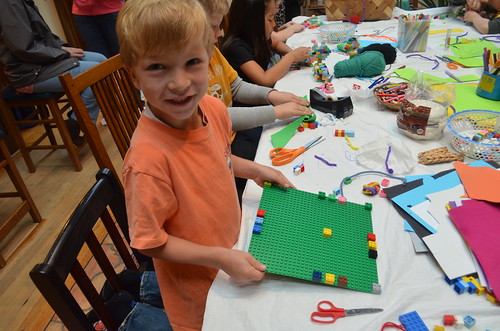
Smile, Owen! He made an imaginary plane (ship or cargo?) out of LEGO on the 2D green board. Check out symmetries.
Charlie is rolling up all three corners of a triangle – something grown-ups have not tried yet:
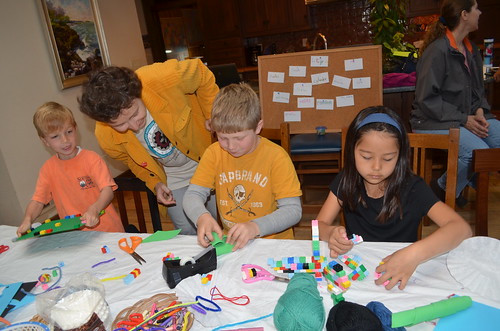
The circle is gathered around the kitchen table to watch “The Dot and the Line: A Romance in Lower Mathematics.”
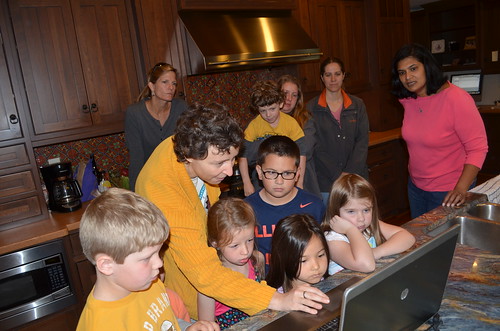
Curious, amused, and giggly faces!
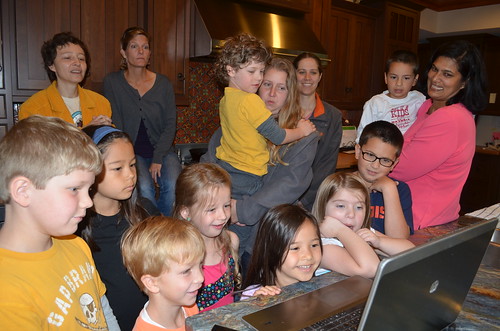
The views from afar and up close.
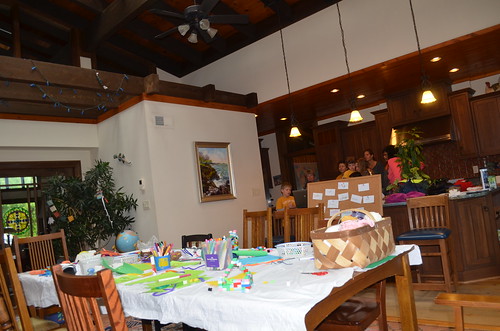


Photos by Erin Song, captions by Erin Song and Maria Droujkova, Math Spark by Kalid Azad, Shelley Nash, and Maria Droujkova, edited by Ray Droujkov.
Posted in Make
Moebius Noodles 2nd edition, and Calculus for Kids: Newsletter May 6, 2015

Subscribe and read archives
Pinterest | Twitter | YouTube | Facebook | Google+
In this newsletter:
- Moebius Noodles, 2nd edition: send us your questions and suggestions.
- Calculus for Kids – get inspired with photos and stories.
Publishing new and improved Moebius Noodles book

The first print run of Moebius Noodles, the book of adventures for young children and their grown-ups, is almost sold out. Good news is that we are about to publish the second edition.
Whether you’ve read the book or not, you can help us make its next version even better! Here’s how:
- Readers asked for more Questions and Answers. Send us your questions about Natural Math ways of learning, or about particular activities from Moebius Noodles. We may include answers in the book, or on the accompanying forum.
- We hear some readers feel inspired, but do not know how to start the activities with children. What helped you or would help you to begin your adventure?
- Have you noticed a typo or a style issue? Let us know!
Email your questions and suggestions to maria@naturalmath.com
Calculus for Kids project
We are running an experimental Calculus for Kids course online and two small local math circles in Cary, NC. We got tons of feedback on the activities, which will go into the next iteration of the course, the next round of math circles, and the book that will accompany them. Meanwhile, you can see lots of photos at the Natural Math site, and try some activities with your children.
Check out Calculus for Kids at https://test.naturalmath.com/tag/inspired-by-calculus/

See you online!
Dr. Maria Droujkova and the Natural Math crew

Posted in Newsletter
Calculus for Kids April 24, 2015 (Fridays)
This week, we created the same object in several different ways. The goal was still to make shapes out of shapes, but this time, we compared and contrasted different ways of doing so. Do we place pieces at random like a pile of rocks making a cone, or do we tessellate them in a careful pattern? Do we use small pieces, large pieces, or vary the sizes? Do we use a continuous (pliable) medium like clay, or discrete pieces like LEGO blocks?
Here is this week’s Spark in PDF. This will help you get started on activities.
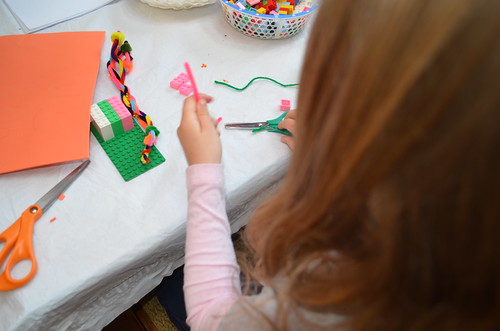
Serrin is making a braid out of 3 pipe cleaners. She already made one, and off-camera she’ll make a third braid, because…

…This way she can make a braid out of braids. It takes 3 pipe cleaners to make a braid, and three braids to make a braid out of braids, which makes 3^2 (three to the power of two) or 9 pipe cleaners. You can see this braid out of braids between 3 LEGO blocks and a cube of 3^3 (three to the power of three) LEGO blocks we made with Maya and Serrin earlier. The braid of braids fits there, because the power of two represents 2D, while the cube represents 3D and 3 single pink blocks represent 1D (especially if you line them up).
Nobody was eager to suggest a shape for everyone to build, so Maria suggested a snail, because it appeared in several crafts before and was a simple enough but interesting shape. Let’s start with 1D medium, the pipe cleaners.
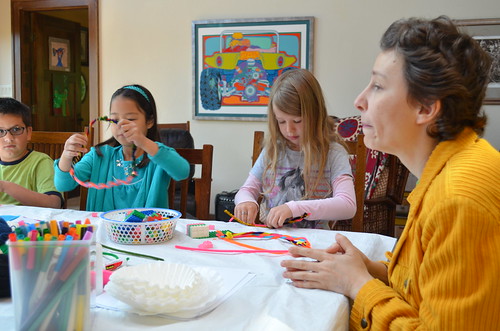
Her own project done, Serrin started using pipe cleaners and other media to make snails.
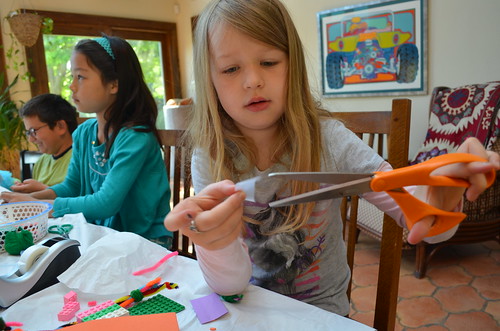
Here a single LEGO block on top of 4 blocks represent an approximation of a 3D shell. The 2D pink sticky note on the bottom stands for the body. We talked on how math is similar to impressionist or abstract art, and this is an excellent example.

Hannah is testing and bending a 1D pipe cleaner while Owen is imagining how to make a snail from a multitude of them. He started with a tiny multi-colored ovoid, about half as long as his thumb, then the project grew.
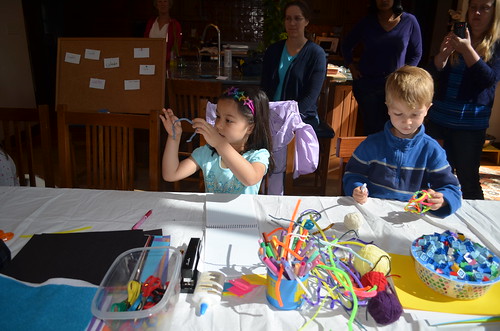
Hannah made a 2D tiny green snail from yarn stapled together. Hard to see, but very soft and cuddly!
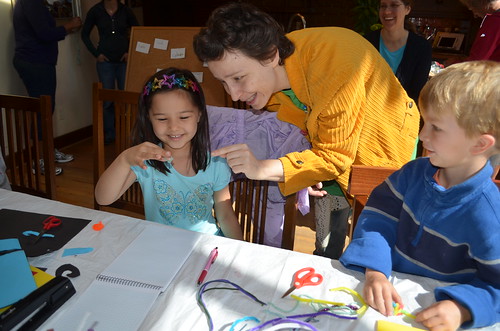
Hannah made another snail; a 3D purple sphere yarn ball topped with a 1D curved orange pipe cleaner for the snail’s antenna. Check out Hannah’s triumphant and crafty smile. That’s a math face for when you find a simple solution to a complex problem. Simplicity is a big mathematical value, and solving problems in simplest ways possible is considered a beautiful thing. “Everything should be made as simple as possible, but not simpler” – Einstein, paraphrased by the composer Sessions (because music shares this simplicity value with math).
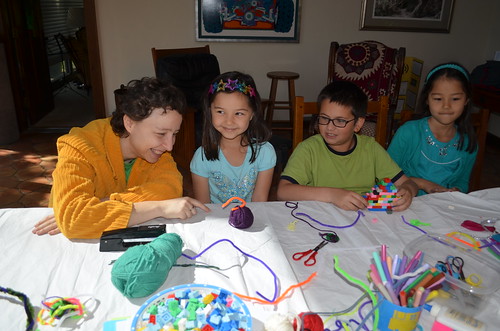
Owen sitting quietly alone working on his snail. When transitioning between activities, leave some time for kids to get to a place where they can pause their projects gracefully and hold their thoughts.

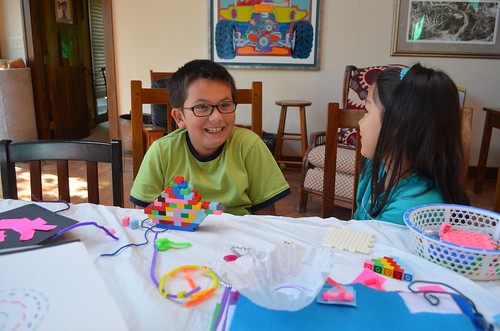
Ecstatic smile, Priyesh! Maya and Priyesh are discussing their LEGO snail projects and just chatting. Priyesh focused on shape, making his snail sturdy and “more three-dimensional” as he put it, and Maya focused on the pattern of colors, analyzing the layers.
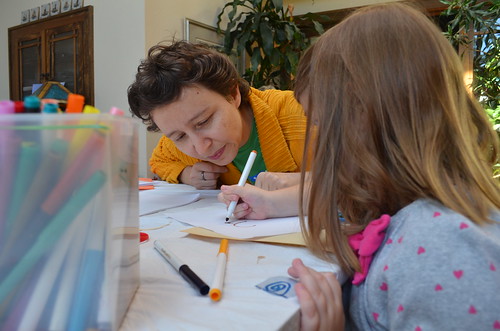
Julianne wished she had a real snail to draw it just the way real snails are. Maria helped in a different way: offering shapes that Julianne could choose for parts. Then Julianne integrated the snail out of parts, choosing which to draw next, which shape it will be, and which size of that shape. This “calculus way to draw” (making shapes out of simpler shapes) helps kids who want to be precise – another value some forms of art share with mathematics!

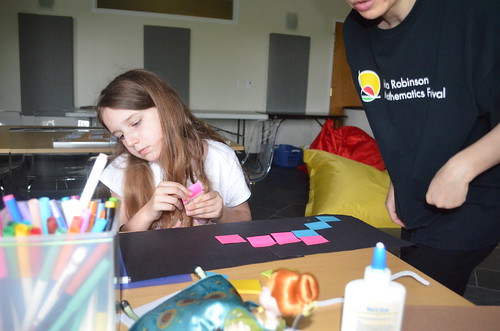
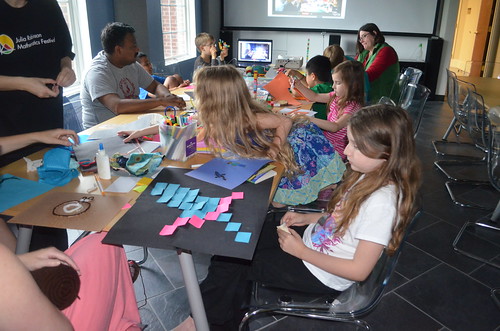
Michele integrated her (2D) snail using pink sticky notes, dramatic on black construction paper. Check out how curves are made of rectangles.
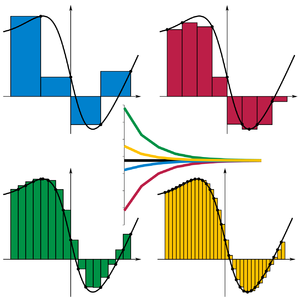
Image credit: Wikipedia article on Riemann sums.
The grand imaginary play battle – Snail vs. Snail, now in 3D! Maya and Priyesh were at it for a while, building their snails up and then pretend-battling them. Making your own pretend-worlds is what children – and mathematicians! – love to do.
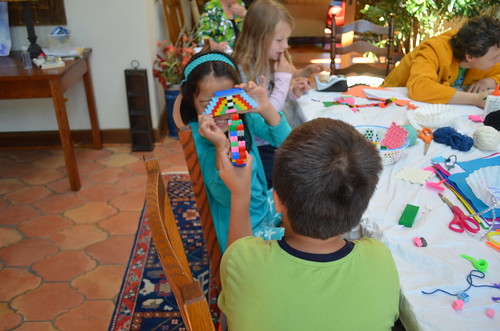

Image credit: Wikipedia article on the made-up world of imaginary (complex) numbers. The picture looks like a battle of rainbow snails, but it’s a graph of sin(1/z).
This time, we had different rules for our Math Words: people got to pin the word if they did not know it yet. Children are generally okay saying they don’t know something, and this game celebrates awareness of not-knowing, then learning.
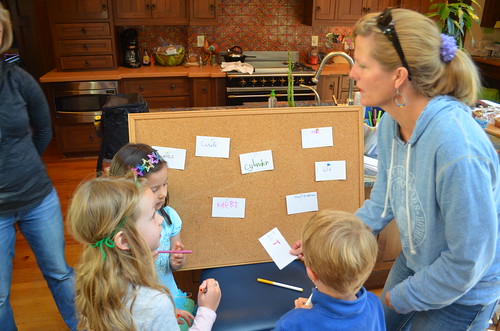
“Wave at me if you made a snail using only 1 color! Now, if you used more than 1 color to “integrate” or put together?” Many kids wanted to write the word integrate, so each wrote a letter in a different color, integrating the word itself out of letters. Here Serrin and Hannah are about to put up “Approximation” and Owen, “Abstract.”
We had a cute little scene about abstraction. Maria asked for people to wave if they made a model somewhat resembling a real snail. Then to wave if their model was pretty far from real snails. “Mine was nothing like a real snail, AT ALL!” – very happily explained a kid, and several others nodded. Then all children started to wave. This is a happy attitude to keep, for both math and art. A formula for a parabola does not resemble the ball flying out of your hands… The formula is abstract, like a model of a snail that does not look like a snail at all.
We are sitting on the ground: “What would make our approximations more perfect?” The participants had ideas for making shapes more precise, but also for artistic merit: “Find enough LEGO of only one color; use smaller pieces or make a larger project; use a better pattern; observe real snails!” Julianne made a passionate speech about following the nature and not messing with it too much.
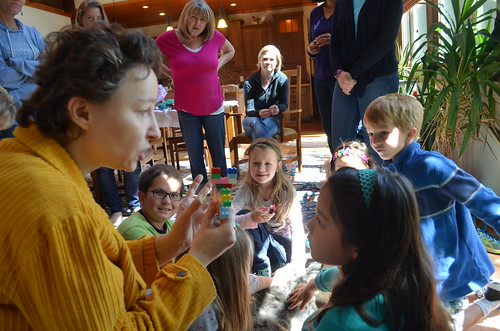
Owen: “My snail could have used a pattern…” Maria: “Look at all the randomness!”

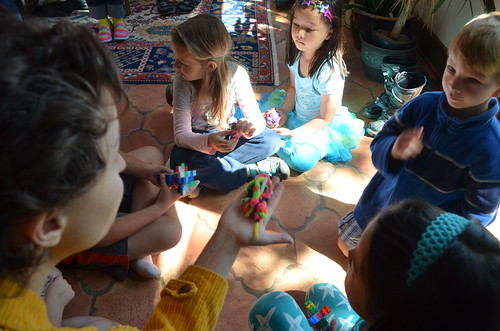
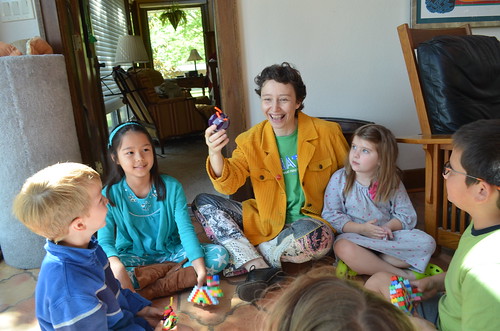
We have a new videographer! Thank you. Videos coming up.

Maria and Jewell are discussing Julianne’s stories that Jewell was recording.

We are integrating a spiral snail out of our own hands. Try to work out your math with your own body – it makes for a very direct understanding, like nothing else does.
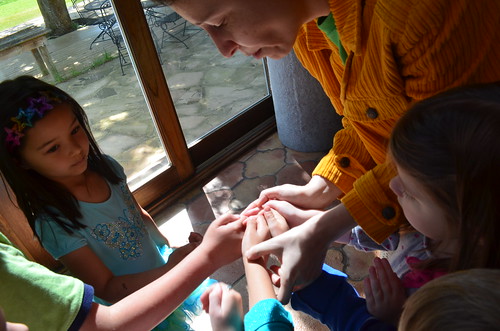
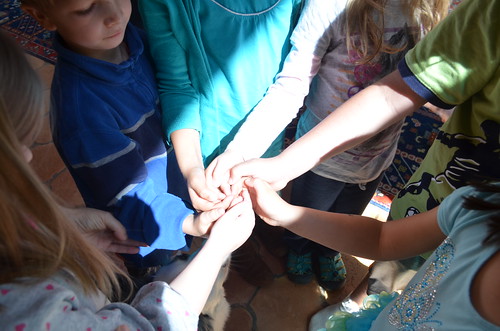
The sun made a piece of impressionist art out of our snail.
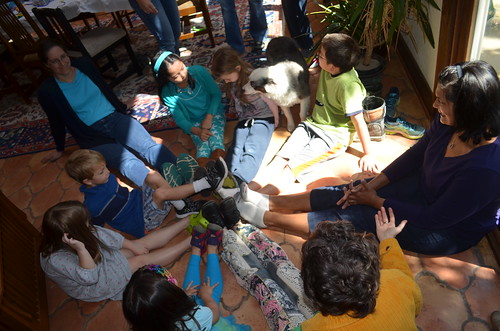
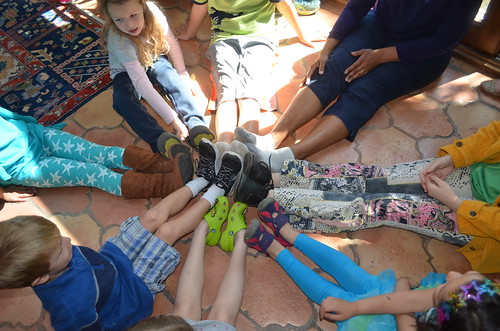
Making people pizza with our legs. It’s a… math circle! A child: “We are not pizza slices, we are lines between the slices.”
All the Math Words.

Video time: Watching “Infinity Elephants” by a mathemusician Vi Hart.

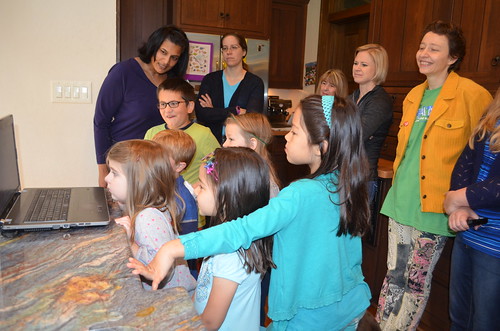
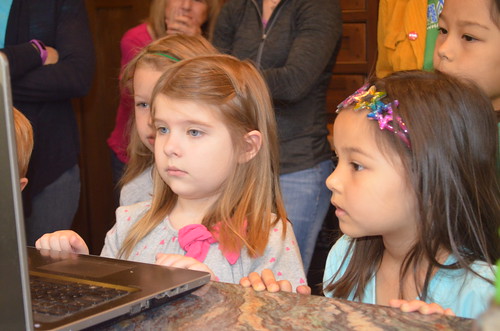
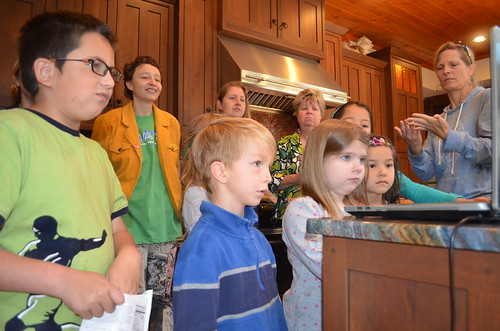
It’s nice to finish with a movie, because it takes less energy from the tired kids, but leaves them focused, calmer, and inspired for their trip home.
Photos by Erin Song, captions by Erin Song and Maria Droujkova, Math Spark by Kalid Azad, Shelley Nash, and Maria Droujkova.
Posted in Make


