- Home
- “Yes, And…” Improving Math Play with Improv
- Althea’s Math Mysteries
- Avoid Hard Work, the Workshop
- Avoid Hard Work! …And Other Encouraging Problem-Solving Tips for the Young, the Very Young, and the Young at Heart
- Blocks and Modeling: A Do-It-Yourself Guide to Exploring Geometric Objects – Online Workshop
- Blog
- Books and Goods
- Bright, Brave, Open Minds
- Bright, Brave, Open Minds: A Problem Solving Kaleidoscope. Open online course for parents and teachers
- Camp Logic
- Cart
- Checkout
- Citizen Science Station
- Consulting and Tutoring
- Courses
- Download File
- Easy Complexity and Special Snowflakes Online Math Circle
- Empires: Year-long prealgebra program in a game
- Expedition Everest
- Five Fabulous Activities for Your Math Circle
- Funville Adventures: Math Personified!
- Funville Web Tour
- Hacking Math
- Hiding in Plain Sight: Vyshyvanka Secret Codes
- Home
- HOW do they do it? Creating your own math puzzles
- Inspired by Calculus: Online course for parents, teachers, and their children ages 5-12
- Kingdom On A Wall
- Kingdom on the Wall
- Ko’s Journey Is Discontinued
- Lapware
- Math Books
- Math Cafe
- Math Circles
- Math Circles 1001 Leaders Course
- Math Future event registration
- Math Future: come and talk!
- Math Goggles Challenges
- Math Renaissance
- Math Trek
- Mathematics & Poetry for All
- Meet the authors
- MidSchool Math Digital Math Tools
- Moebius Noodles
- mpsMOOC13: Problem Solving for the Young, the Very Young, and the Young at Heart
- Multiplication Explorers FAQ
- Multiplication Explorers LIVE workshop
- Multiplication Explorers Online Course
- Multiplication Explorers Registration
- Multiplication Explorers, the book
- Multiplication Models Poster
- My Account
- Natural Math Multiplication Course
- Online Logic Summer Camp for Kids!
- Online Summer Calculus for Kids Camp!
- Pay Natural Math
- Playing with Math: Stories from Math Circles, Homeschoolers, and Passionate Teachers
- Reviews of the Moebius Noodles book
- September 25: Math Storytelling Day
- Socks Are Like Pants, Cats Are Like Dogs
- Speaking and events
- Start Here!
- test001
- The Art of Factorization Diagrams
- The Iditarod
- The seven principles of Natural Math
- Transformers: Matrices & Graphs!
- Veronica’s Multiplication: a Natural Math circle online
- WOW! Multiplication – an open course in September 2013
- Ying and the Magic Turtle
- About Natural Math
- Contact Us
- Get Involved
Pi is calculus (for 5 year olds): Natural Math newsletter 3/14/15

Subscribe and read archives
Pinterest | Twitter | YouTube | Facebook | Google+
In this newsletter:
- Three awesome activities where Pi is calculus (for 5-year-olds) – happy 3/14/15
- March 27-28 MoSAIC: Mathematics of Science, Arts, Industry and Culture (Raleigh, NC)
- Work or volunteer for Natural Math
Celebrate Pi Day with calculus-inspired activities for the young and the young at heart
Happy 3/14/15 – and let’s hope you read it exactly at 9:26 for even more digits of Pi! Here are three activities for celebrating with your children and friends.
It’s a triangle! It’s a square! It’s a… circle?!
You will need a lot of straight thin objects about the same length: twigs you find outside, pencils on a blanket so they don’t roll, craft sticks, or simply strips of cut paper. Make a triangle out of your sticks. Add one more stick – you get a square. Add more sticks – you get a pentagon. Keep adding sticks. Pretty soon, you (better – your kids!) will marvel out loud that your shape is now a circle. Is it really a circle? Engineers say “Close enough!” and mathematicians say “No way!”

- Where is Pi? Do like the ancients. Measure the length of your stick, multiply by the number of sticks, and divide by the diameter of your circle (which you measure too). You get, and I quote the engineers, close enough to Pi – the ratio of the circumference to the diameter.
- Where is calculus? What you did here is approximating a curve with straight lines. This is a step in many calculus algorithms for integration, differentiation, and limits.
- A fun twist. Instead of sticks, use kids sitting on the floor, feet-to-behinds. It’s a great photo-op for a math circle – literally!
Three and a little bit
This is perfect for young children who are starting to fall in love with numbers: “Mom, what is a million?” Or those wishing to feel with their own hands where Pi comes from. You will need yarn, tape, or anything else you can easily unfurl and cut. Find a hula-hoop or a pot lid, or draw a large circle. Measure it across with your yarn and cut – that’s your unit (the diameter). Invite your child to estimate how many such units will fit around the circle.
Keep measuring out and adding units around your circle. Three should almost cover it, but not quite! Make an extra unit, and ask your child what part of it would fit into the space that is left around your circle. Will a half fit (fold your unit in half to show)? How about a third? Find a fraction small enough that it fits the gap. But if there is a bit more of the gap left, you can estimate that with a fraction of your fraction, and so on.
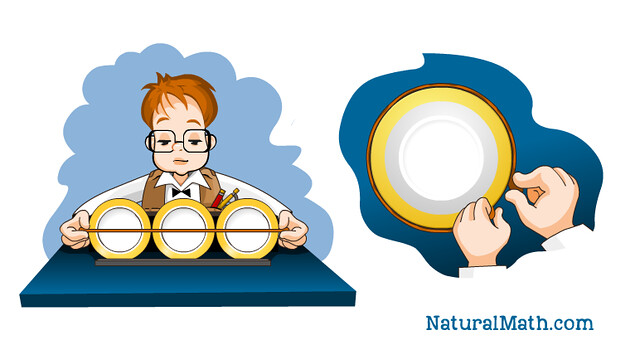
- Where is Pi? You are approximating Pi with diameter units. Start with three units, then add some piece of a unit (maybe 1/6 or 1/8), then add a smaller piece (maybe 1/4 of the piece you had before) and so on.
- Where is calculus? A mathematician claims that if you do your measurements very precisely, you will get an infinite series of fractions! Because Pi is irrational, your series will never end. Infinite series are a staple of calculus. But an engineer will say you’ll cover the circle completely in just a few steps, because your yarn measurements are approximate.
- A fun twist. With older kids, try dividing your unit (your diameter) into tenths, then those fractions into tenths, etc. You might see that the circumference is about three units, one tenth, and four hundredth… Pi = 3.14… but you may get slightly different values depending on your precision.
Pi=4
This is a teen or grown-up party trick. The steps are so simple a five-year-old would get them, but to enjoy the punchline, you do need to know what Pi is.
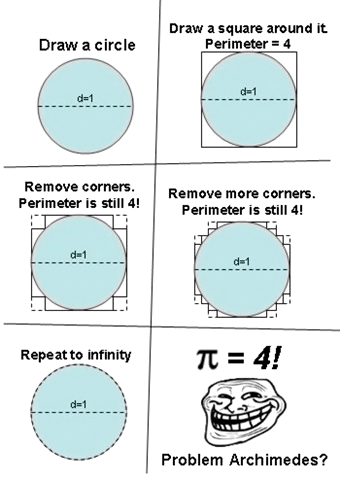
- Where is Pi? Well, we found Pi, and it’s apparently equal to four. Engineers like Archimedes who just approximate everything – beware! But wait, aren’t our previous two activities all about approximations? Were they all wrong too?! (No, they just happen to be okay.)
- Where is calculus? This intriguing piece of math trolling demonstrates that in the calculus world, things aren’t always what they seem. Taking a limit can easily go very wrong. Vi Hart has more to say. https://www.youtube.com/watch?v=D2xYjiL8yyE
- A fun twist. Could you use other shapes to “prove” Pi equal to other numbers?
For more young calculus, check out the Moebius Noodles collection!
MoSAIC Festival in Raleigh March 27-28
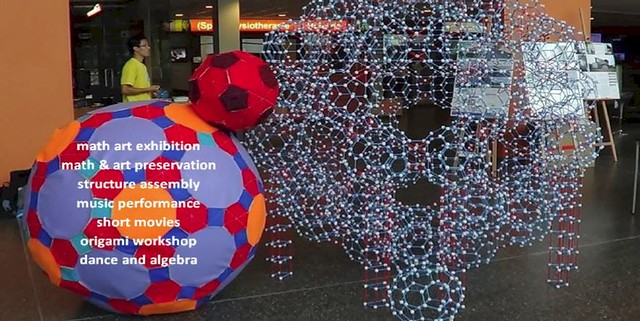
MoSAIC: Mathematics of Science, Arts, Industry and Culture is a festival celebrating the connections between mathematics and the arts. The festival will take place March 27-28, 2015 and it is free and open to the public. It is a great opportunity for children and adults to experience and reflect about the interplay between math and art, and for parents and teachers to find inspiration for student activities.
Join the Natural Math crew
We are growing. Join our adventures!
Part-time paid positions
- Lead math circles and courses. Help us meet the demand for family activities in the Raleigh-Durham, NC area, or lead online courses for families and teachers.
- Scout the web for young adventurous math. Want to seek young algebra and calculus around the web and blog about it? Want to look for innovative math circles and write their stories? This job is for someone who loves to browse the web, connect with interesting people online, and to blog.
Volunteer opportunities
Spend quality time with engaged people working on meaningful mathematics! You can volunteer as little as an hour per month. Our current volunteers include teens, parents, university researchers, software developers, retired professionals, social media activists, and creative writers. This is perfect for people who want more active but casual engagement, or want to ramp up their skillset and resume.
Email maria@naturalmath.com to talk about work or volunteering.
See you online! Dr. Maria Droujkova and the Natural Math crew


Posted in Newsletter
Math art collections: favorites on Pinterest
Here are three things we at Natural Math like to do with other people’s mathematical collections on Pinterest. Try for yourself if you have not yet.
- Browse a favorite collection, relax to beautiful images and videos, and meditate.
- Invite your children to browse together – it’s like a trip to an art museum, but it only takes 3 minutes and there is no driving.
- Take favorite pieces for your own collection. Here are our collections.
Our newest blog writer Ruby gives you a tour of five lovely math collections. Enjoy!
The board Pop up 3d by SO Satori features many great examples of pop-up artwork. Some of the designs are asymmnetrical in a way that makes you wonder how they created them. It makes you want to just grab a piece of paper and start folding!
The board Countable – 1 to 10 by Maria João Lagarto features various images that would be great to show to preschoolers to help them learn to count in a natural way. Some of the images could be used to teach multiplication or square roots.
The board Balloons_Math Related by Victoria Skye is a collection of photos and videos of amazing balloon art. It could be used as a cool and interactive way to teach kids about 3D models and fractals. No matter what, the amazing sculptures will capture your attention.
The board Mathy Math by Adelaide Leigh has great examples of radial symmetry and reflection symmetry art. Some of the pins include integration and fractals, while others are great ways to learn about modeling.
The board Reggio Classroom and Activities by Beck has lots of inviting activities for modeling with kids. Some of the activities use simple supplies like cardboard boxes. They are geared mainly towards kids that are 5 to 8 years of age.

Posted in Grow
Multiplication heat map, reworking calculus, join our crew: Newsletter February 5, 2015
Subscribe and read archives
Pinterest | Twitter | YouTube | Facebook | Google+
In this newsletter:
- “Heat map” of the hardest multiplication facts.
- Reworking calculus for 5 year olds: January survey.
- What is James really trying to do? James Tanton’s Common Core video and our reply.
- Math storytelling and crafts for an autistic spectrum child.
- We are hiring and seeking volunteers.
“Heat map” of the hardest multiplication facts
How do you know you are actually learning something? Usually, through testing. But how do you or your children feel facing a math test someone else inflicts? Many people find that scary and stressful. Yet total freedom from progress-tracking may sap motivation and make it hard to pursue big goals.
Computer games have levels and achievements that not only orient players within the game, but also add spice and motivation. Scientists also work on tracking progress in meaningful ways. Why not adopt these gamer or scientist techniques, in ways that make sense for you?

For example, check out this heat map for a group of children memorizing times tables. Think of your own maps you and your child can build. Which multiplication facts take you the longest to recall or figure out? Is your map symmetric, or do you also find 7*6 slightly easier than 6*7? And what does your map say about ways you can improve your number sense and fluency?
Our online course Multiplication Explorers helps participants learn these mapping tools. Here is an example: a work-in-progress map a teen created for reviewing times tables through patterns, a.k.a. “facts I don’t need to memorize.”
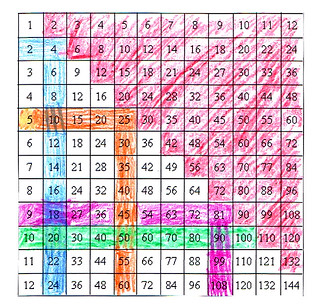
The next session of the course starts February 9th. Join with your family, math circle, or class!

199 families and groups signed up for the course as of this writing. We love to read notes from participants explaining why they join, so here are a few:
- I hope to solidify my 5th grader’s multiplication skills and introduce it to my first grader and maybe even four-year-old.
- Always looking for engaging ways to help my son (with poor working memory) to learn about multiplication – preferable without the reliance on rote learning!
- I will use the course and poster to help my special needs granddaughter in her struggles with math. She is a third grader.
- I teach at the secondary level to kids (Gr. 9 and 10) with very poor numeracy skills. I want to teach numeracy (esp. multiplication) since this has been a major ‘gap’ or roadblock to understanding curriculum.
- My homeschooler (age 7) is discovering multiplication. He thinks math is like a fun mystery puzzle.
Reworking calculus for 5 year olds: January survey
One of our ongoing projects is making calculus radically accessible. As in “a five-year old can do it” accessible. That’s why we started an informal survey. Maria Droujkova recently presented at the Joint Math Meetings, the largest math gathering in the world. She used this opportunity to ask the conference participants these questions:
- If you were to explain calculus to a non-mathematician friend through one idea, what would it be?
- How about that friend’s curious five-year-old kid?
- What is one calculus idea you’d want everyone in the world to understand?
We also took the survey to our blog and to Twitter. Here are some responses. Wouldn’t it be great if children learned that from calculus?
- The purpose of all math is to describe relationships in nature (@jevanyn)
- How calculus is used to determine and predict change in anything/everything (@earlsamuelson)
- That many functions are approximately linear at small scale. The idea of local vs global (@daveinstpaul)
- The concept of adding “more and more of less and less” (@dmarain)
You can view more responses and share your ideas on our blog.

What is James really trying to do?
James Tanton is one of our favorite mathematics educators. He recently created a neat learning manifesto full of ideas you can use to share meaning, relevance, and joy of mathematics – with the unexpected title of, “What is the Common Core and what is it really trying to do?” On her video blog Math Accent, Maria Droujkova responds with, “What is James really trying to do?”
What do you think?

Math storytelling and crafts for an autistic spectrum child
The richly illustrated story Lisa McCarville shared in January is one of the most-read on our blog. Lisa’s family deals with their special needs with care and creativity. Check out detailed instructions on DIY math manipulatives, and see why storytelling makes the world of difference.
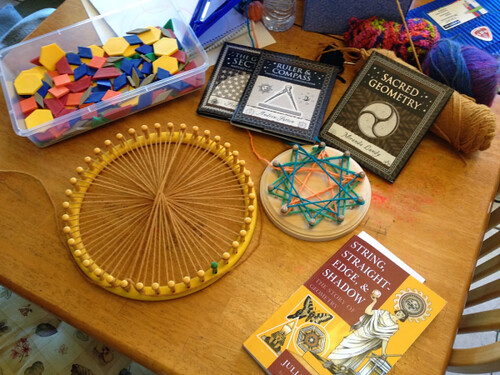
Lisa writes: “The most important reason why I do what I do is these looks of happiness from my son. He loves learning this way. He uses what he learns in his own studies of art, drawing spaceships and futuristic communities using these shapes and patterns. He can synthesize what he learns and make it meaningful to his own interests. My goal is for him to be a lifelong learner and I think that making math enjoyable, practical and engaging leads to that goal.”
Want to share a math story, a short observation, or just a cute phrase your child said? Send it our way!

Join the Natural Math crew
We are growing. Can you help? Join our adventures!
Part-time paid positions
- Book layout. Help produce beautiful books for standard printing requirements (e.g. Ingram) as well as .ePub and .moby electronic formats.
- Community-centered marketing and sales. Focusing on helping people, sustainable growth, and meaningful engagement.
- Leading math circles and courses. Help us meet the demand for family activities in Raleigh-Durham, NC area, and/or lead online courses for families and teachers.
Volunteer opportunities
Spend quality time with engaged people working on meaningful mathematics! You can volunteer as little as an hour per month. Our current volunteers include teens, parents, university researchers, software developers, retired professionals, social media activists, and creative writers. This is perfect for people who want more active but still casual engagement, or want to ramp up their skillset and resume.
Email maria@naturalmath.com to talk about work or volunteering.

See you online! Dr. Maria Droujkova, Yelena McManaman, and the Natural Math crew
Posted in Newsletter
Fundamental Ideas of Calculus – a survey
What is one central idea of calculus you would want everyone in the world to understand?
Add your ideas in comments.
Posted in Grow


