- Home
- “Yes, And…” Improving Math Play with Improv
- Althea’s Math Mysteries
- Avoid Hard Work, the Workshop
- Avoid Hard Work! …And Other Encouraging Problem-Solving Tips for the Young, the Very Young, and the Young at Heart
- Blocks and Modeling: A Do-It-Yourself Guide to Exploring Geometric Objects – Online Workshop
- Blog
- Books and Goods
- Bright, Brave, Open Minds
- Bright, Brave, Open Minds: A Problem Solving Kaleidoscope. Open online course for parents and teachers
- Camp Logic
- Cart
- Checkout
- Citizen Science Station
- Consulting and Tutoring
- Courses
- Download File
- Easy Complexity and Special Snowflakes Online Math Circle
- Empires: Year-long prealgebra program in a game
- Expedition Everest
- Five Fabulous Activities for Your Math Circle
- Funville Adventures: Math Personified!
- Funville Web Tour
- Hacking Math
- Hiding in Plain Sight: Vyshyvanka Secret Codes
- Home
- HOW do they do it? Creating your own math puzzles
- Inspired by Calculus: Online course for parents, teachers, and their children ages 5-12
- Kingdom On A Wall
- Kingdom on the Wall
- Ko’s Journey Is Discontinued
- Lapware
- Math Books
- Math Cafe
- Math Circles
- Math Circles 1001 Leaders Course
- Math Future event registration
- Math Future: come and talk!
- Math Goggles Challenges
- Math Renaissance
- Math Trek
- Mathematics & Poetry for All
- Meet the authors
- MidSchool Math Digital Math Tools
- Moebius Noodles
- mpsMOOC13: Problem Solving for the Young, the Very Young, and the Young at Heart
- Multiplication Explorers FAQ
- Multiplication Explorers LIVE workshop
- Multiplication Explorers Online Course
- Multiplication Explorers Registration
- Multiplication Explorers, the book
- Multiplication Models Poster
- My Account
- Natural Math Multiplication Course
- Online Logic Summer Camp for Kids!
- Online Summer Calculus for Kids Camp!
- Pay Natural Math
- Playing with Math: Stories from Math Circles, Homeschoolers, and Passionate Teachers
- Reviews of the Moebius Noodles book
- September 25: Math Storytelling Day
- Socks Are Like Pants, Cats Are Like Dogs
- Speaking and events
- Start Here!
- test001
- The Art of Factorization Diagrams
- The Iditarod
- The seven principles of Natural Math
- Transformers: Matrices & Graphs!
- Veronica’s Multiplication: a Natural Math circle online
- WOW! Multiplication – an open course in September 2013
- Ying and the Magic Turtle
- About Natural Math
- Contact Us
- Get Involved
Soroban abacus and finger math

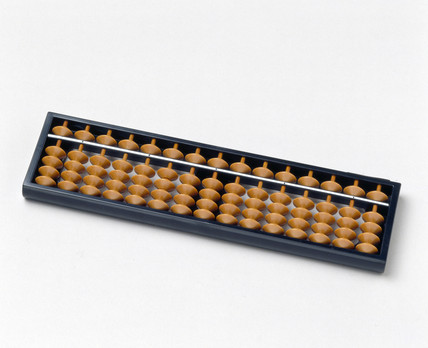
Have you ever wondered why the Oriental Soroban abacus has 4 separate beads? It is in base 10, not 4 or 5, so why organize it that way?
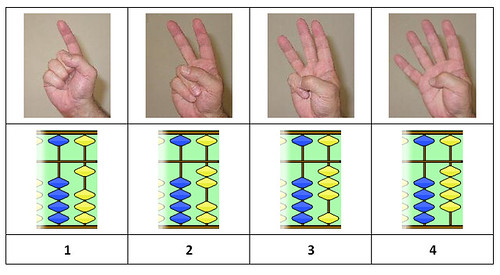
In response to yesterday’s post Hand tricks! Alexander Bogomolny linked his page explaining finger math. As I looked at that neat way of counting to 99 on your two hands, I finally understood Soroban! The four beads stand for the four fingers on your hand, and the separate bead for the thumb.
With Alexander’s photos of hands, and screenshots from an online Soroban abacus, I can show the idea. It works the best if you count along. First, use the four fingers of your right hand to count 1, 2, 3, 4. This corresponds to the four beads in the first row of Soroban, shown yellow.
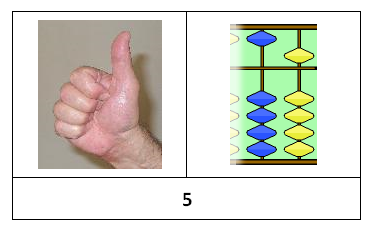
Then things become slightly more abstract. The thumb stands for 5, all by itself, just like the lonely yellow bead does. We move from direct counting to symbols:
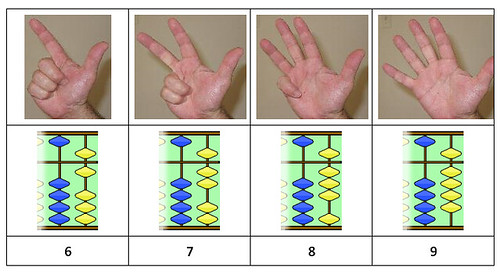
You add fingers to the thumb to count 6, 7, 8, 9. Imagine a young child playing traditional finger counting games with parents. Kids can instantly recognize (subitize) quantities from 1 to 4, but the Western finger counting goes all the way to 10 – well beyond the subitizing range. Unlike the Western finger counting, this system introduces groups and symbols (the thumb stands for 5), as well as addition, as soon as you leave the subitizing range. In other words, the system follows the way children’s minds work.
What happens when you arrive at 10? Something very rewarding and exciting! You get to use your other hand, which stands for the new place value – and the new row of beads on the abacus. The digits, the beads, and the fingers all fit together like hand in glove.
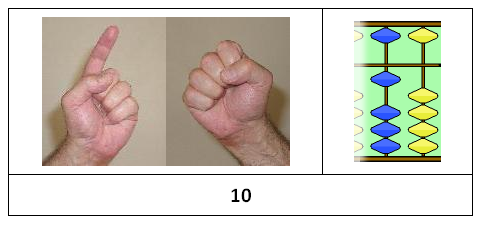
Here is another difference of this system from just counting your 10 fingers. You can count all the way to 99 on your two hands!

And if you join forces with a friend, you can show even bigger numbers.

Here is a video showing how to count all the way from 1 to 99:


Posted in Make
Hand Tricks!

Using one’s hands is practically intuitive in the math world. Counting on one’s fingers is the most basic mathematical practice one could think of. But there is other more complex math you and your kid can do with your hands!

For example, you are hardly limited to counting to 10. If you bring the binary system into the equation, your kid can count all the way to 1,023 using their hands. It’s pretty simple: 0 is your right fist, 1 is your right thumb, 2 is your right index finger, and 4 is your right middle finger. Do you see a pattern? Each finger number is the double of the one before it. So, if you want to count 6, you hold up your index and middle finger (2 and 4). A more thorough explanation is in comic form at Instructables.

In addition to counting on your hands, you can also use them as multiplication tables. Ms. K at Teacher Blog Spot explains how your kid can divide each finger into sections of 3 or 4 and multiply by the number of fingers, with a maximum of either 15 or 20.

A similar method of multiplying on your fingers is called finger reckoning. Finger reckoning has been used since at least the 15th century, when merchants would use it to calculate numbers out of the sight of competitors eyes. While Ms. K’s method is based primarily on counting, finger reckoning uses multiples of ten. It is more complex but you get the answer faster and more efficiently. You can read more about finger reckoning in our blog post about it.
 There’s no need to limit you or your kid to computing multiplication and addition, however. An easy and useful trick for remembering how many days are in each month is to count out the months on your knuckles and the spaces in between. Make sure to remember that each knuckle is 31 days and each space is 30 days, except February, which is 28 or 29.

Hand tricks aren’t limited to computation either. One of the most common practices in kid art is tracing hands for drawings, and that can be used to teach symmetry. While we didn’t come up with this particular example, the Moebius Noodles book has a symmetry game called Double Doodle Zoo which demonstrates how one shape (like the hands) can turn into another (the heart).

An easy three-dimensional example of a hand shape is getting a few people together and having them recreate a fibonacci spiral with their hands. This is a great example of shapes in math and how they can transcend two dimensions.
You can do even more geometry with your body than making a Fibonacci spiral with your hands. In this video, mathemetician James Tanton explains how to do the National Math Salute. Using knot theory, you create a simple knot with your hands and undo it. The hand salute also uses elements of topology: the study of insides and outsides, and the orientation of surfaces. It’s simple to watch, but it’s easy to do it wrong. See if you and your kid can figure it out!
Posted in Make
Who am I? A guessing game
“Math is not linear.”
People say that, but do you believe it?
Here is the history of one person’s interaction with Khan Academy. Answer this person’s riddle: WHO AM I?
Judging by this historical document, how old do you think the person is? What is the grade level? Anything else you care to guess?
Yes, all these are trick questions. I will post the answer in comments on August 10th. Leave your guess as a comment and subscribe, to see the surprising answer.
Update: the mystery person revealed (see comments).


Posted in Grow
Infinity Is Farther Than You Think


What’s bigger, a fillion or a cometallion? These are the two big numbers my son and his friend made up one day. They couldn’t give me any more details other than “these are huge numbers” and “but smaller than a googol”. To them, all numbers went to googol, after which was the infinity. My idea of how big numbers could get was actually pretty much the same. And then we read the Really Big Numbers book by Richard Evan Schwartz.
Although reading is probably not the best word to describe it. The author himself likens the book to “the game of bucking bronco”. You follow the text for a while until it gets to be too much. But it’s perfectly okay because, as the introduction explains, “This book isn’t something that you have to read all at once… Just read as far as it makes sense and then save the parts you don’t understand for later.”
And just like any good bucking bronco ride, the book starts off slowly, counting by 1, then by 10, then by 100… It’s a gentle ride and you begin to wonder how is this book any different from other children’s books about big numbers.
So we get to count by millions, then – billions. Exponents enter the scene. Well, for adult readers this is a familiar and fairly comfortable territory. And we are heading safely to googol! Which is unimaginably huge, bigger than the number of atoms in the observable universe, but it is still comfortable and familiar.
And that’s where you get kicked off your high horse of “I know all about really big numbers” (well, I did anyway). Because next comes googol-plex. And it is an even more enormously big number than googol. You are barely hanging on now. And then, just as you think it won’t get any crazier, come Fred and Big Jim. And “Fred” is a number so huge that it dwarfs googol-plex. And “Big Jim” is way way way bigger than “Fred”. And more and more incomprehensibly, stupendously, mind-bogglingly huge numbers follow. The numbers get to be so ridiculously ginormous that the exponential notation fails. A different way of writing numbers is introduced. The bronco bucks and we are, once again, off of it (well, I am anyway).
The comforting familiarity of millions, billions and other big numbers disappears when you get to REALLY BIG numbers. Instead, you face something that is hard, seemingly impossible to comprehend. These numbers just don’t make sense! And then you realize that this is what young kids feel like when first learning counting past ten, facing the abstractions outside the range of their experiences. And you realize that you’ve already felt this way before, long time ago, when you were a child just learning to count. And you get a chance to empathize with your kids.
Here’s something else Really Big Numbers helps with as it takes adults out of the realm of familiar. It gives a chance to become an explorer. Most of the time when we talk about math and read math books to our kids, the math in them is well-known to us. So we assume a kind of tour guide attitude and expect the kids to be these well-mannered and appreciative tourists. Richard Schwartz, by contrast, invites us to an unfamiliar, counter-intuitive, “there be dragons” math where both tour guides and tourists become explorers and adventurers.
Really Big Numbers is a small book that can take a long time to read or even look through. It is a chance to learn something new about the really big numbers. But it is also a chance to experience the awe, the mystery and the playfulness of math with your child and as a child.
Posted in Grow


