- Home
- “Yes, And…” Improving Math Play with Improv
- Althea’s Math Mysteries
- Avoid Hard Work, the Workshop
- Avoid Hard Work! …And Other Encouraging Problem-Solving Tips for the Young, the Very Young, and the Young at Heart
- Blocks and Modeling: A Do-It-Yourself Guide to Exploring Geometric Objects – Online Workshop
- Blog
- Books and Goods
- Bright, Brave, Open Minds
- Bright, Brave, Open Minds: A Problem Solving Kaleidoscope. Open online course for parents and teachers
- Camp Logic
- Cart
- Checkout
- Citizen Science Station
- Consulting and Tutoring
- Courses
- Download File
- Easy Complexity and Special Snowflakes Online Math Circle
- Empires: Year-long prealgebra program in a game
- Expedition Everest
- Five Fabulous Activities for Your Math Circle
- Funville Adventures: Math Personified!
- Funville Web Tour
- Hacking Math
- Hiding in Plain Sight: Vyshyvanka Secret Codes
- Home
- HOW do they do it? Creating your own math puzzles
- Inspired by Calculus: Online course for parents, teachers, and their children ages 5-12
- Kingdom On A Wall
- Kingdom on the Wall
- Ko’s Journey Is Discontinued
- Lapware
- Math Books
- Math Cafe
- Math Circles
- Math Circles 1001 Leaders Course
- Math Future event registration
- Math Future: come and talk!
- Math Goggles Challenges
- Math Renaissance
- Math Trek
- Mathematics & Poetry for All
- Meet the authors
- MidSchool Math Digital Math Tools
- Moebius Noodles
- mpsMOOC13: Problem Solving for the Young, the Very Young, and the Young at Heart
- Multiplication Explorers FAQ
- Multiplication Explorers LIVE workshop
- Multiplication Explorers Online Course
- Multiplication Explorers Registration
- Multiplication Explorers, the book
- Multiplication Models Poster
- My Account
- Natural Math Multiplication Course
- Online Logic Summer Camp for Kids!
- Online Summer Calculus for Kids Camp!
- Pay Natural Math
- Playing with Math: Stories from Math Circles, Homeschoolers, and Passionate Teachers
- Reviews of the Moebius Noodles book
- September 25: Math Storytelling Day
- Socks Are Like Pants, Cats Are Like Dogs
- Speaking and events
- Start Here!
- test001
- The Art of Factorization Diagrams
- The Iditarod
- The seven principles of Natural Math
- Transformers: Matrices & Graphs!
- Veronica’s Multiplication: a Natural Math circle online
- WOW! Multiplication – an open course in September 2013
- Ying and the Magic Turtle
- About Natural Math
- Contact Us
- Get Involved
Inspired by Calculus Math Circle – Week 3


Would 7-year olds really use calculus? Wouldn’t they forget it all by the time they encounter calculus in school, if ever? We frequently revisit these questions as we continue to plan and lead Inspired by Calculus local math circles for 7-11 year olds. The issues of knowledge retention, use, and transference came up again during the Week 3 meeting.
Do try these activities at home by yourself (good), with your child (better), or invite some friends over (the best). If you do, please share your experience with us. As always, we welcome your questions and comments.
Week 1 activities | Week 2 activities
Week 3 – Pyramids and Integration
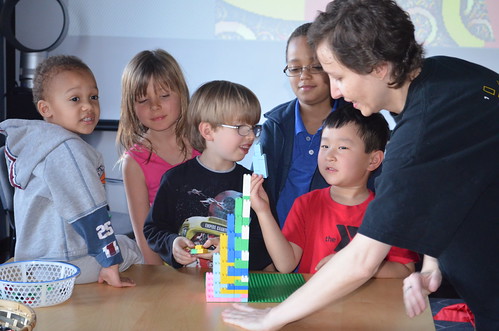
We spent our third meeting delving deeper into integration – making objects and shapes out of infinitely many slices or lines. We also built beautiful LEGO towers and, while working on them, talked about slopes. For homework we asked kids and adults to look for examples of pyramids and stepped structures, perhaps even to create a model or two.

But first, we asked the kids to make paper squares and gave them standard 8 ½ by 11 sheets, markers and scissors to complete the task. Making a square out of a rectangular piece of paper seems simple – fold and cut. The trick, of course, is to fold on a diagonal. Interestingly, while the kids were folding and cutting, they were folding paper horizontally or vertically, sometimes folding a couple of times before trying to cut a square. Each time they ended up with quadrilaterals that were somewhat squarish. And each time we asked them to refine their models and make them more precise.
All the kids had previous experience folding diagonally to make a square out of a rectangle. They did it at the previous math circle, after all. Did the knowledge not stick? Why? Perhaps a couple of factors played a role:
- Up until now the kids have not had the need for precision. In this activity, precision was not an internalized need, but an imposed request. The super-compelling “why do it” was simply not there.
- At the same time, a diagonal fold is a pretty challenging one for young kids and, when done without any assistance from adults, the fold itself is not nearly as precise as the easier horizontal and vertical folds.
At the same time, one of the children suggested starting with a circle and “cutting away at the edges” to make a square. This led to some unsuccessful attempts and a lovely discussion about commutativity: making squares out of circles and circles out of squares.
Next came Photospiralysis, a free software that you can download or use online to apply the Droste effect to your photos. You can read about the Droste effect here or just play a while with Photospiralysis. Here’s an example of a nested fractal made with the software:

You might be wondering what do Droste effect has to do with pyramids and why spend time with Photospiralysis. The answer is “collapsible cups” – like this one:

Imagine taking a flat Photospiralysized image and pushing it up and out, extending it into the 3D space. Or imagine taking a pyramid and squishing it flat. Or look at a LEGO pyramid directly from above. What would you get?
We will do more of this work next time, hoping the connection between the Droste effect and stairs and pyramids clicks for the kids.

Next up, the kids looked at the two pyramids built out of interlocking blocks. One of the kids pointed out that only one of these objects was a pyramid. The other one was “just stairs” since it wasn’t filled in with blocks. After a little “mathematician vs. engineer” discussion (engineers build, mathematicians imagine), we asked the kids if they would build their own LEGO pyramids. An easy task, for sure! Except, there was a catch – their pyramids’ slopes had to be different from the slopes of the original two pyramids.

The kids did awesome! They had a pyramid with a variable slope, with a slope twice as steep as the original pyramid, three times as steep, half as steep, with a zero slope, with a vertical slope, and with a negative slope. More negative slopes were made by turning pyramids upside-down. Way to go!
The last task was building multiplication towers. And they had to follow certain “crazy” rules that, as we promised, “would make sense in the end”. The towers came out beautifully and the kids spent some time exploring them, pretending to be climbing different routes to the summit, exploring slopes and rates of change along the way.
Collecting Math – More Than Happy Familiarity

Remember how the kids forgot how to fold paper to make a square? It wasn’t just the lack of folding skills: they could’ve asked adults for help. Their learning experiences from last week and from other times they folded paper or observed folding did not transfer to this new situation.
If this happened to a relatively simple geometry concept, won’t the same happen to more abstract and complex calculus ideas? If so, why not wait until high school or college to introduce calculus?
Let’s think beyond learning this or that skill. How can we help kids develop logical thinking and problem-solving in new situations? One of the best tools for developing these skills is using analogies and metaphors. We use metaphors a lot in our activities. We also encourage children to define a mathematical object or process by comparing it to something else. For example, when asked about shapes, kids in our groups usually reply with iconic objects (a CD, a plate, a pizza) rather than math words (a circle, a disk).
What is going on and why? First, the kids use analogies and metaphors. Second, they engage in mini-scavenger hunts for collections of everyday examples. Once children collect enough examples, their minds start organizing examples into categories. Categories are more universal, thus more transferable to new situations than individual examples. Once the categories are in place, we encourage kids to use math words and more precise methods. Then particular skills and overall ideas stick better!
Building an extensive collection of usable mathematical imagery takes time. That’s why we encourage to start early. It gives kids happy familiarity with the math they find, make, and explore. Children build a multitude of connections, and notice patterns that are transferable to other contexts.


Posted in Grow
Heart Collage

If you’re looking to teach kids about symmetry, a new app called Heart Collage is a great start!

Where there is love there is life’s Facebook Page
Available on Google Play and the iTunes Store, Heart Collage guides you through a series of photographs to create a composite image, using a system called integration. Integration is the mathematical concept that big objects are made of small objects. The idea itself is easy and versatile. Integration is one of the fundamentals of calculus.

The app can be used to create many shapes, as well as hearts. Heart Collage can create perfectly symmetrical images like the one above. The same mathematical skills and logical thinking are present throughout the creation process, no matter what shape the user creates. The possibilities are endless!

I did a mini-interview with Heart Collage creator Chiu-Ki Chan about the app and its relationship with math.
Do you like math? Are there any ways it influenced you to create Heart Collage?
Will you be disappointed if I tell you I did not think about math at all when I created Heart Collage? That’s the beauty of it though – math is everywhere, even when I am not thinking about it.
What kinds of mathematics did you have to take into account when creating the structure of the collages, to make sure the collection of images form a specific shape?
Symmetry plays a large part in structure of the collages. The heart shape is symmetric vertically, but the diamond shape is symmetric both horizontally and vertically. Things get really interesting in the alphabet series. Take a look at letter J:

The letter itself is not symmetric, but I want to create it with as few photos as possible, so I had to find symmetry within the letter. As you can see, I have mirroring for the top horizontal bar and the curve in the bottom, even though I am not mirroring the whole letter.

If you play Heart Collage with your kids, talk about symmetry and integration – and share what kids notice and what they say with us!
Posted in Make
Multiplication course and bananapples: Newsletter March 31

Subscribe to Moebius Noodles newsletters
Pinterest | Twitter | Facebook | Google+
I am Moby Snoodles, and this is my newsletter. Send me your questions, comments, and stories of math adventures at moby@moebiusnoodles.com

Math Spark: Bananapple!

When you start with a whole object and take it apart, your action can be a metaphor for differentiation. Find many different ways to slice the fruits and veggies you find: a perfect snack time activity! Then reassemble new crazy fruits out of slices. This can be a metaphor for integration.
For more detail, read the story from our local Math Circle.
Have a math spark from your family or group? Email us so we can share your adventures on the blog!
April-May open online course MULTIPLICATION: join 390+ participants!
I can’t wait to start the course. Hundreds of adventurous parents, math circle leaders, and teachers will invite their kids to share adventures inspired by algebra and calculus, art and storytelling, pretend-play and computer modeling.
Click to learn more and join the course.
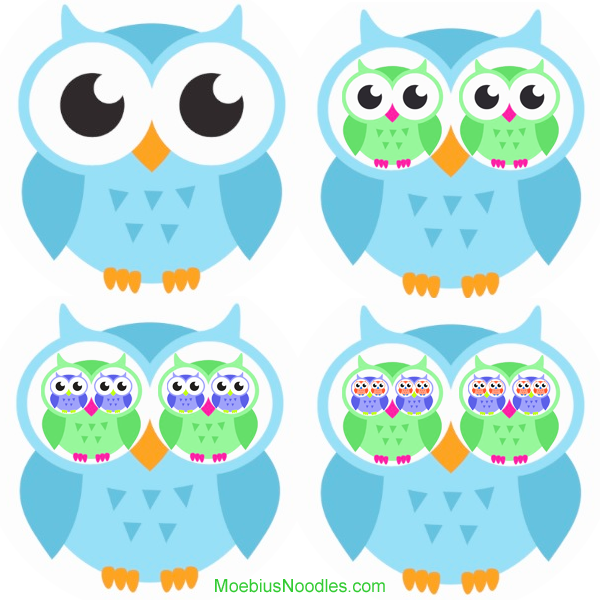
Here is a picture from one of Week 2 activities about fractals, powers, and place values:
Why do people take the course? I read all the registration notes. I feel deeply touched every time I see the most frequent, simplest note: “For my child.” Here are some representative quotes:
- Glynn, USA: To continue to help me develop a math mind, so I can continue to help my kids do the same.
- Meg, Australia: We are homeschoolers. My 8 year old is very disengaged after spending two years in school. I am hoping to try something different to get him interested in exploring his world and I am hoping to learn more about following his lead.
- Serena, Australia: Homeschool with a nearly 5 yr and a 2 yr and a 9 month old. We love the Moebius Noodles book!
- Nike, England: As a volunteer teacher in an after school centre.Jessica, Canada: I am a K-3 Teacher and I am hoping to use this program to inspire my teaching.
- Lisa, USA: Homeschooling 12 year old with autism who has issues remembering his multiplication tables.
- Ellen, Belgium: With my grandchildren.
- Farrell, Canada: To help interest and educate my grandchildren in the joys of mathematics.
- Karen, USA: Fun with my grandkids.
- Jana, USA: I’m a classroom teacher in Adult Education/GED prep. I am particularly looking for materials to incorporate art in algebra! I have the PDF version of Moebius Noodles.
- Nancy, USA: I’m looking forward to using the math activities with advanced students in PreK-grade 2.
- Lezah, USA: I intend to see if I can implement any of the activities with my precocious 4 year old.
- Roberta, Canada: I have a 3 year old daughter and am looking for ways to teach her in a more natural and playful way than I was taught when I was a kid. She’s already learning so much through play!
- Gaelen, USA: Use it to get ideas for engineering things I do with little kids. Yadira, USA: I teach science and engineering classes to kids and thought this might be helpful.
- Kacey, USA: As a play therapist.
- Surabhi, Canada: I have a 3.5 year old boy I plan to unschool. I am looking for ways for him to explore his beautiful world and existence of math everywhere.
- B, USA: Just curious.
- Gilberto, Portugal: Private tutoring.
- Maureen, USA: I want to learn about math with my four-year-old son. He’s doing some multiplication at his Montessori preschool. I’d like to support at home but feel intimidated.
- Schuyler, Canada: I plan to use this to help me teach multiplication to my mixed-grade primary class.
- Katherine, USA: I have a math crazy 10 yo who loves math but still struggles memorizing her multiplication tables due to dyslexia. Thought I’d just try this out to see if it interests her and helps.
- Shannon, Canada: I plan to show it to my staff and fellow math teachers in our district during our monthly Math Inquiry project.
- Deb, USA: With my 10th grade who struggles with math (dyscalculia).
- Lian, Hong Kong: Supplement for my 3 y/o.
- Sara, USA: Help me get over my math anxiety so I can help my school-age kids.
- Manish, India: To teach math fun way to my children.
- Kate, USA: Planning to use this with my family and a math circle for 9-10 year olds.
News and reviews

Laura Grace Weldon did a detailed interview about Natural Math for GeekMom. One of my favorite questions: “On NaturalMath.com, you write about a community of people sharing naturally math-rich and meaningful activities for children from babyhood on. We’d love to hear about math circles and what you mean by math communities.”

The Italian journal D: la Repubblica published an interview about our work by Di Stefania Mendetti. Quote: “Alcune fra le opzioni più famose, ricorda Droujkova, sono Made in Italy, come il metodo montessoriano, sviluppato per individuare e correggere autonomamente gli errori e quello della Scuola di Reggio, che avvicina i bambini alla matematica attraverso progetti aperti.” English translation: “Some of the most popular alternative education systems, recalls Droujkova, come from Italy, such as the Montessori method, including self-correcting independent tasks, and that of the School of Reggio, which brings children to mathematics through open projects.”

A Turkish math and science site posted a translation of The Atlantic interview, by Merve Özçelik, with great illustrations such as origami snowflakes:

Sharing
You are welcome to share the contents of this newsletter online or in print.

Talk to you soon! Moby Snoodles, aka Dr. Maria Droujkova
Posted in Newsletter
Inspired by Calculus Math Circle – Week 2

Can you really teach calculus concepts to young children? Don’t they need to know algebra first, or at least arithmetic? We receive these questions a lot, and we do have our share of worries as we plan and lead “Inspired by Calculus” local math circles for 7-11 year olds. But let’s be brave together! Do try these activities at home by yourself (good), with your child (better), or invite some friends over (the best). If you do, please share your experience with us. As always, we welcome your questions and comments.
The first post in the series is here.
Second Meeting – Bodies of Revolution, Part 2
Our second meeting had to be rescheduled because of the weather. So kids had some extra time to play with the concept of integration (making big things out of many little things) using String Spin. Their new scavenger hunt task was to search for edible bodies and surfaces of revolution.
We started by revisiting integration. But we also worked on the concept of differentiation. Which brings up the question: “How can we show something this complex to young children?”
We find activities that serve as metaphors for the concepts, for example, differentiation as slicing an object into many parts.
First, kids tried to make some circles: “Remember that circles are made of triangles?” Children remembered this folding and cutting method from the last meeting, but it was still hard (most ended up with squares!) – so they were motivated to look for an alternative.

So out came salt dough. For the first few minutes the children just sat in a circle on the floor, divvying up the dough, smelling it, rolling and crumbling it, pounding it and mixing colors, and talking about it. This play time helps children to become familiar with properties of a new manipulative, before using them for mathematics.
Logistics won’t allow making salt dough with the kids during the math circle. But do try it at home! Making manipulatives together with your child is a powerful way to explore mathematics. For another good example, read this post about math of henna art by Rodi over at the Talking Stick Learning Center.
After a few minutes of free play, most kids ended up with some salt dough circles, made by squishing spheres or sculpting by hand. It was time to show them a more precise way of making a circle out of paper triangles (integrating).

At this point, children had done a lot of free play, both with physical objects (paper, salt dough, bodies of revolution they found/noticed around them) and software (String Spin). We noticed that their guesses (i.e. what curve would produce what surface in String Spin) were getting more precise – a good indicator that the kids were starting to discover patterns.
So the kids made their circles out of triangles until the salt dough got way too soft to handle. Then we returned to the unanswered question from our first meeting.

“What if we had a thick book with very many pages and we opened it so that the covers would touch. What shape would it make?”
This time, we actually had a cylinder made out of an old paperback book. And the question was more concrete: “What shape should we draw in String Spin so that when it rotates, we get this cylinder?” Interestingly, while all the kids recognized the object as a book, many came up with answers that looked nothing like a rectangle. Here are a few of their suggestions.

What was happening? It took us a few days to come up with the hypotheses that kids were trying to integrate 2-dimensional solids (book pages) out of 1-dimensional lines. We will test the idea next time. We modeled all children’s ideas using the software, but the solutions looked more like explosions or slices than book art. We’ll seek more precise software next time to do what we think kids want with integration. This was a very cool experience for the adults as it reinforced the following idea.
When choosing a math activity, it is not enough for the activity to be a metaphor for whatever advanced concept you want to teach to a child. It should also provide a way to help children communicate and share their math discoveries. And the best way to do so for young kids is not through words or formal mathematical notations, but by making things.
It was time to move to the metaphor for differentiation (in the grown-up eyes) – slicing (in children’s eyes). We asked participants to bring fruits and vegetables that were bodies of revolution.
Off we were to find yet another solution to our “how to make a circle” problem. All the kids figured out how to slice their fruits to get circles. So we asked them what would happen if we stacked the circles on top of each other? Would we get a cylinder, as some suggested? What if we stacked circles of different diameters? And what shape would we end up with if we kept stacking smaller and smaller circles?

And here came an interesting twist. Most kids insisted, even after modelling in String Spin, that stacking smaller circles would get us a pyramid. We are pretty sure that all the kids in the Circle are familiar with the words “pyramid” and “cone”. But we are also pretty sure that for now they do not distinguish between the two. One reason is that there has been, up to now, very little practical need for them to distinguish the two. The other reason is that a pyramid and a cone share a lot of essential mathematical qualities!
Which brings us to the question:
Shouldn’t kids know the difference between a pyramid and a cone, before working on calculus concepts?
From the calculus point of view, the difference between the two is insignificant. The process of differentiating and integrating and the volume formulas are the same for pyramids and cones. Overall, the sequence of mathematical education, what comes first and what comes after, is largely a matter of the established tradition. And the importance of knowing particular math facts or having certain math skills is relative to the area of the mathematics you want to learn.
Posted in Grow


