- Home
- “Yes, And…” Improving Math Play with Improv
- Althea’s Math Mysteries
- Avoid Hard Work, the Workshop
- Avoid Hard Work! …And Other Encouraging Problem-Solving Tips for the Young, the Very Young, and the Young at Heart
- Blocks and Modeling: A Do-It-Yourself Guide to Exploring Geometric Objects – Online Workshop
- Blog
- Books and Goods
- Bright, Brave, Open Minds
- Bright, Brave, Open Minds: A Problem Solving Kaleidoscope. Open online course for parents and teachers
- Camp Logic
- Cart
- Checkout
- Citizen Science Station
- Consulting and Tutoring
- Courses
- Download File
- Easy Complexity and Special Snowflakes Online Math Circle
- Empires: Year-long prealgebra program in a game
- Expedition Everest
- Five Fabulous Activities for Your Math Circle
- Funville Adventures: Math Personified!
- Funville Web Tour
- Hacking Math
- Hiding in Plain Sight: Vyshyvanka Secret Codes
- Home
- HOW do they do it? Creating your own math puzzles
- Inspired by Calculus: Online course for parents, teachers, and their children ages 5-12
- Kingdom On A Wall
- Kingdom on the Wall
- Ko’s Journey Is Discontinued
- Lapware
- Math Books
- Math Cafe
- Math Circles
- Math Circles 1001 Leaders Course
- Math Future event registration
- Math Future: come and talk!
- Math Goggles Challenges
- Math Renaissance
- Math Trek
- Mathematics & Poetry for All
- Meet the authors
- MidSchool Math Digital Math Tools
- Moebius Noodles
- mpsMOOC13: Problem Solving for the Young, the Very Young, and the Young at Heart
- Multiplication Explorers FAQ
- Multiplication Explorers LIVE workshop
- Multiplication Explorers Online Course
- Multiplication Explorers Registration
- Multiplication Explorers, the book
- Multiplication Models Poster
- My Account
- Natural Math Multiplication Course
- Online Logic Summer Camp for Kids!
- Online Summer Calculus for Kids Camp!
- Pay Natural Math
- Playing with Math: Stories from Math Circles, Homeschoolers, and Passionate Teachers
- Reviews of the Moebius Noodles book
- September 25: Math Storytelling Day
- Socks Are Like Pants, Cats Are Like Dogs
- Speaking and events
- Start Here!
- test001
- The Art of Factorization Diagrams
- The Iditarod
- The seven principles of Natural Math
- Transformers: Matrices & Graphs!
- Veronica’s Multiplication: a Natural Math circle online
- WOW! Multiplication – an open course in September 2013
- Ying and the Magic Turtle
- About Natural Math
- Contact Us
- Get Involved
Math mind hacks: Make mistakes on purpose


Turn making mistakes into a game. Make as many mistakes as you can in one problem. Can you make huge mistakes? Tiny, subtle mistakes? Clever mistakes and silly mistakes?
This game helps to prevent, or cure, math anxiety.
Here is Neil Gaiman’s speech on the subject.
Thank you for the poster idea, Julia Brodsky of the Art of Inquiry!


Posted in Grow
Multiplication course, bodies of revolution, global news: Newsletter March 17, 2014
Subscribe to Moebius Noodles newsletters
Pinterest | Twitter | Facebook | Google+
I am Moby Snoodles, and this is my newsletter. Send me your requests, questions and comments at moby@moebiusnoodles.com

Math Spark: Bodies of Revolution
Math Sparks are quick activities for grown-ups. If this one sparks your curiosity, share it with kids too!
Calculus studies how big things are made of little things. You can make some surfaces out of infinitely many copies of the same line, rotated in space. The best way to define solids and surfaces of revolution is by describing how to make them. If you’ve worked with a wood lathe, a pottery wheel, or an ice cream scoop, you are already familiar with the idea.
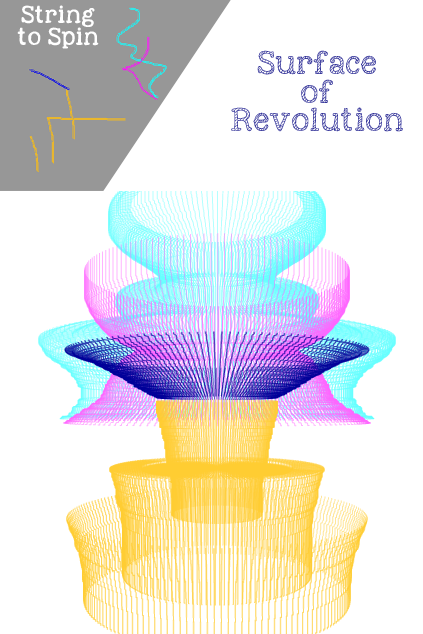
Here’s how mathematicians might give a constructive definition of a solid of revolution:
1. Draw a straight line.
2. Start at one end of the line and draw a squiggle that ends at the other. Now you have a shape.
3. Rotate this shape around the straight line
For a surface of revolution, you don’t even need to connect your squiggle to the line of rotation. Try creating your own surface of revolution with String Spin: http://www.zefrank.com/string_spinv2/
Any squiggle, even a random toddler’s doodle, becomes interesting once you spin it.
Moebius Noodles in the global news
My interview by Luba Vangelova for The Atlantic, 5-Year-Olds Can Learn Calculus, has generated discussions on blogs, forums, and news sites. I feel very thankful for the thoughtfu comments and deep questions. The themes that emerge from discussions make me cautiously optimistic. Many grown-ups believe that young math will finally give them a second chance at making sense of algebra and calculus. Others look for the balance between conceptual understanding and fluency at manipulating numbers. Even if 5-year-olds understand calculus, what would they use it for? Can we even call activities algebra or calculus if there are no formulas? Are young kids capable of abstraction?
At the same time quite a few people have come out saying that they are already playing advanced math games with toddlers or young kids – or that their parents did so with them! Our Natural Math community will be following up on these themes with an open event series, interviewing parents, teachers, researchers, and project leaders who work in related areas.





Want to join the discussion? Send me a story about math adventures of your kids, your students, or someone you know. It can be a cute thing your three-year-old said, or a game your mom made up for you when you were little, or an activity you adapted for your math circle. I am making a collection of happy young math stories!
Natural Math Multiplication: an online course in April

We invite parents, teachers, playgroup hosts, and math circle leaders to join us in April for an open online course about multiplication. Each week there will be five activities to help your kids learn multiplication by exploring patterns and structure. To get your course completion badge, do at least two activities every week. The course starts April 6 and runs for four weeks.
Each activity will have adaptations for toddlers (2-4), young kids (4-6), and older kids (7-12). If you want to remix activities for babies or teens, we will help!
Click to join the course.
Here is the preliminary syllabus.
Week 1: Introduction. What is multiplication? Hidden dangers and precursors of math difficulties. From open play to patterns: make your own math. 60 ways to stay creative in math. Our mathematical worries and dreams.
Week 2: Inspired by calculus. Tree fractals. Substitution fractals. Multiplication towers. Doubling and halving games. Zoom and powers of the Universe.
Week 3: Inspired by algebra. Factorization diagrams. Mirror books and snowflakes. Combination and chimeras. Spirolaterals and Waldorf stars: drafting by the numbers. MathLexicon.
Week 4: Times tables. Coloring the monster table. Scavenger hunt: multiplication models and intrinsic facts. Cuisenaire, Montessori, and other arrays. The hidden and exotic patterns. Healthy memorizing.
Sharing
You are welcome to share the contents of this newsletter online or in print.

Talk to you soon! Moby Snoodles, aka Dr. Maria Droujkova
Posted in Newsletter
Ethnobraiding with Bread

Braiding is one of the simplest forms of mathematical art. While it is a subject that can become complex, the basics are easy to learn. Braiding can be seen around the world in different cultures, and learning from these cultures can turn braiding into an ethnomathematic adventure. When you add bread into the equation, the educational activity also becomes delicious!

Wolfram Math World talks about how braids can be expressed through a series of equations. Every equation can be coded with a braid word that explains how the braid is weaved.
 Translate braids into braid words from left to right and then from top to bottom. This braid word is
  . When you first start with bread, you won’t need to braid anything this complicated. Braid words are like a magical incantation: once you know the different individual symbols, you can cast more and more complex spells, or weave more complicated braids.
In this video, artisanal baker Tina Luu shows how to braid live dough. She cautions to shape the bread but not to make it tight – it will grow in the oven.

A kind of braided bread called Challah is omnipresent in Jewish tradition. It is eaten on the Sabbath and on holidays. This recipe on My Jewish Learning is one of hundreds online. This is a demonstration of a simple braid word: the recipe says to “Pinch 1 end of all the strands together and plait them: bring the rope on the right over the middle one, then bring the one on the left over it and continue to the end.” If  means to bring the right rope over the middle and
  means to bring the left rope over the middle, than with these instructions, the braid word would be a repeating pattern of
  .
.

If your kids are partial to apple pie, they might enjoy this apple-stuffed bread recipe by La Fuji Mama, Rachael. Filled with cinnamon and apples, this recipe is constructed differently from challah — because there are apples inside, the baker must braid the dough over them. This is the simplest possible braid word, a repeating pattern of for each pair of strips. She illustrates this concept at Eat, Live, Run.

How about a traditional apple pie? You may want to follow the directions on Inspired by Charm and your own open-faced pie recipe to teach kids the beauty of braiding. The border is braided using the word and is then is laid around the rim of the pie.
Adding a lattice to the top of the pie can make bridges to symmetry and weaving, in addition to learning about braids.

Barbara Schieving constructs her braided bread a bit differently. Her Russian Braided Bread is braided using the word and then curled into a wreath. If you or your kids are not fans of pesto, or if you want a dessert version, My Diverse Kitchen alters Barbara’s recipe to be made with cinnamon.

Christine Ho has a recipe for Tangzhong Walnut and Raisin Bread, another variation of the word. Tangzhong is a flour paste used in many Chinese recipes to make light, fluffy breads.

Koeksisters, a kind of pastry made in South Africa, are made by braiding dough using the word, then deep-frying it and dipping it in ginger or cinnamon syrup. At My Diverse Kitchen, they give the recipe for Afrikaner koeksisters, which are crispy and braided.

Braided breads can even be eaten as a full meal, with Kenyan chef Fauzia M. Afif’s recipe for Chicken Bread. Much like the apple bread recipe, this bread is not constructed by braiding lengths of dough — instead it is braided using crossing strips and the braid word. Even though they are braided the same way, the chicken and apple breads look very different due to their ingredients and the tightness of the braid.

The Corner Café has recipes for Japanese Coconut Buns. Though the Japanese buns have filling, they are cut into strips and then braided using the more involved  word. While previous recipes cover the filling, this one incorporates it into the braid.
Any one of these recipes can help teach your child about braiding patterns and how braids are constructed mathematically — once you are used to the simple braid words, you can make up your own and see how they turn out. Have fun and eat well!

Posted in Make
Inspired by Calculus – Objects of Revolution: Mondays Math Circle Week 1

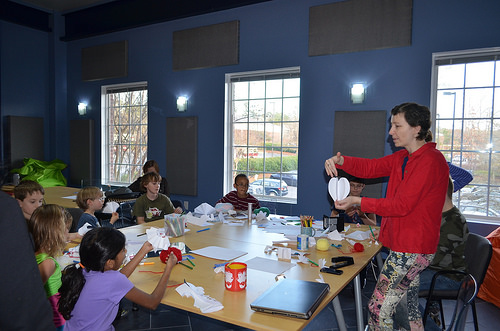
What does calculus for young kids look like? And what can kids do with calculus? These are the questions we get a lot. So over the next 5 weeks we will be publishing a series of “Inspired by Calculus” posts. These are notes from a local math circle for 7-11 year olds, led by Maria Droujkova. Do try these activities at home by yourself (good), with your child (better) or invite some friends over (the best). If you do, please share your experience with us. As always, we welcome your questions and comments.
First Meeting – Objects of Revolution
Calculus studies ways big things are made of little things. For example, some surfaces can be made out of infinitely many copies of the same line, rotated in space. A solid object can be assembled out of infinitely many infinitely thin slices.
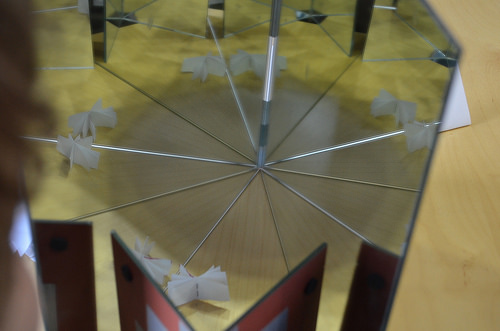
The idea of infinity (of large things or tiny things) is fascinating to many children. In this respect, two small mirrors taped together, the set up known as a “mirror book”, are a gift that keeps on giving. Place a toy, or your fingers, or your nose inside the mirror book, and start closing the pages. What happens? Can you get to infinity this way? Hint 1: imagine the gap between pages getting smaller and smaller – infinitely small! Hint 2: use more than one mirror book.
One of the ways to notice infinity is to look at solids and surfaces of revolution. And the best way to understand what they are is by making them. But how? If you worked with a wood lathe, a pottery wheel, or an ice cream scoop, you are already familiar with the idea. But if not, we suggest playing with String Spin.
Maria demonstrated it to the children first. She then showed a triangular prism and asked if it could modeled in String Spin.

Maria chose to start with a tricky object because children respond to trick questions in a more active and engaged way. This design choice, just like starting with a more straightforward example, has its own pros and cons.
The trick question achieved its goal: a lively discussion followed with children coming up with ideas about how to draw the lines so that when they spin, they would make a prism. Someone suggested to draw three lines like three sides of a rectangle. Maria modeled; nope, no prism, but a nice cylinder. Someone else suggested to draw just one line. Sure, let’s try this. Nope, no prism. Someone suggested using two lines like the two sides of a triangle. But this too did not make a prism. After a few more attempts, most kids decided that they could not make a prism by rotating a line around an axis, and the rest decided to experiment more at home.
Once in a while, pose problems that have no solutions, or ask for counter-examples. In a friendly and playful group, these tasks reduce math anxiety (after all, we are looking for “wrong” answers on purpose) and increase analytic thinking.
Then it was time for some paper modeling. One way to define a body of revolution is by starting with a slice, and “integrating” that slice around the middle line – “the stem of the apple” as Oviya explained. The process is simple for kids to follow yet does not limit their creativity and free play. At the end of the circle there was a lovely collection of paper models of all shapes and sizes.
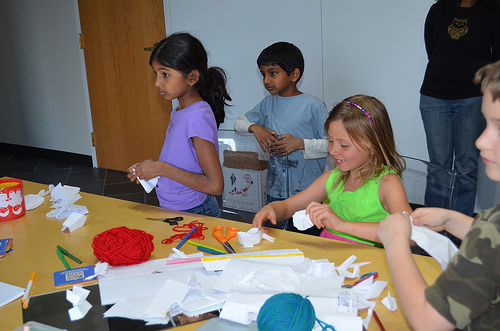
At first the kids would draw lines with an idea “to see what happens”. After 2-4 models done in this free play mode, they started digging deeper. Some tried to start with a specific shape, for example the Olympic rings, to see what happens to it as it’s turned into an object of revolution. Others tried to figure out what shape to cut out for the end result to look a certain way, say, like a pear.
After a while of playing with these “bookform” models, Maria asked this question: “What if we had a thick book with very many pages and we opened it like we did the models. What shape would it make?”
Surprisingly (or not), the first few suggestions were, “It would make a prism!” After a bit more thinking and experimenting, some kids decided it would make a cylinder and the rest of the kids agreed. What happened here? Didn’t they just spend half an hour trying it out?
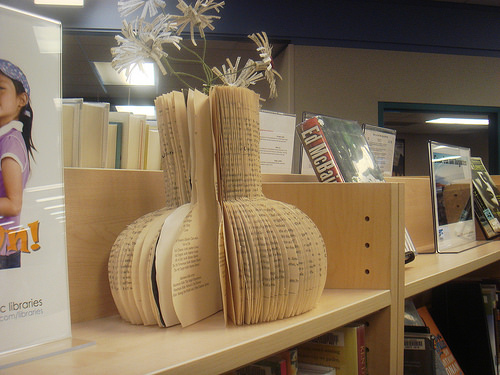
Infinity is an abstraction. Young kids can explore abstract ideas through grounding metaphors: stories or objects that form a bridge from a concrete physical experience to abstractions. That’s why children are so successful at discovering and recognizing infinity in the mirror books or in the String Spin, yet have a difficulty when asked about a book with infinitely many pages.
From calculus point of view, some models make it easier to “integrate” (make big things out of small pieces) and other models make it easier to “differentiate” (take big things apart into small pieces). In all models, navigating between these two opposite operations is complex and challenging. Bookform models we made had so few slices, that kids have hard time imagining all the wedges between, and integrating this vision into a 3D object. Next week, we will work with other slicing (“differentiating”) models to move farther along that road.
We started on another model: making circles out of snowflake-folded papers. Or rather, making circles out of triangles (“integrating” triangles around the center). Of course, they are really many-sided polygons and not circles, but, as engineers say, “close enough for all practical purposes.” Such as making stylish hats. The idea that you can approximate a circle with triangles, and the method of doing so with paper, is powerful mathematically – and led to much free play.

So let’s see what happened in that hour. Several kids and their moms got together, played with mirrors, cut shapes out of paper, thought about how some objects can be made out of a string that spins around an axis and some other objects can’t; and how familiar shapes look very different if you rotate them many many times around an axis.
How far can the kids get from free play with slices to integration and differentiation? Next week we’ll post the notes from the math circle’s second meeting.
Posted in Grow


