- Home
- “Yes, And…” Improving Math Play with Improv
- Althea’s Math Mysteries
- Avoid Hard Work, the Workshop
- Avoid Hard Work! …And Other Encouraging Problem-Solving Tips for the Young, the Very Young, and the Young at Heart
- Blocks and Modeling: A Do-It-Yourself Guide to Exploring Geometric Objects – Online Workshop
- Blog
- Books and Goods
- Bright, Brave, Open Minds
- Bright, Brave, Open Minds: A Problem Solving Kaleidoscope. Open online course for parents and teachers
- Camp Logic
- Cart
- Checkout
- Citizen Science Station
- Consulting and Tutoring
- Courses
- Download File
- Easy Complexity and Special Snowflakes Online Math Circle
- Empires: Year-long prealgebra program in a game
- Expedition Everest
- Five Fabulous Activities for Your Math Circle
- Funville Adventures: Math Personified!
- Funville Web Tour
- Hacking Math
- Hiding in Plain Sight: Vyshyvanka Secret Codes
- Home
- HOW do they do it? Creating your own math puzzles
- Inspired by Calculus: Online course for parents, teachers, and their children ages 5-12
- Kingdom On A Wall
- Kingdom on the Wall
- Ko’s Journey Is Discontinued
- Lapware
- Math Books
- Math Cafe
- Math Circles
- Math Circles 1001 Leaders Course
- Math Future event registration
- Math Future: come and talk!
- Math Goggles Challenges
- Math Renaissance
- Math Trek
- Mathematics & Poetry for All
- Meet the authors
- MidSchool Math Digital Math Tools
- Moebius Noodles
- mpsMOOC13: Problem Solving for the Young, the Very Young, and the Young at Heart
- Multiplication Explorers FAQ
- Multiplication Explorers LIVE workshop
- Multiplication Explorers Online Course
- Multiplication Explorers Registration
- Multiplication Explorers, the book
- Multiplication Models Poster
- My Account
- Natural Math Multiplication Course
- Online Logic Summer Camp for Kids!
- Online Summer Calculus for Kids Camp!
- Pay Natural Math
- Playing with Math: Stories from Math Circles, Homeschoolers, and Passionate Teachers
- Reviews of the Moebius Noodles book
- September 25: Math Storytelling Day
- Socks Are Like Pants, Cats Are Like Dogs
- Speaking and events
- Start Here!
- test001
- The Art of Factorization Diagrams
- The Iditarod
- The seven principles of Natural Math
- Transformers: Matrices & Graphs!
- Veronica’s Multiplication: a Natural Math circle online
- WOW! Multiplication – an open course in September 2013
- Ying and the Magic Turtle
- About Natural Math
- Contact Us
- Get Involved
Book Update – Now Shipping


Last Monday, just 7 days ago, two things happened. Our area of North Carolina got hit with a late winter storm (hopefully, the last one for the season) and Maria Droujkova’s interview appeared in The Atlantic. Guess which of these two events had a greater effect on us. Hint: it wasn’t the storm.
The Article
So, first, the great news. The article was widely shared and discussed online. The comments we read, whether on The Atlantic’s site, on Reddit, YCombinator, Facebook, Twitter, Google+, and in other communities, these comments were terrific. So many touching stories were shared; so many important questions were asked; so many ideas were voiced!
Many of the readers visited our website. Many downloaded the PDF and Kindle versions of our book, Moebius Noodles. Perhaps you already started to read, or tried an activity or two. When you get a chance, please share your thoughts (and maybe even pictures) with us. You can do so by posting to our Facebook page, commenting here on the blog, or e-mailing us at moby@moebiusnoodles.com.
If you downloaded a copy of the book, you might be wondering what you should be doing next. Our book is not a curriculum. It does not have a schedule or a must-follow progression for doing any of the activities. We realize it can be a bit disorienting and we are here to help. So we put some suggestions in the “What Comes Next?” section of this post.
Now Shipping!
Many of you have ordered a paper copy of the book either directly at our site or at Amazon.com. We are overwhelmed at such a response, both emotionally and in a very physical sense. So here’s what’s going on with the paper book orders and why.
A couple of years ago, as we were writing the book, we agreed on keeping it open and available to all. To achieve it, we decided to offer PDF downloads as name-your-own-price and become our own shipping and handling department for the paper copies (to keep their price low). This worked fine when we were getting a trickle of orders. But since last week we got flooded with book orders. And sending out lots and lots of books in a short period of time presents unique challenges.
But, after spending a few days packing all the orders, signing all the thank you notes, and taping down all the shipping labels, we are caught up and the books are on their way.
We estimate that, given no freaky weather, most of the books sent to the addresses in the US should get to you by the end of the week. It will take a bit longer for the international buyers, including all our friends in Canada. If you don’t get your order in the next 10-14 business days, drop us a line at moby@moebiusnoodles.com.
What Comes Next?
As we have mentioned, we are jumping for joy from the discussions that followed the article and from all the questions and comments we continue to receive. Many touch up on very important topics – research into cognitive development, pathways to mathematical fluency, need for passionate teachers and math circle leaders, to name a few. We’d like to answer them all as soon as we’re done with the shipping the books.
And as we have also mentioned, we expect a lot of “ok, I have your book, now help me get oriented and get started” questions. And we also expect many “Book or no book, how and where do I get started” questions.
That’s why we have the Ask Forum at the ready. Ask away and we will help you out. Aside from our sage guidance, you will also be able to benefit from advice and insight of some of the most knowledgeable and friendliest folks with a deep interest and passion in early math education – mathematicians, mathematics educators, and math circle leaders.
If you are not sure what to ask, you can just browse or add your voice to an already-existing discussion, for example
Is instant recall of math facts important? If it is, how to help children develop fluency?
How and when to move from mathematical free play to a more formal math work?
Which math concepts are easier for young children to understand?
How can adults start developing appreciation of mathematics?
If you want to talk by email, write to moby@moebiusnoodles.com any time!


Posted in Newsletter
“5-Year-Olds Can Learn Calculus” interview at The Atlantic blog


About Natural Math, early calculus, and the role of free play in learning. An interview by Luba Vangelova.
“You can take any branch of mathematics and find things that are both complex and easy in it,” Droujkova says. “My quest, with several colleagues around the world, is to take the treasure of mathematics and find the accessible ways into all of it.”
It will be interesting to see how this discussion develops!
Pose your questions about early advanced math, free play, or math circles at our Q&A hub.
Update: the discussion develops, with many interesting points in comments.
- r/math Reddit community
- Ycombinator Hacker News
- Slashdot News for Nerds
- Globe and Mail follow-up interview (Canadian newspaper)
- Full translation of the article by RIA (Russian News and Information Agency)
- A shortened translation into Japanese (GigaZine)
- The Times – Picayune
- BoingBoing
Posted in Grow
Play Power

This post originally appeared on my personal blog on May 21, 2012. At the end of this post you will find a question related to the following story–I would love to hear your thoughts, ideas and responses. –Malke
______________________
Although I know it already, it never ceases to surprise me just how true it is.
Learners of all ages need the opportunity to experiment with a new medium before putting it to its more formal or expected use. Often this kind of activity is called ‘playing around’ which I have often perceive as a derogatory term in relation to learning. But, in my experience, if you observe children at play long enough and really pay attention you will be astounded by the myriad of ways they are representing their knowledge, understanding and mastery of a subject. Play and exploration are not wasted time. In fact, I think it is exactly the kind of activity that builds the foundation of real understanding.
Here is a case in point from a Math by Design Family Night. Having finally found success using straws and pipe cleaners as a math toy and building material with my own six year old, I decided to include it in the Family Night for the first time. I made some models of polygons and polyhedra, gave the station volunteer a quick orientation, and left the materials to be discovered.

Immediately, it was the most popular station of the eight offered that night. As the children descended, the adults followed, providing lots of helpful advice and some modeling…
…which the kids politely and assiduously ignored as they confidently forged ahead.

This initial inclination to explore the materials on their own terms was fortified by the fact that this was not officially ‘school time’. There was no pressure to do things ‘right’, or follow the rules, or learn and use proper technique.
As a result, most kids cheerfully ignored the formula for folding a pipe cleaner in half and making a nice right angle before inserting it as a connector between two straws, and instead found their own twisty or unequal ways to make it work.
Most also ignored the nice models I had made and created their own. They were having a grand time ‘playing around’ when I noticed something amazing happening. After a very focused exploration period, they started discovering the rules on their own!
This little one, two years old according to her brother who sat beside her, had been methodically putting pipe cleaners into the straws, one after another. It looked like a little gallery of Q-tips, someone joked.

She was working on her own. She must have been at it for thirty minutes and then…she started connecting straws together!

Voila! A hexagon. No one, I suspect, expected much out of a girl so young. And yet, there she was discovering the materials and watching others around her, ultimately creating something for herself. I’d wager that if someone had insisted on sitting her down and showing her how to make a hexagon, she might have been less interested, engaged, focused and, ultimately, successful. Children much older also experienced this same progression.

Throughout the evening, kids kept coming up to me wanting to know if they could have the dodecahedron I made as model for the night. Sort of like a door prize? I said, “Well, no, that one’s mine. But you could make your own!”
Only one girl decided to make one for herself; she also really wanted me to sit next to her while she figured it out. I provided moral support for about five minutes, and then had to ‘go do something…’ A few minutes later, she came and found me with a question and, still later, enlisted support from another adult so she could finally finish it. But you know what? She did all the work, she just needed help ‘seeing’ the structure and pattern. If we had had more time she and I could have talked how to make all the angles congruent so it would be more regular but, still…what a prize!

So, what kind of learning was happening during all this ‘playing’?
I heard a teacher mention that this activity reinforced the learning they were doing in class about corners and sides. Yes, and so much more.
The side of the shape becomes a shared edge. You only need one straw for each edge. The more you build on to your initial shape, the more this aspect of intersection and sharing is apparent. A vertex can be created from the intersection of two, three, sometimes even five different lines/edges.
Depending on what polygon or polyhedron you’re making, the pipe cleaners need to be bent at different angles. An equilateral triangle’s angles are different from a square’s which are different yet again when you create a hexagon, or a pentagon. These are properties you might not truly understand unless you had to make them yourself. And, when every angle in a shape has to be the same, and you’re the one who has to make them that way, you truly build a new understanding of ‘sameness’.
All in all, a good evening’s work. I think my new definition of success is when my project idea is just the starting point and, over the course of the ‘lesson’ not only do multiple right answers emerge but the children are satisfied with their efforts. If the resulting mess is any indication, I’d say it was an entirely satisfying evening.

You can answer the question “How do you transition from playing math to more formal math activities/lessons?” here or on the Moebius Noodles Question & Answer Hub. Thank you in advance for sharing your thoughts and ideas!
__________________________________
Malke Rosenfeld is a percussive dance teaching artist who blogs about her experiences at the intersection of math, the arts, and learning at The Map is Not the Territory.
Posted in Grow
“Adventurous Math” on Kindle; what is multiplication? Newsletter February 17
Subscribe to Moebius Noodles newsletters
Pinterest | Twitter | Facebook | Google+
I am Moby Snoodles, and this is my newsletter. Send me your requests, questions and comments at moby@moebiusnoodles.com

Book news
Adventurous Math for the Playground Crowd is now available for Kindle and other e-readers in the .moby format.

What is multiplication?
Questions, comments, ideas, blog posts about multiplication are coming in for the project that starts with our online and local Math Cafe on February 18th. @twen1977 and quite a few others ask about memorization:
Is there a better way to learn multiplication tables besides just memorizing?
Yes, yes there is! We will be addressing this and other parent and teacher questions during the Math Cafe, and throughout the multiplication project. Meanwhile, head for the blog to check out the variety of posts that bridge multiplication and other human endeavors.
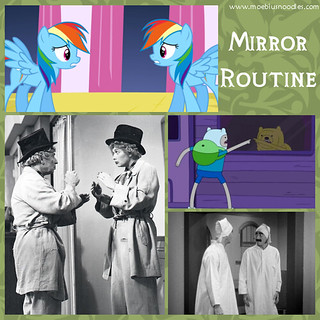
Marina Mersenne presents an advanced theater game, The Mirror Routine – easy enough for toddlers to learn, complex enough for professionals to use. Of course, symmetry is one of the major models of multiplication.
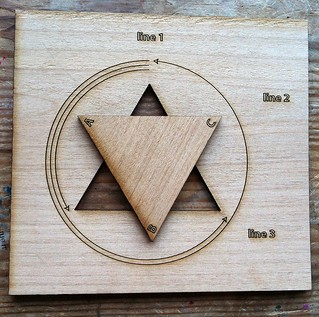
Malke Rosenfeld invites you to share memories of Beautiful Objects from your childhood, using a hands-on manipulative about group theory (hence multiplication!) as her example. Alexander Bogomolny, a mathematician and math educator of Cut-the-Knot fame, responds with a touching example:
Puddles, I was absolutely taken with the puddles. The surprising thing was that an object’s reflection moved when I moved while it was not mine but the object’s.
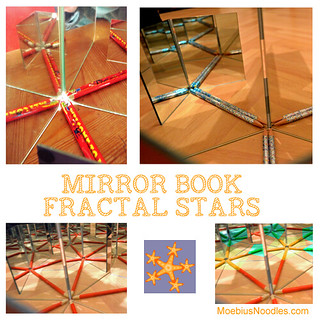
Yelena McManaman shares an invention of her son Mark (7), who found a way to model fractal stars with mirror books: a combination of two models of multiplication in one beautiful project.
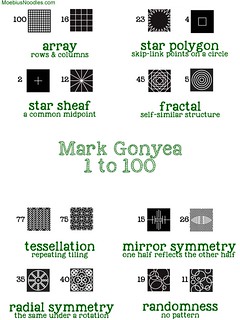
Mark Gonyea gave us an interview about his artistic 100-charts, with many cells built on arrays, fractals, symmetry and other multiplication patterns.
The Natural Math crew added new finds to our big history of the Multiplication Tower, a slightly mysterious 3D-modeling project that people have been independently reinventing since the 1970s.
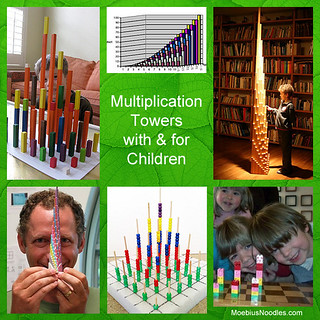
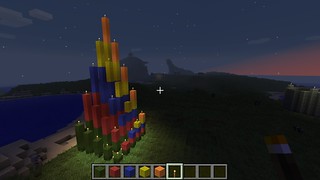
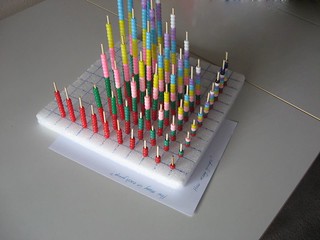
In response to examples made of wood, LEGO, beads and more, we got two fresh versions. The history continues to grow: after our story came out, Jenny’s son Viktor built his multiplication towers in Minecraft, and Sheryl Morris remixed the bead version in Montessori colors.
Sharing
You are welcome to share the contents of this newsletter online or in print.

Talk to you in two weeks! Moby Snoodles, aka Dr. Maria Droujkova
Posted in Newsletter


