- Home
- “Yes, And…” Improving Math Play with Improv
- Althea’s Math Mysteries
- Avoid Hard Work, the Workshop
- Avoid Hard Work! …And Other Encouraging Problem-Solving Tips for the Young, the Very Young, and the Young at Heart
- Blocks and Modeling: A Do-It-Yourself Guide to Exploring Geometric Objects – Online Workshop
- Blog
- Books and Goods
- Bright, Brave, Open Minds
- Bright, Brave, Open Minds: A Problem Solving Kaleidoscope. Open online course for parents and teachers
- Camp Logic
- Cart
- Checkout
- Citizen Science Station
- Consulting and Tutoring
- Courses
- Download File
- Easy Complexity and Special Snowflakes Online Math Circle
- Empires: Year-long prealgebra program in a game
- Expedition Everest
- Five Fabulous Activities for Your Math Circle
- Funville Adventures: Math Personified!
- Funville Web Tour
- Hacking Math
- Hiding in Plain Sight: Vyshyvanka Secret Codes
- Home
- HOW do they do it? Creating your own math puzzles
- Inspired by Calculus: Online course for parents, teachers, and their children ages 5-12
- Kingdom On A Wall
- Kingdom on the Wall
- Ko’s Journey Is Discontinued
- Lapware
- Math Books
- Math Cafe
- Math Circles
- Math Circles 1001 Leaders Course
- Math Future event registration
- Math Future: come and talk!
- Math Goggles Challenges
- Math Renaissance
- Math Trek
- Mathematics & Poetry for All
- Meet the authors
- MidSchool Math Digital Math Tools
- Moebius Noodles
- mpsMOOC13: Problem Solving for the Young, the Very Young, and the Young at Heart
- Multiplication Explorers FAQ
- Multiplication Explorers LIVE workshop
- Multiplication Explorers Online Course
- Multiplication Explorers Registration
- Multiplication Explorers, the book
- Multiplication Models Poster
- My Account
- Natural Math Multiplication Course
- Online Logic Summer Camp for Kids!
- Online Summer Calculus for Kids Camp!
- Pay Natural Math
- Playing with Math: Stories from Math Circles, Homeschoolers, and Passionate Teachers
- Reviews of the Moebius Noodles book
- September 25: Math Storytelling Day
- Socks Are Like Pants, Cats Are Like Dogs
- Speaking and events
- Start Here!
- test001
- The Art of Factorization Diagrams
- The Iditarod
- The seven principles of Natural Math
- Transformers: Matrices & Graphs!
- Veronica’s Multiplication: a Natural Math circle online
- WOW! Multiplication – an open course in September 2013
- Ying and the Magic Turtle
- About Natural Math
- Contact Us
- Get Involved
Mirror book fractal stars

Yelena McManaman’s son Mark loves deep ideas. Yelena writes: “Mark is obsessed with the idea of symmetry and infinity. Now he’s also trying to build up on his “zero infinity and infinite zero” ideas.” In one of his latest experiments, Mark invented a way to model fractals with two mirror books.
There is a chapter on fractals and another chapter on mirrors in our Adventurous Math book, but I’ve never thought of combining the two ideas! This is a great example of why we need children in our workplaces and creative projects. Young kids are great at divergent thinking, unexpected connection, and noticing details. Imagine the worlds where engineers and scientists developed a way to consult Mark and other young kids during explorations.
Here is Mark’s fractal star, with four rays made out of double pencils. Note how both mirror books are opened at 90 degree angles, to make four copies.
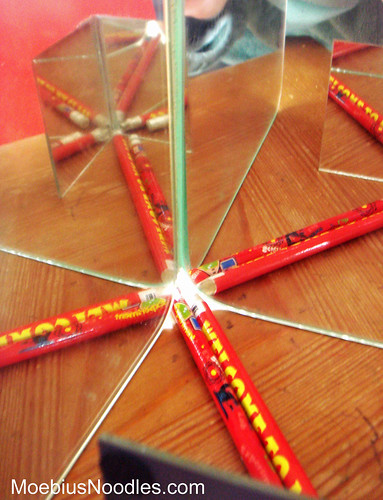
After Yelena sent me this cool photo, I just had to make my own mirror book fractal stars! I played with three-ray stars and five-ray stars.
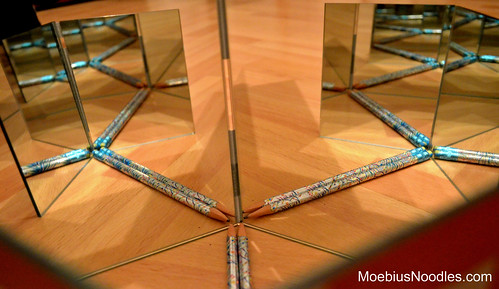
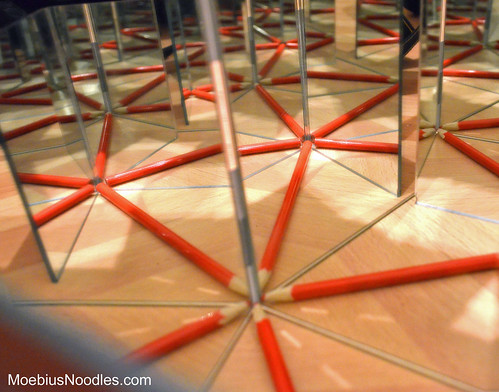
When kids draw fractals by hand, they often use new color for each new level. I colored levels of my five-ray fractal in Photoshop: the first level stayed the original orange, the second level is yellow, and the third level is green.
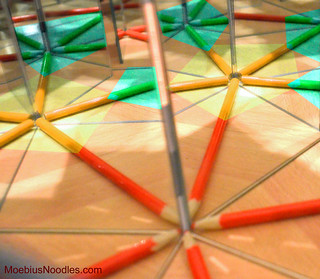
This is how the setup with two mirror books looks from the top. You can only see a few levels of the fractal from that angle:

You can get small mirrors in craft stores, and large mirror tiles in home improvement and hardware stores. Invite your kids to join Mark in his experiments! If you want to share your mirror book or other fractal creations, email me your photos – moby@moebiusnoodles.com


Posted in Make
One to one hundred: a series of posters from Mark Gonyea
Mark Gonyea is an artist and graphic designer who recently crowd-funded an inventive and elegant series of 100-charts. The artwork caught my eye because the patterns were both adventurous and algebraic. Want to borrow my math goggles? Go on a scavenger hunt within the posters to find these mathematical structures:
- Arrays
- Star sheafs and star polygons
- Fractals
- Tessellations
- Mirror and radial symmetry
- Randomness
My finds (and the brief definitions of these math terms) are at the end of the post. What else do you see in the posters?
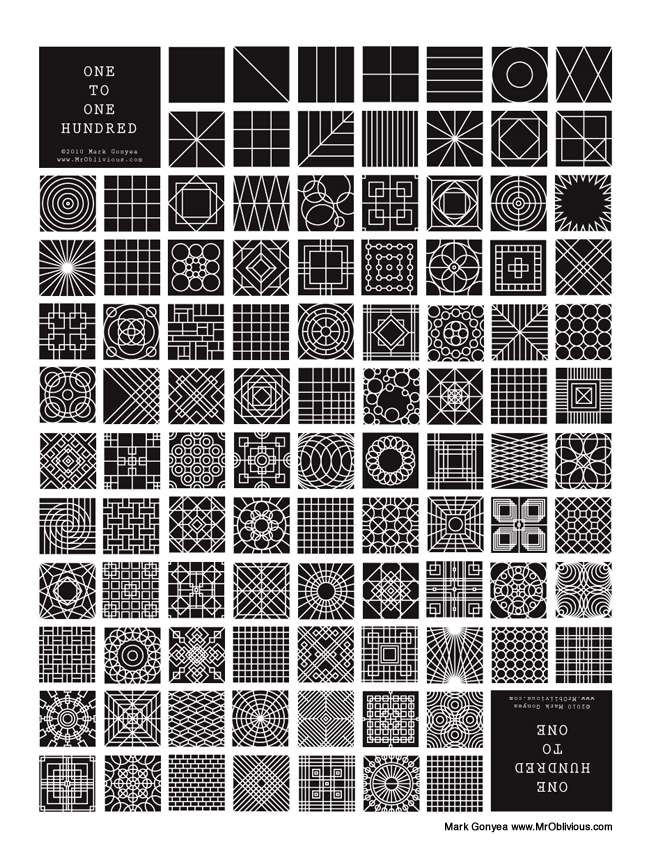
I sent Mark a few interview questions.
— Do you remember how math was for you when you were a little boy?
— I remember being good at math. I liked Algebra the most, which when I think about it is not unlike graphic design to me. It’s adding, subtracting, dividing and multiplying. It’s all about trying to solve a problem.
— What feelings drove you to create that many complex hundred-charts? What’s the story of this project, and the meaning of the story for you?
— I started creating multi-panel posters around the year 2000 as a reason to exhibit at the San Diego Comic-con. So at first, they were very much narrative and kind of a long comic strip in nature. Fairly quickly I started to do more design focused posters as well and a few years ago one of those posters was reprinted in an art book about abstract comics. The piece was a 48 panel comic called Squares in Squares where each panel pulled back to reveal more and more squares surrounding each other with no narrative other than the increasing complexity of shapes. So when I started to think about what kind of Kickstarter project I wanted to do I thought back to the popularity of that poster and it really got me thinking of doing a series of sequential designs.
— Can you give a few design tips for families and Math Circles creating their own artistic number charts?
— Definitely start small. I realized pretty quickly how complicated things can get, even before I got to the larger numbers. With the first 1 to 100 poster (Shapes) I think it was actually #14 where I realized “Oh, this is going to be more involved than I thought” and that number became my first asymmetrical panel.
— Where can we find your work online?
— MarkGonyea.com is the best place to see what I’m up to and where to find my work online. Thanks!
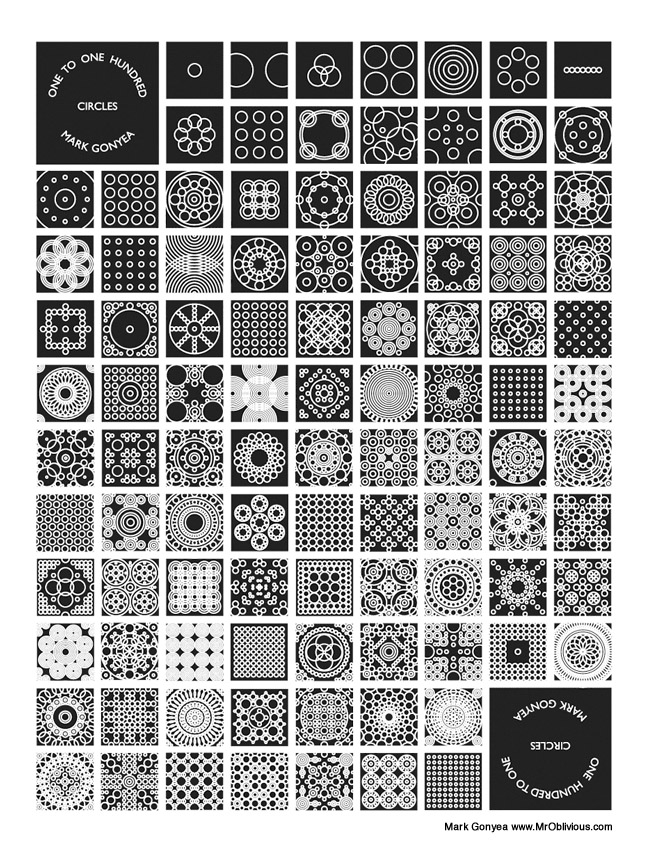
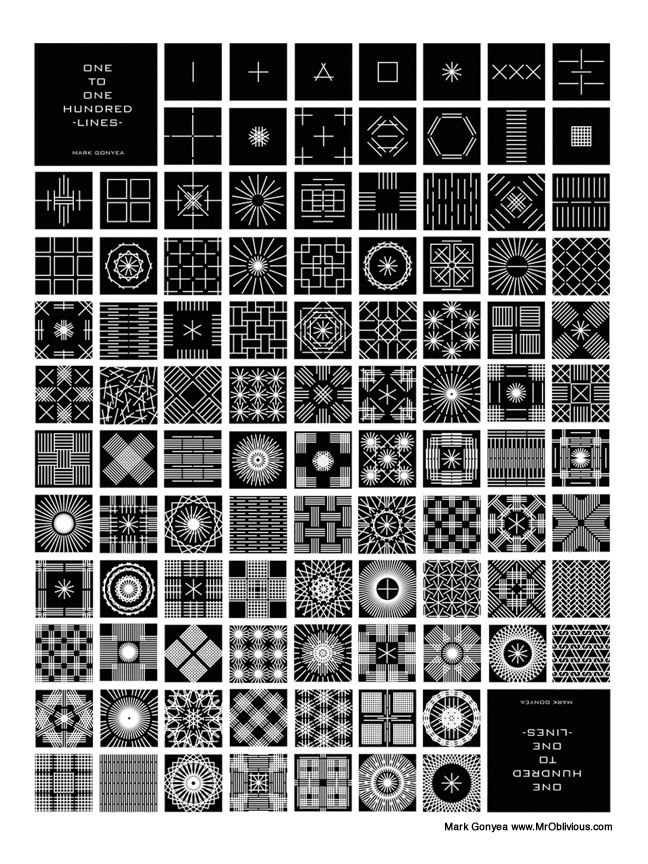
Here are examples I found. It strikes me that many of them have to do with multiplicative reasoning: grids, symmetry, and fractals for sure! What other math ideas do you see here?

Posted in Make
Multiplication Towers
Check out activity ideas, adaptations by ages, and even more examples of Multiplication Towers (plus 14 other awesome topics):
Multiplication Explorers Self-Paced Course
One of the wonders of the ancient times is that many tribes and nations from different continents independently discovered and built patterns we call Labyrinths. Some math ideas are universal like that! Over the last decades, the Multiplication Tower idea has been appearing in many different projects. We interviewed authors from the 1970s to early 2000s, and it turned out they came up with the idea independently! But for the last few years, we’ve all been talking to one another, directly or through our blogs. Kids and their grown-ups build multiplication towers using many kinds of materials: wooden blocks, LEGO bricks, software and 3D printing, and beads.


This page documents the appearances of multiplication towers. If you build a tower or know of an example we missed, please send it to moby@moebiusnoodles.com
2013 Moebius Noodles
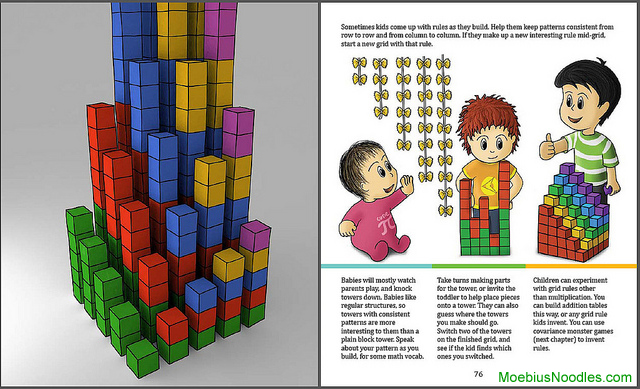
We have a chapter on Multiplication Tower games for young kids in the Adventurous Math for the Playground Crowd book. It summarizes ideas from many other projects on this page.
2013 Malke Rosenfeld
In a blog post with many quality photos and thoughts on commutativity, Malke shares her easy-to-make, beautiful version of the Tower.
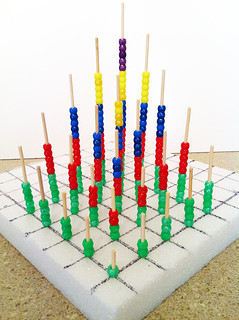
Malke writes: “When we started building this tower the questions started flooding in. I started wondering about a LOT of things…” Indeed! So will you wonder, if you build the tower.
2013 Sarah Dees
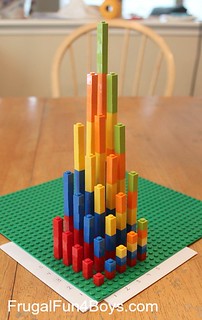
In her blog post, Sarah included detailed instructions and her thought about the design. She writes: “The finished graph lends itself to interesting observations if you look at it from different angles. I ordered the blocks from the Pick-a-Brick section on lego.com. We have invented several math activities with these bricks (more posts to come!), and it has been totally worth the cost.” Sarah’s activity was inspired by Malke’s beads.
2013 jmommymom at Highhill Homeschool

What a creative way to replace materials! The blog post explains: “We didn’t have a foam block, so we filed a cardboard box with cotton to serve as our base. Then we stuck in wooden skewers in a 5×5 grid pattern, and added beads to that corresponded with the multiplication tables.” This activity was inspired by Malke’s beads, as well.
2013 Andrew Staroszik and Roman Hegglin on Thingiverse
In 2013, several tower model appeared on Thingiverse, a 3D printing site. You can use these files to print your own towers.

Andrew’s tower was originally inspired by Michael Punzak’s wooden model we describe below.

Roman’s tower comes with captions in Roman numerals and Braille. It’s also made of thin tiles rather than cubes. These two features make for more formal or abstract remixes.
2010 Brenda Weiss
Brenda is a physicist and a creative parent. When her son Corbin set out to make a multiplication table with Cuisenaire rods, he built the first set of towers on his own. Brenda writes: “In ‘helping’ make it symmetric, I ended up knocking over most of what he had built. We built this together. Corbin was responsible for the multiple block levels, as I couldn’t balance more than two blocks.” It helps kids to know they are giving real help. Take a page out of Brenda’s book: be open about the areas where you need help.

2010 Colin Graham
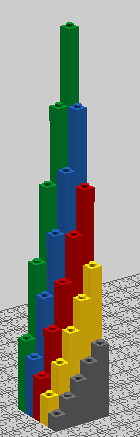
Colin made a collection of 20 math adventures with LEGO, modeled with the free Digital Designer software, and invited colleagues to add more ideas. Here is the multiplication tower from his collection.
2007 Studio 1:1
The design studio from Gdansk, Poland made this giant tower and took several artistic photos of it.

2004 and up, Maria Droujkova’s Math Circles
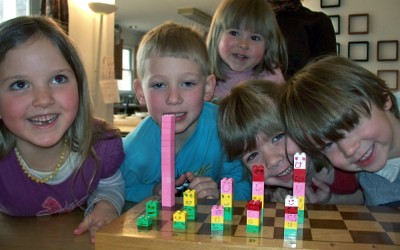
Five Math Circle kids built these LEGO towers on a chessboard in 2010. The story was that each block was a creature (hence the smiley faces) that kept growing from row to row.
Later in 2010, the same Math Circle built a model with a cereal box and bamboo skewers. The picture shows the 3 by 4 array with pencils. The skewer in the lower right corner of the array sticks out by 12 units, that is, 3×4.
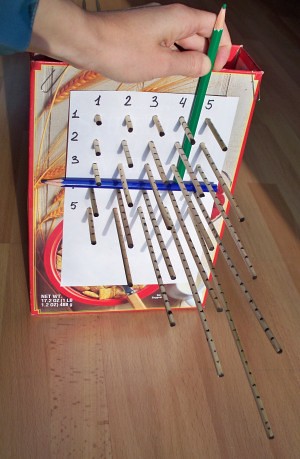
The above model was inspired by the Kinetic Structure BMW installation:
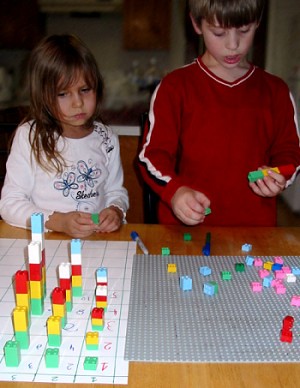
An earlier picture, from 2004, shows two kids from a Math Circle building with LEGO on a poster board.
2001 and up, Dor Abrahamson and friends
In 2010, Dor wrote: “Multiplication Tower as an Object-to-think-with.” Well put! Check out Dor’s page about 3d multiplication, with more pictures, at his Embodied Design site at University of California, Berkeley. This six-foot structure made of wood was constructed by Michael Bryant, one of Dor’s graduate students.
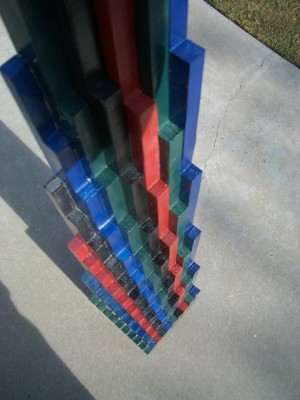

In 2005, when 3D printers were still rare, Paulo Blikstein printed this model at Uri Wilensky’s lab. Here is Dor playing with the Tower. Paulo now leads Transformative Learning Technology Lab at Stanford.
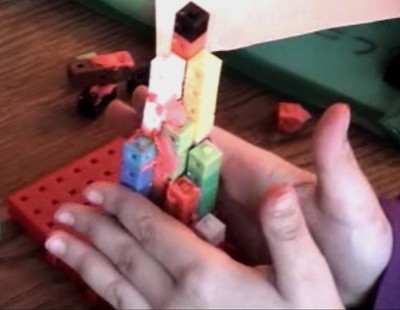
Here is a third grader building the multiplication tower from plastic blocks and play-dough in one of Dor’s experiments in 2001.
That was the year Dor designed the tower, first as a 3D output from a spreadsheet. Here is that historic document.

1988 and up, Michael Punzak, Michael Gleason, Douglas Shult, and Joshua Tenenbaum
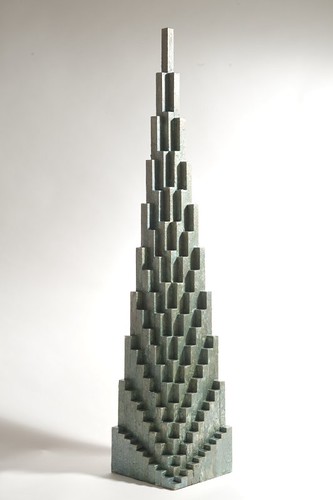
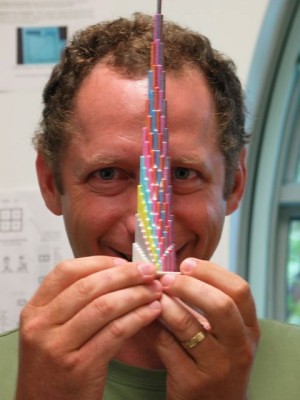
Michael writes in commentary to his page of lovely hands-on explorations into patterns: “I made my first model about 20 years ago. It was inspired by an article and photograph in The Mathematics Teacher (Shult, and Tenenbaum, 1988: A three-dimensional multiplication table inspires mathematical discovery). I found this first model, which is about 3 feet tall, a lot of fun to paint (about 10 coats of acrylic, to get a metallic look to it) but very heavy to schlep around. I commissioned a friendly carpenter, Michael Gleason of Newton, MA, to build a smaller (about 18 inches tall) model, which is much lighter. I also use a 5-by-5 multiplication table model built with LEGO blocks for volume and surface area challenges. It is surprising and a bit disappointing that so far my 4-6 graders (a STEAM) after school class in Needham, MA, have not made the necessary jump from the 5×5 model to the 10×10 model.”
1975 Don Cohen
In the oldest multiplication tower we found, the layers were cut out of wooden Dienes blocks by Don. He has kept it around for his students to build up the layers and to find more patterns. His camera wasn’t good at close shots, so the numbers here are written over the picture. Check out Don’s work on calculus by and for young people!
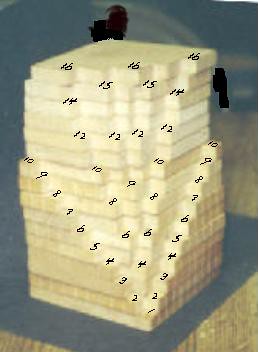
Happy tower building!
Posted in Grow
Beautiful Objects

Note: This post originally appeared on my personal blog on January 24, 2014 and can be found here. At the end of this post you will find a question related to the following story–I would love to hear your thoughts, ideas and responses. –Malke
___________________________
I’ve been thinking quite a lot lately about the role of physical objects in math education. Sometimes called manipulatives or, more generally, tools, I’ve discovered conflicting opinions and strategies around the use of such objects. In her book Young Children Reinvent Arithmetic, Constance Kamii helpfully sums up some of the issues with which I’ve been wrestling:
“Manipulatives are thus not useful or useless in themselves. Their utility depends on the relationships children can make…” p25
“Base-10 blocks and Unifix cubes are used on the assumption that they represent or embody the ‘ones,’ ‘tens,’ ‘hundreds,’ and so on. According to Piaget, however, objects, pictures and words do not represent. Representing is an action, and people can represent objects and ideas,but objects, pictures, and words cannot.” p31
So, it is not the object itself that holds the math, but rather the process in which the learner uses the tool that creates the meaning. But, of course, when we use this kind of language we are talking abstractly about hypothetical objects and generalized characteristics of ‘the child,’ not any specific object or individual learner in particular.
Too much generality and abstraction drives me crazy so imagine how pleasantly surprised I was when this showed up in my mailbox the other day:

What is it? Well…it’s an object. And a beautiful one, at that. An object that can be “manipulated” (the triangle comes out and can be turned). A thinking tool. It was designed and created by Christopher Danielson to investigate symmetry and group theory with his college students. Not only are parts of this tool moveable, but it also has the potential to help “facilitate [mathematical] conversations that might otherwise be impossible.” (Christopher on Twitter, Jan 17, 2014)
What was even better than getting a surprise package in my real life mailbox containing a real life manipulative (not a theoretical one) was my (real) eight year old’s interest in and reactions to said object.
She spotted the envelope and said, “Hey! What’s that?!” I told her that a math teacher friend of mine had sent me something he made for his students to use. I took it out of the envelope for her to look at.
First thing she noticed was the smell — lovely, smokey wood smell which we both loved. She investigated the burned edges, tried to draw with them (sort of like charcoal). This led to a discussion about laser cutters (heat, precision) and the fact Christopher had designed it.
I pointed out the labeled vertices on the triangle, showed her how you can turn it, and mentioned that the labels help us keep track of how far the shape has turned. She immediately took over this process.
She repeatedly asked if she could take it to school! I asked her, “What would you do with it?” She said, matter-of-factly: “Play around with the triangle…and discover new galaxies.”

Then, she turned the triangle 60° and said, “And make a Jewish star…” Then she put the triangle behind the the opening so it (sort of) made a hexagon. I asked, “What did you make there?” She said, “A diaper.” Ha!
I hope Christopher’s students are just as curious about and enthralled with the “object-ness” of this gorgeous thing as they are with the idea that it helped them talk and think about things that might otherwise be impossible to grasp. I know that the objects themselves hold no mathematical meaning but watching how intrigued my daughter was with Christopher’s gift, I am left thinking about what we miss out on if we consider a tool simply a bridge to the ‘real’ goal of mental abstraction.
Beautiful and intriguing objects, I think, have a role in inspiring the whole of us, all our senses, kinetics, and curiosities, not just our minds, to engage in the process of math learning. An object doesn’t necessarily have to be tangible; narrative contexts are highly motivating ‘tools’ when working with children. As I blend math, dance and basic art making I see over and over again how presenting the object (idea) first pulls my learners in — they are curious about what this dance is, how they might weave their own wonderful designs using math, what does she mean “growing triangles” and why are these pennies on the table?
Learning is hard work, but my experience is that students will gladly work hard if they have even a small sense of the direction in which they’re headed.
MALKE’S QUESTION:
MALKE’S QUESTION:
_____________________________
Malke Rosenfeld is a percussive dance teaching artist who blogs about her experiences at the intersection of math, the arts, and learning at The Map is Not the Territory.
Malke Rosenfeld is a percussive dance teaching artist who blogs about her experiences at the intersection of math, the arts, and learning at The Map is Not the Territory.
Posted in Grow


