- Home
- “Yes, And…” Improving Math Play with Improv
- Althea’s Math Mysteries
- Avoid Hard Work, the Workshop
- Avoid Hard Work! …And Other Encouraging Problem-Solving Tips for the Young, the Very Young, and the Young at Heart
- Blocks and Modeling: A Do-It-Yourself Guide to Exploring Geometric Objects – Online Workshop
- Blog
- Books and Goods
- Bright, Brave, Open Minds
- Bright, Brave, Open Minds: A Problem Solving Kaleidoscope. Open online course for parents and teachers
- Camp Logic
- Cart
- Checkout
- Citizen Science Station
- Consulting and Tutoring
- Courses
- Download File
- Easy Complexity and Special Snowflakes Online Math Circle
- Empires: Year-long prealgebra program in a game
- Expedition Everest
- Five Fabulous Activities for Your Math Circle
- Funville Adventures: Math Personified!
- Funville Web Tour
- Hacking Math
- Hiding in Plain Sight: Vyshyvanka Secret Codes
- Home
- HOW do they do it? Creating your own math puzzles
- Inspired by Calculus: Online course for parents, teachers, and their children ages 5-12
- Kingdom On A Wall
- Kingdom on the Wall
- Ko’s Journey Is Discontinued
- Lapware
- Math Books
- Math Cafe
- Math Circles
- Math Circles 1001 Leaders Course
- Math Future event registration
- Math Future: come and talk!
- Math Goggles Challenges
- Math Renaissance
- Math Trek
- Mathematics & Poetry for All
- Meet the authors
- MidSchool Math Digital Math Tools
- Moebius Noodles
- mpsMOOC13: Problem Solving for the Young, the Very Young, and the Young at Heart
- Multiplication Explorers FAQ
- Multiplication Explorers LIVE workshop
- Multiplication Explorers Online Course
- Multiplication Explorers Registration
- Multiplication Explorers, the book
- Multiplication Models Poster
- My Account
- Natural Math Multiplication Course
- Online Logic Summer Camp for Kids!
- Online Summer Calculus for Kids Camp!
- Pay Natural Math
- Playing with Math: Stories from Math Circles, Homeschoolers, and Passionate Teachers
- Reviews of the Moebius Noodles book
- September 25: Math Storytelling Day
- Socks Are Like Pants, Cats Are Like Dogs
- Speaking and events
- Start Here!
- test001
- The Art of Factorization Diagrams
- The Iditarod
- The seven principles of Natural Math
- Transformers: Matrices & Graphs!
- Veronica’s Multiplication: a Natural Math circle online
- WOW! Multiplication – an open course in September 2013
- Ying and the Magic Turtle
- About Natural Math
- Contact Us
- Get Involved
The Mirror Routine

If you have seen any comedic performance in the past century, you have likely seen the Mirror Routine. When two people try to seamlessly imitate each other, it is not only entertaining to the viewers, but to the performers as well!

In its chapter on symmetry, the Moebius Noodles book gives instructions on how to do this “live mirror” activity with your kids, with examples of movements, and extensions of the game. The Mirror Routine is easy to learn for both kids and adults when the movements are simple. As they grow more complex, however, you may find yourself struggling to keep up with your kid!
[youtube=http://www.youtube.com/watch?v=VKTT-sy0aLg&rel=0]
The Mirror Routine has been around since vaudeville days. The most well-known example of it is this scene from the Marx brothers’ film Duck Soup. In Duck Soup, Harpo Marx’s character breaks a mirror and pretends to be his brother’s reflection in order to conceal it.
[youtube=http://www.youtube.com/watch?v=E4YZKGpe-D0&rel=0]
Twenty-two years later, Harpo Marx returned to the screen on I Love Lucy. When Lucy tries to trick her friend Carolyn into thinking she is Harpo Marx, she is surprised by the real Harpo and mirrors his exact movements.

Your kid or student might be familiar with the routine already! In this scene from My Little Pony: Friendship is Magic, pegasus Rainbow Dash is confronted with a changeling clone of herself and mirrors her every move.
[youtube=http://www.youtube.com/watch?v=64bAg3Zz40w&rel=0]
Or, if your kid is a fan of Adventure Time, they might have seen the magical dog Jake attempting and failing to do the Mirror Routine when his human friend Finn catches him trespassing in their friend Marceline’s house.

Invite your kids to try the Mirror Routine: it will challenge and delight the little performers.


Posted in Make
Math Cafe, holidays <3, three new book and course projects: Newsletter January 31

Got this from a friend? Subscribe!
I am Moby Snoodles, and this is my newsletter. Send me your requests, questions and comments at moby@moebiusnoodles.com

Math Cafe February 18
Several of us at Natural Math are long-time fans of Science Cafes. Yelena McManaman and I presented a Cafe on early cognition in 2013, and will present a teen Cafe on math-rich occupations in March 2014, at the North Carolina Museum of Natural Sciences. From their definition of Science Cafes:
Anyone can participate in topical discussions with leaders in the fields of science and technology. These talks promote discussion of science in an informal setting. Prominent researchers share their expertise during presentations, discussions, and informal talks.

We want to organize a series of cafes of our own: Math Cafes, open to the world. If you are in the Raleigh-Durham area, NC, join Yelena and me on February 18th at 6 pm EST at Cafe Carolina on 137 Weston Parkway, Cary. Bring a device to participate in text chat. If you are elsewhere, brew a cup, get a cookie, and join us online. Get together with friends and family for your own local chat, if they can join you. We will do a short sweet presentation on the surprising and wild science behind multiplication. Then we’ll answer questions from online and local participants – while you informally discuss the ideas. After we try out the format, we will be bringing other leaders of mathematics education communities for more Cafes.
Registration is free and open: your entry ticket is a question about multiplication. Register now!
Description of the first Math Cafe: What is multiplication?
What is multiplication? Well, it’s when you multiply one number by another number. Hmm, that doesn’t sound very helpful, does it? What does it mean to multiply a number by another number? Your child’s experience with multiplication will depend on the answer (or several) you have to this question. It will also determine where you will look for examples of multiplication – multiplication tables, a mirror, your child’s drawings, a stroll around your neighborhood… And researchers suspect that early experiences with multiplication (or lack thereof) largely determine the future success with all math and science. That’s because multiplication is the cornerstone of algebra.
How will learning these critical concepts fit your and your child’s day-to-day activities? And how will it help enrich your and your child’s relationship with mathematics? We will discuss these and other questions in our upcoming Math Cafe.
It is open for sign-up now. Even if you can’t attend, sign up anyway, and we will send you the recording. Ask us your question, tell us your or your child’s multiplication story, share your successes or concerns. The power to shape you child’s view of mathematics is in your hands – and it all starts with asking questions!
(Math) x (Holidays) = <3
February 7th is e day. It’s less famous than the Pi Day, but the more math holidays, the merrier! Check out an intuitive guide to e from Better Explained.
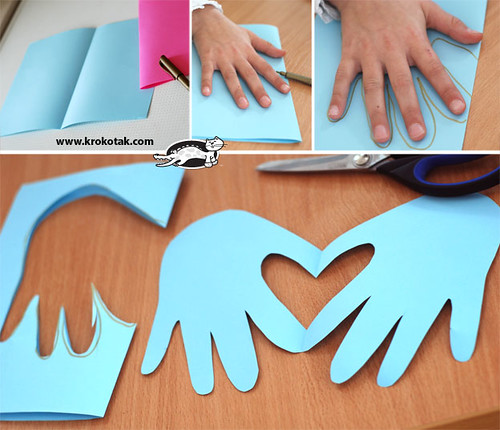
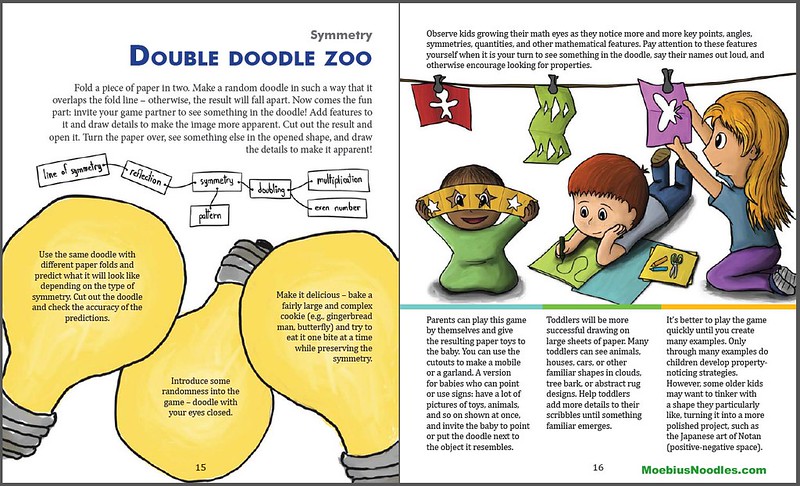
If you want to bring math into Valentine’s Day, here is a cute heart-shaped card idea from KrokoTak, similar to the Moebius Noodles art and visualization game called “Double Doodle Zoo.” Check out the clever use of symmetry and negative space!
Book news
With help from Polgarus Studio, we are making a simplified layout of Moebius Noodles for ebook readers such as Kindle, and also for the translations.Our colleague M. Onur Cesur, a professor at Maltepe University in Istanbul, is going to lead the Turkish translation. The closest to completion is Hebrew; Russian and Farsi are done. If you are interested in translating the book into another language, let me know.
There is also good news from Delta Stream Writers, a Natural Math incubator for projects similar to Moebius Noodles. We just began three new projects, which means more online courses for you, and more books – very soon!
Rodi Steinig of Talking Stick learning center, a math mom, and a blogger is working on a book about her Math Circles – with big help from her daughter Rachel.

Photo from Talking Stick.
Mark Saul and Sian Zelbo of Center for Mathematical Talent, an outreach program of the Courant Institute of Mathematical Sciences, New York University, are making a book of logic games and activities for Math Circles.
Kalid Azad of Better Explained will be joining Yelena McManaman and me in turning our Inspired by Calculus adventures into a book.
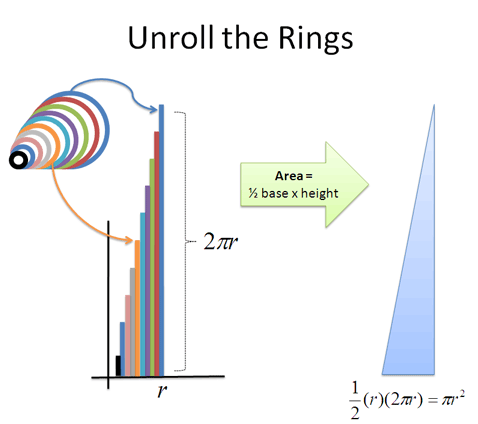
Picture from Kalid’s Gentle Intro to Calculus.
Sharing
You are welcome to share the contents of this newsletter online or in print.

Talk to you in two weeks! Moby Snoodles, aka Dr. Maria Droujkova
Posted in Newsletter
4 projects from world-famous art exhibits your kids can do
There are math exhibitions held in many locations with many themes. The Bridges Conference and Joint Mathematics Meetings are two groups that seek to explore the many ways one might apply math to multiple disciplines, including art. The contributors to these conventions work in many disciplines ranging from mathematics and weaving to dancing and computer science and attract thousands of people annually. The Joint Mathematics Meeting of 2013 had over 6000 attendees!
These events are not only beneficial to adults. People of all ages can learn from art exhibitions. Seeing artwork inspires kids to start projects of their own and expand their artistic abilities.

From our “Do your little kids draw grids?” post
I went through galleries from the 2013 Bridges Conference and the 2013 Joint Mathematics Meetings and compiled some art pieces great to do with kids.
 Jane Adler for the 2013 Bridges Conference
Jane Adler’s complicated looking tessellations on the quilt she designed for mathematician Marjorie Rice are as simple as drawing and coloring in triangular grids. Learning to work with grid shapes beyond squares can lead into more complex geometric thinking. In time, your kid or student will be working with diamonds, polygons, and more.
 Horst Schaefer for Joint Mathematics Meetings
Using a combination of square and triangular grids, children can begin to draw mental connections with the way shapes relate to each other in a plane. Much like puzzle pieces fit together, so can polygons. Drawing these connections can inspire kids to look for connections in shapes throughout the world, first in a two-dimensional sense and then a three-dimensional one.
 Marc Chamberland for Joint Mathematics Meetings
Marc Chamberland describes this exhibit as something even a child could do and he’s right. With markers or other coloring tools, paper, and scissors, kids can learn how squares are constructed from parallel and perpendicular lines and how even the pieces that don’t seem like they would fit together can form perfect squares.
 Ton Oostveen for the Bridges Conference
Using a pencil and paper and the images found here, your child can learn how parallel and perpendicular lines can create the illusion of a three-dimensional wireframe. This teaches kids how three-dimensional objects present in the physical world are constructed.

Posted in Make
3D illusions, function machine props, tech for math ed online course: newsletter January 17, 2014
Got this from a friend? Subscribe!
I am Moby Snoodles, and this is my newsletter. Send me your requests, questions and comments at moby@moebiusnoodles.com

More about the multiplication project
For those who follow our multiplication adventures, here are more details. The next multiplication-centered event for parents will start with parent questions. Think of it as a citizen science project of the action research type. Action science is for a community solving a current problem using scientific tools. Together, participants collect data, analyze the data, implement the changes the analysis suggests, collect more data on how those changes worked, and so on – until great solutions to the problem emerge.

Picture from TheGriddle.net
We invite you to tell us what you and your children want about multiplication – and to figure out how to make these dreams come true! Depending on the level of community interest and support, the study may produce some or all of these results. As with all our projects, the results will be shared with the world, under a Creative Commons open license.
- THE MAP – The booklet “Multiplication: from worries to dreams” (PDF) with transcribed answers to selected questions from live webinars with parents and teachers.
- THE BIGGER MAP – We map out and briefly answer all the questions that did not make it into the webinars, and past questions from WOW! Multiplication course.
- THE INTERACTIVE MAP – We research and add links, resources, and full references to all answers, making everything is super-easy to find.
- NOW WITH TELEPORTS – We organize the resources into a web portal, Multiplication Planet, that is easy to use and invites further research and discussion.
Want in on this? Email me!
Blogs and networks
One of our most popular Pinterest boards is Eat Your Math. Check it out, and send us links or ideas for more tasty math activities!

Meet our newest blogger, pen name Marina Mersenne (check out the history), debuting with 3D Illusions with Easy Grids. Children often ask how they can create their own illusions. Your children can start with these art project ideas, and then experiment with other shapes and grids!

In the Math Mind Hacks series, check out Guesstimate. After I made the mini-poster, Sheryl Morris commented on our Facebook page that it would be nice to make a version for the Montessorians. The proof of concept comes from research of cognitive neuroscientists Park and Brannon, from Duke University.

We took part in the 70th monthly Math Teachers at Play blog carnival – a big collection of family math activities. For example, Mashka introduces her preschool/kindergarten math circle to thinking about systems in Tricky PreK Math, Lesson 8 – Year 2.
Take a huge loop of yarn (the size of half a room) and ask the kids to hold it at any place. Then tell them to close their eyes and that if they peek, the game will not work. Then, tell them that with their eyes closed, they have to make a square with the yarn. They are allowed to communicate with each other. Try it multiple times and see what happens! We only had a couple of minutes to play, but it came out very funny with everybody tangled. Almost all of them were cheating (their eyes were open) and they still couldn’t make a square (or even get untangled).
Questions and answers
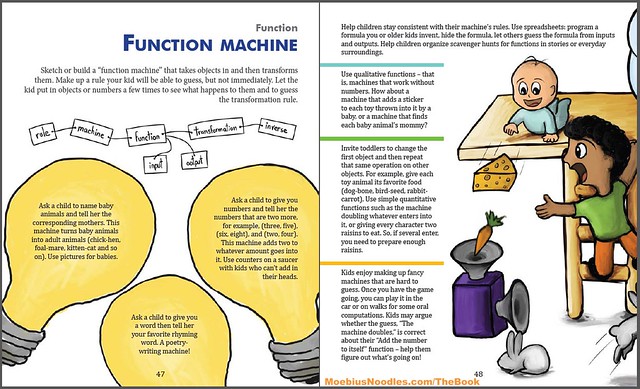
We have a playschool group with kiddos 0-5, with moms, and were thinking about acting out function machines with one mom in a box and we hand her input (toys, numbers) and she give us output (altered, increased, decreased). Has anyone done something similar and can you recommend what props are good to have on hand to make this fun?
Share your prop ideas at the forum! Meanwhile, here are some suggestions:
- Boxes with both ends open, or tubes (you can just tape paper into a cylinder) are more fun to use than a flat Function Machine drawn on paper.
- Heads up: young kids want a new function machine for every new function they make up, or you make up. For older kids, the same diagram or just the letter F can stand for different functions, and the same prop can represent different machines. Little kids won’t like that, at least at the beginning. Later you can introduce a magic wand or a wrench that kids can use to change and modify your old function machine they already explored into something new and exciting. You can use a pencil to pretend-play that tool, or bring a strange-looking shop tool or utensil for your prop.
- Food you can slice, such as apples, works great for machines that cut things into halves or other parts. Raisins are nice if the machine houses something like Purple-Tailed Raisin Eater, who always swallows two of the raisins that enter and no more.
- Playdough or soft modeling clay can create interesting machines. You can slice it, stretch it, squish it for a variety of 3D transformations.
- Small stickers or cards plus large markers can be props for coloring machines that turn everything that enters green, red, or polka-dotted.
In general, think of machine rules ahead of time, and how you would pretend-play them!
We have several activities in the Moebius Noodles book, which also has some suggestions for prompts.
An open graduate level course for teachers and parents: Technology for Math Ed

I am leading a semester-long online course at Arcadia University. As usual for the courses I design, all course assignments will happen in live online communities, and people who are not at Arcadia are welcome to participate. You can view the syllabus and jump right in with the first assignments! Here is the plan, by weeks:
- Introduction, setup, review of your goals and needs
- Tech we use for the course
- Meeting one another. Who are you? What do you want in math ed?
- Topic brainstorm: what will your personal week be all about: Take 1
- Mathematical modeling and its pedagogical uses
- Models of math vs. modeling (of other entities) with math
- Make and share, or consume? Roles of students in modeling
- Models and multiple representations
- Example of modeling software: GeoGebra
- Crowd-learning: networks and communities
- The cultures of sharing: Pinterest, Tumblr, Flickr…
- Mathematical problem-solving with computers and social tools
- Examples of social phenomena: Scratch and Project Euler
- Topic brainstorm, Take 2
- Our Wikipedia article, Take 1
- Hands-on tech
- Manipulatives
- The maker movement
- Comparing and contrasting virtual and physical worlds
- Examples of physical and virtual tech
- Crystallized and fluid intelligences
- Solvers, calculators, graphers, and sending humans to do robotic jobs
- Problem-solving, problem-posing, conjecturing, proving: creating and evaluating in math
- Computer superpowers and what you can’t do without
- Examples of computer-based and computer-delivered math: Wolfram|Alpha and Khan Academy
- Humanistic mathematics
- Math-rich digital arts
- Computational origami, hyperbolic crocheting, fractal cookies: 21st century crafting
- Interpretive dance and underwater basketweaving: issues of intellectual honesty
- Examples: Bridges conference and Gathering for Gardner
- Accessibility and diversity
- Learning styles
- Tech for boys and girls
- Disabilities and learning tools in mathematics
- Advanced math without prerequisites (young kids, ESL, troubled learners)
- Example: ethnomathematics community
- Our Wikipedia article, Take 2
8. Maria’s topic of interest: algebra and calculus for very young kids
9-14 Your topics of interest (to be determined in earlier weeks)
15. Summaries and farewells
Sharing
You are welcome to share the contents of this newsletter online or in print.
Talk to you in two weeks! Moby Snoodles, aka Dr. Maria Droujkova
Posted in Newsletter


