- Home
- “Yes, And…” Improving Math Play with Improv
- Althea’s Math Mysteries
- Avoid Hard Work, the Workshop
- Avoid Hard Work! …And Other Encouraging Problem-Solving Tips for the Young, the Very Young, and the Young at Heart
- Blocks and Modeling: A Do-It-Yourself Guide to Exploring Geometric Objects – Online Workshop
- Blog
- Books and Goods
- Bright, Brave, Open Minds
- Bright, Brave, Open Minds: A Problem Solving Kaleidoscope. Open online course for parents and teachers
- Camp Logic
- Cart
- Checkout
- Citizen Science Station
- Consulting and Tutoring
- Courses
- Download File
- Easy Complexity and Special Snowflakes Online Math Circle
- Empires: Year-long prealgebra program in a game
- Expedition Everest
- Five Fabulous Activities for Your Math Circle
- Funville Adventures: Math Personified!
- Funville Web Tour
- Hacking Math
- Hiding in Plain Sight: Vyshyvanka Secret Codes
- Home
- HOW do they do it? Creating your own math puzzles
- Inspired by Calculus: Online course for parents, teachers, and their children ages 5-12
- Kingdom On A Wall
- Kingdom on the Wall
- Ko’s Journey Is Discontinued
- Lapware
- Math Books
- Math Cafe
- Math Circles
- Math Circles 1001 Leaders Course
- Math Future event registration
- Math Future: come and talk!
- Math Goggles Challenges
- Math Renaissance
- Math Trek
- Mathematics & Poetry for All
- Meet the authors
- MidSchool Math Digital Math Tools
- Moebius Noodles
- mpsMOOC13: Problem Solving for the Young, the Very Young, and the Young at Heart
- Multiplication Explorers FAQ
- Multiplication Explorers LIVE workshop
- Multiplication Explorers Online Course
- Multiplication Explorers Registration
- Multiplication Explorers, the book
- Multiplication Models Poster
- My Account
- Natural Math Multiplication Course
- Online Logic Summer Camp for Kids!
- Online Summer Calculus for Kids Camp!
- Pay Natural Math
- Playing with Math: Stories from Math Circles, Homeschoolers, and Passionate Teachers
- Reviews of the Moebius Noodles book
- September 25: Math Storytelling Day
- Socks Are Like Pants, Cats Are Like Dogs
- Speaking and events
- Start Here!
- test001
- The Art of Factorization Diagrams
- The Iditarod
- The seven principles of Natural Math
- Transformers: Matrices & Graphs!
- Veronica’s Multiplication: a Natural Math circle online
- WOW! Multiplication – an open course in September 2013
- Ying and the Magic Turtle
- About Natural Math
- Contact Us
- Get Involved
Math goggles: Moebius jewelry and 19th-century animation machines


Math Goggles help you notice math everywhere. Thank you, Katrina Mills and STEMcrafted (J.E. Johnson) – you notice beautiful math on Pinterest!

If your kids don’t work with gold and silver as the sculptor Ilana Krepchin, you can still make Moebius strip jewelry out of fabric, polymer clay, or thick paper. Cover the strip with paint or polish to make it sturdy and pretty. Glue on a marble. It invokes the amazing property of the Moebius strip’s topology: your marble could roll around and around the single side!

Calculus is like animation: it captures infinitesimal instances of change and movement as snapshots! Invite your kids to animate like it’s 1830s. It takes just a few minutes to make a flipbook, a zoetrope, or a phenakistoscope. The hardest to pronounce is the easiest to make.


Posted in Grow
Math goggles: cymatics and minimalist posters
Math Goggles help you notice math everywhere. Via Simon Gregg and Becka Rucker, who notice math on Pinterest.
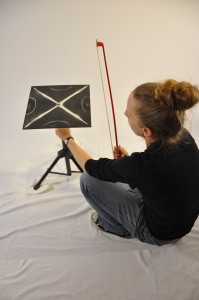
Can you see sounds? Over a vibrating surface, sand or powder arranges itself into a symmetrical pattern, like a snowflake. You can use these cymatics effects to make fine art.

Try it at home with a DIY sound plate – or with a bit of sand on top of your subwoofer.
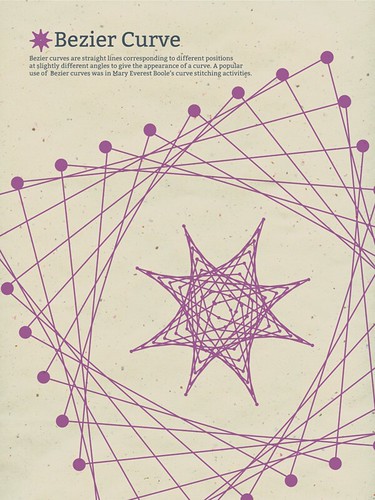
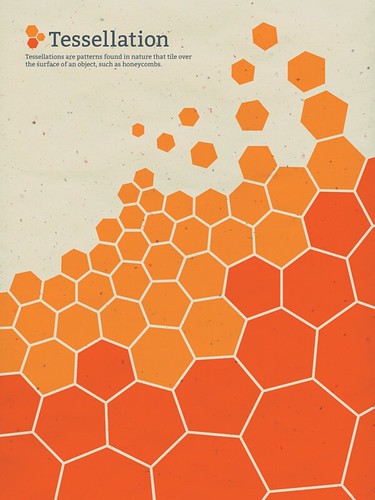
The genre of minimalist poster is accessible and popular, so you can easily make your own. Here are some beautiful examples from Emma Megan Moore.
Posted in Grow
Snowflakes, Part II: 3D origami, fractals in the Alps, artistic apps
Subscribe to the Moebius Noodles newsletter
Welcome to adventurous math for the playground crowd! I am Moby Snoodles, and I love to hear from you at moby@moebiusnoodles.com

Special snowflakes, take 2!
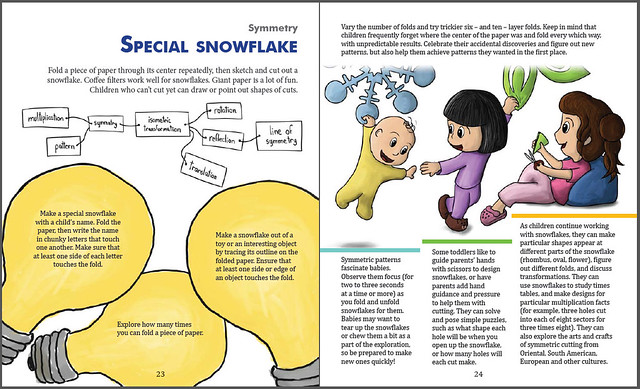
Happy holidays! Last December, we wrote about snowflake-related math in our December newsletter. “Special Snowflake” is one of the most popular activities in the Moebius Noodles book (see below) and our workshops, so we are doing a snowflake newsletter again!
Snowflakes as fractals
What do snowflakes, trees, corals, and your lungs have in common? They consist of branching structures! These types of structures are called tree fractals. Check out instructions on how to make a hexagon-based fractal snowflakes designed by MathRecreation. You can make some snowflake tree fractals – or maybe tree tree fractals – as holiday decorations.

3D origami snowflakes
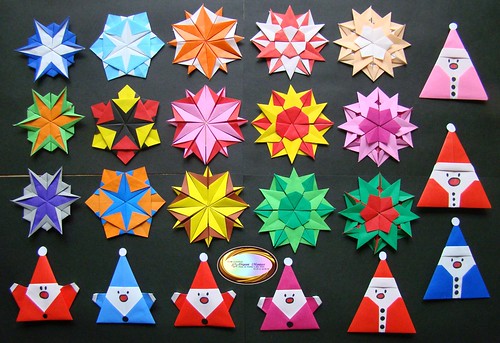
Most people know how to cut snowflakes out of paper. The Japanese term for paper craft with scissors is kirigami. But you can also make snowflakes in the tradition of origami, that is, folding without cutting. Just follow video instructions from Origami Maniacs. Origami is an art, but also a type of geometry, with its own set of axioms more powerful than Euclid’s. And as far as young kids are concerned, paper folding develops attention, precision, and appreciation of beauty: the values necessary for doing mathematics.
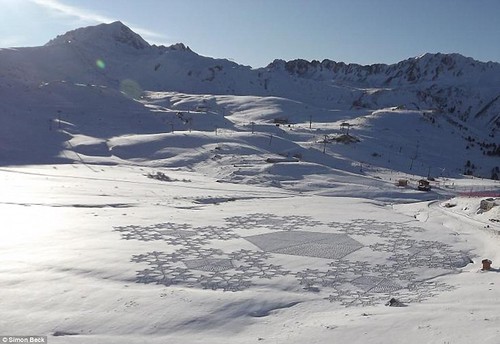
Giant snowflakes in the Alps… or at the beach
Check out giant snowflake art pieces covering whole mountain slopes. Even if you are not joining Simon Beck’s math adventures in the French Alps, you can make smaller symmetrical designs at the park or in your yard.
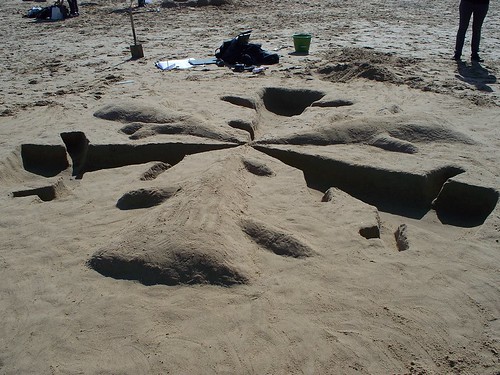
Snow is not an option? Make snowflake art at the sandy beach or in a sandbox!
Snowflake lapware
Lapware is the software for the kid cuddling in your lap. Here are my picks that show both beauty and symmetry of snowflakes.
Weave Silk feels great on touch screens (Android, iOS), but you can also play it on PC. The interface is easy enough for toddlers, and includes terms like 6-fold symmetry for parents.
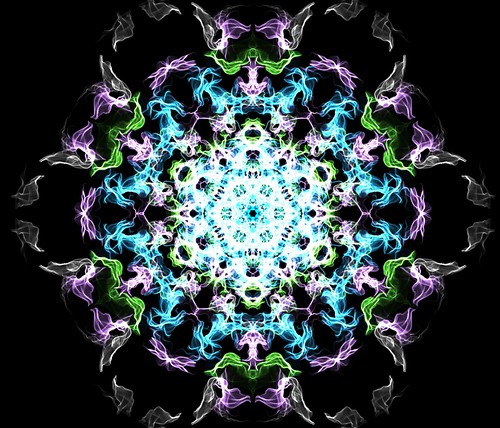
Make sure to click both 2D and 3D rotate buttons after designing a snowflake with zefrank’s browser applet. The transformations are mesmerizing!

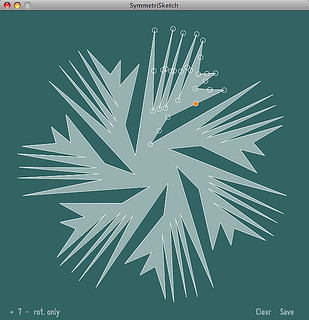
SymmetriSketch software for Mac, Windows or Linux comes from EvilMadScientist.com – with the name like that, it must be awesome!
Sharing
You are welcome to share, remix and tweak. Please credit MoebiusNoodles.com under the Creative Commons Attribution-NonCommercial-ShareAlike license: CC BY-NC-SA.

Happy Holidays!
Moby Snoodles, aka Dr. Maria Droujkova
Posted in Newsletter
Purple Comet! math meet: 4 awesome design features, and a book
Many math symbols are really pictures, such as 0 for emptiness or ∞ for endlessness. In the title Purple Comet! Math Meet the exclamation mark in the middle is the picture of a comet, of course. But what is a math meet?

Pictures: the Buddhist symbol of emptiness, the infinity logo of the Journal of Humanistic Mathematics, and the Purple Comet! logo.
Imagine a group of kids who like to solve math problems, and who get together for the purpose. This is one of traditional ways to run a Math Circle. You just need some enthusiastic, more experienced kids or grown-ups as helpers, and good problem collections. Right? Not exactly! Turns out that in a few months, just solving problems becomes too monotonous.
Let us look at gaming. All successful games have a series of doable, satisfying, repeatable tasks. But these tasks build up to larger, more complex goals. Good games have sophisticated end-level puzzles, big construction projects that take all your resources, or fierce boss fights you can only win by heroic measures. You valorize the daily tasks, because you anticipate and remember these awesome special events.
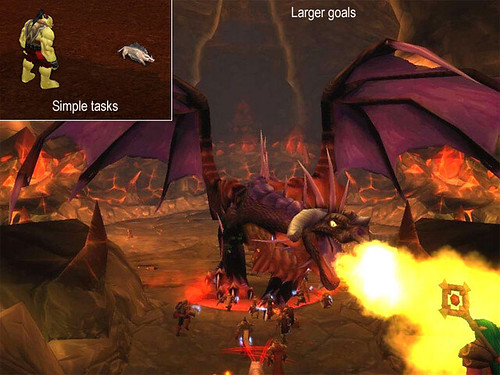
The traditional big events for problem-solving Math Circles are math competitions. There are many competitions, but Purple Comet! math meet stands out because of its clever, modern design. As other quality competitions, Purple Comet! offers children original, meaningful, interesting, tricky problems that are a joy to solve – that is, real mathematics. But there is more:
- Global network, local communities. Purple Comet! is an international festival and an online event – but it consists of local experiences with friends. The global network generates energy, problem-posing support, and the sense of scale that a local circle would not achieve alone. But local communities provide the depth of discussion, camaraderie and nurturing that a global network lacks. Together, the two aspects work their magic.
- Teamwork. The vast majority of math and science is done collaboratively, but children often take tests and competitions alone. Purple Comet! invites teams to solve problems together, only competing against other teams. This allows for more interesting types of problems. For example, some problems require insight, which is more likely to happen in group brainstorming. Other problems split into multiple sub-problems, so each person can tackle a piece of the bigger puzzle.
- Technology is welcome. While doing things by hand can be artistic, quaint, or cute, most children who love science and math, and of course all STEM professionals, use computational tools in their problem-solving. Purple Comet! problems are designed with computing devices in mind. The problems focus on ingenuity and reasoning, rather than memory or computation. However, many problems are based on number patterns, so students learn to appreciate how numeracy and computational fluency help in problem-solving.
- Self-checking. The design principle of self-checking goes back to Montessori. All problems have nonnegative integer answers. At the beginning, this principle made it easier to program Purple Comet! software. By now, it became an appreciated tradition. If a team gets a different sort of answer, they know to rework the problem. The known format of an answer is a hint, but not a big reveal, like knowing the correct answer would be.
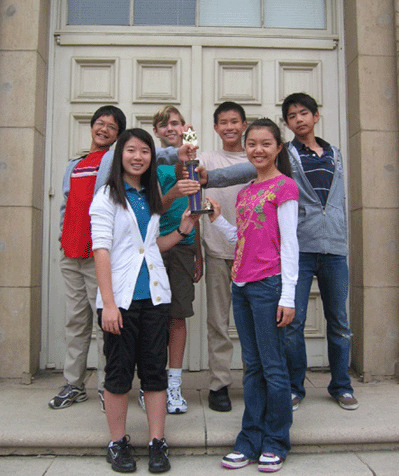
Photo: Pasadena Middle School Purple Comet! team
To share the joy, Titu Andreescu and Jonathan Kane of the appropriately named AwesomeMath assembled problems from the first ten years of Purple Comet! math meet in a hardcover book with beautiful, clean layout of formulas and diagrams. You can use the book as a source of problems for family math or Math Circles. If you are a designer, the collection will be a valuable source of strong practices in curriculum development centered on problem-solving.

This December, Purple Comet! and other books from AwesomeMath are 20% off.
Posted in Grow


