- Home
- “Yes, And…” Improving Math Play with Improv
- Althea’s Math Mysteries
- Avoid Hard Work, the Workshop
- Avoid Hard Work! …And Other Encouraging Problem-Solving Tips for the Young, the Very Young, and the Young at Heart
- Blocks and Modeling: A Do-It-Yourself Guide to Exploring Geometric Objects – Online Workshop
- Blog
- Books and Goods
- Bright, Brave, Open Minds
- Bright, Brave, Open Minds: A Problem Solving Kaleidoscope. Open online course for parents and teachers
- Camp Logic
- Cart
- Checkout
- Citizen Science Station
- Consulting and Tutoring
- Courses
- Download File
- Easy Complexity and Special Snowflakes Online Math Circle
- Empires: Year-long prealgebra program in a game
- Expedition Everest
- Five Fabulous Activities for Your Math Circle
- Funville Adventures: Math Personified!
- Funville Web Tour
- Hacking Math
- Hiding in Plain Sight: Vyshyvanka Secret Codes
- Home
- HOW do they do it? Creating your own math puzzles
- Inspired by Calculus: Online course for parents, teachers, and their children ages 5-12
- Kingdom On A Wall
- Kingdom on the Wall
- Ko’s Journey Is Discontinued
- Lapware
- Math Books
- Math Cafe
- Math Circles
- Math Circles 1001 Leaders Course
- Math Future event registration
- Math Future: come and talk!
- Math Goggles Challenges
- Math Renaissance
- Math Trek
- Mathematics & Poetry for All
- Meet the authors
- MidSchool Math Digital Math Tools
- Moebius Noodles
- mpsMOOC13: Problem Solving for the Young, the Very Young, and the Young at Heart
- Multiplication Explorers FAQ
- Multiplication Explorers LIVE workshop
- Multiplication Explorers Online Course
- Multiplication Explorers Registration
- Multiplication Explorers, the book
- Multiplication Models Poster
- My Account
- Natural Math Multiplication Course
- Online Logic Summer Camp for Kids!
- Online Summer Calculus for Kids Camp!
- Pay Natural Math
- Playing with Math: Stories from Math Circles, Homeschoolers, and Passionate Teachers
- Reviews of the Moebius Noodles book
- September 25: Math Storytelling Day
- Socks Are Like Pants, Cats Are Like Dogs
- Speaking and events
- Start Here!
- test001
- The Art of Factorization Diagrams
- The Iditarod
- The seven principles of Natural Math
- Transformers: Matrices & Graphs!
- Veronica’s Multiplication: a Natural Math circle online
- WOW! Multiplication – an open course in September 2013
- Ying and the Magic Turtle
- About Natural Math
- Contact Us
- Get Involved
Do your kids draw grids? Part II: shape-filling grids

Want to participate in citizen science, collecting data of children’s math art? Happy to display your child’s creations beyond your the fridge? Then send us grid drawings!
Thank you, Alexia Idoura, Maria Genkin, and Dan White for sharing your children’s art and stories.
Here is Part I of “Do your little kids draw grids?” And here is the fresh grid art, with a few comments on the psychology of math ed.
Alexia Idoura: This is one of Maxime’s grids from preschool – still have on my bulletin board!
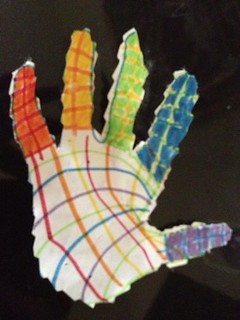
Filling shapes with girds is more challenging than it looks. Notice how Maxime decided to continue grid lines from the edges of fingers to the edge of the thumb, rather than to the wrist? This allowed her to make the lines across, and still fill the space of the palm. She also changed the spacing and direction of the lines on the palm, but not on the fingers – because she was very aware of the boundaries! To make it work, it took a pretty sophisticated analysis of the shapes. Some five years later, Maxime is still doing grid art, rocking fractals at our Inspired by Calculus Math circle.

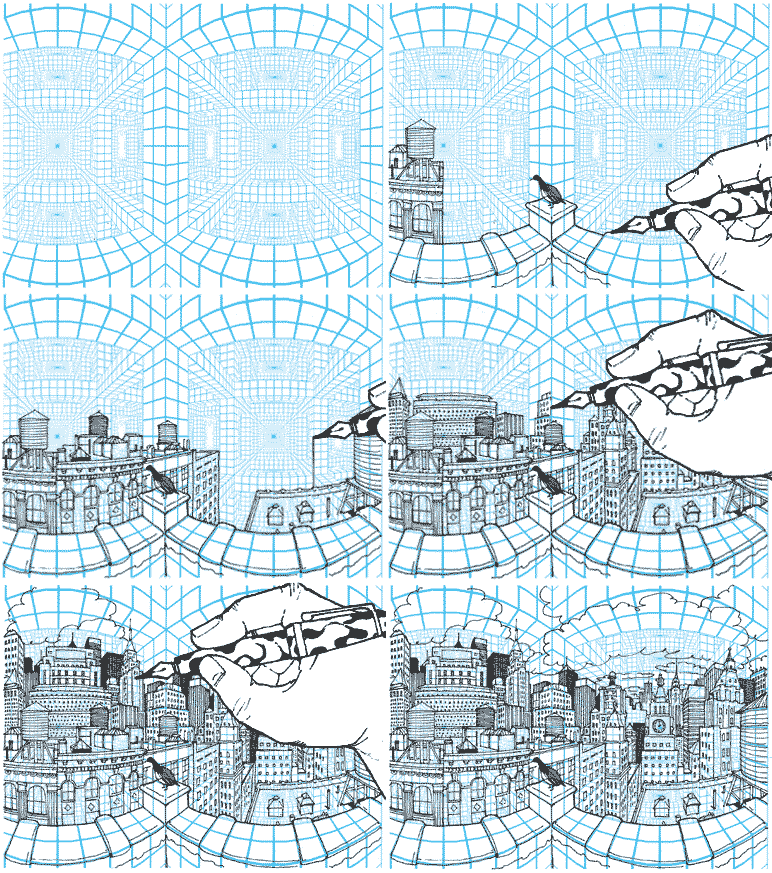
Here are two related grown-up art projects. David Chelsea‘s curvilinear perspective fill spheres:
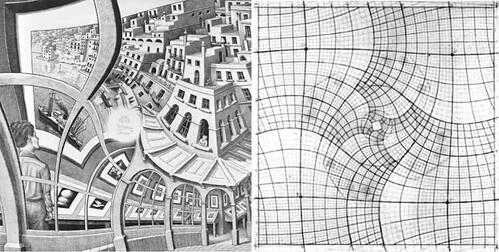
Escher nested grids, also called Droste Effect fractals, fill curved spaces:
Maria Genkin gave me permission to post her son Ronik’s art. In Maria’s blog post with the pictures, she laments that young kids are pressured to adopt a primitive visual language of representational art, like stick figures and square houses with triangular roofs. I hope our collections of grids will help parents value and appreciate kids as abstract artists.
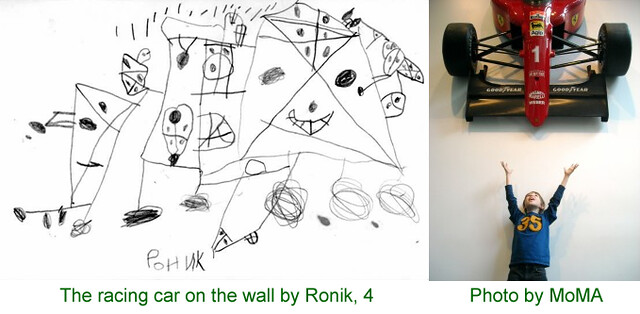
Note how Ronik uses different criss-crossing patterns to fill different shapes: the heart, the smile, kite-like forms. Check out the nested (fractal) element at the top of the “face” of the car. The square is separated by the diagonals, then the topmost triangle is separated some more. This grid within grid is an advanced stage in children’s grid art.
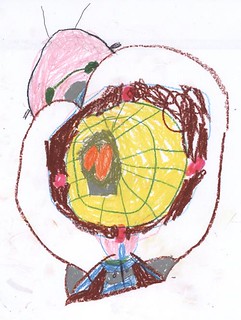
Here is another picture by Ronik, turning concentric circles into a grid. Before they learn to draw grids, children draw spirals or circles, by moving their hands around and around. They sometimes learn to do so before their first birthdays, but typically between two and three years of age. Even older kids often start an art project with concentric circles, and then turn it into a spiderweb grid.
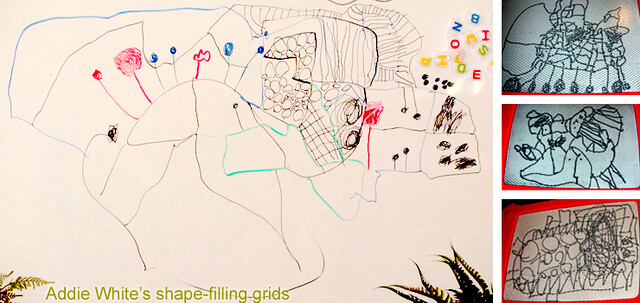
Dan White says his daughter Addie (5) has been drawing grids for a while, more and more as she’s growing older. Addie often fills shapes with a variety of grid-like, regular textures, including parallel lines, zigzags, rows and columns of circles, and square grids. The creative math/artistic puzzle or problem with each of these grids is, “Which texture goes well with each shape?” You can see a curious stage of cognitive development in the top right corner of the picture above. Note how Addie (almost 3) drew a grid cell by cell by cell, rather than making longer lines cross. Some of the cells line up, but mostly they do not. In the bigger picture on the left, Addie (almost 4) drew some grids by crossing long lines, and some by arranging individual cells – this time, lined up much more. In this picture, Addie can line up cells by hand, because she now has a stronger image of grids in her mind.
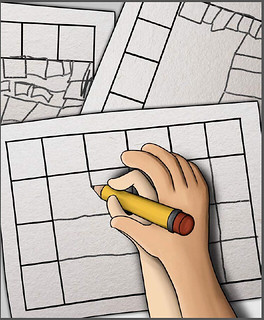
Above is the illustration of the cell-by-cell grids from Moebius Noodles: Adventurous Math for the Playground Crowd. It comes from the chapter about doodle games parents and kids can play with grids.
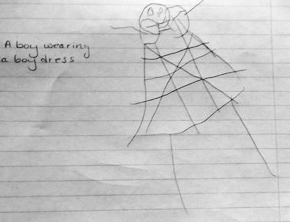
In this more recent picture, Addie superimposed diagonals (which form triangles) over a square grid. That is, she built the new structure right over the old structure already in place. That is somewhat difficult, like speaking over another speaker. It requires pretty reliable mental images of the grid structures.


Posted in Make
Mood-o-meter, 0/0 yin-yang, books with friends: Newsletter December 2
Got this from a friend? Reading online? Subscribe! I am Moby Snoodles, and this is my newsletter. Send me your requests, questions and comments at moby@moebiusnoodles.com 
Questions and answers
Help @remypoon at the Ask and Tell hub with this new question:
How can we help young students to know learning mathematics is more than just getting the answer? Click to reply.
Sheryl Morris emailed Moby:
Manipulatives don’t always help – they sometimes impede learning. How do you feel about manipulatives?
Moby:
Here are some examples of known issues with manipulatives.
- Kids are driven to distraction and totally free play, away from any math whatsoever.
- The manipulative only represents one aspect of an abstract idea, but kids are forever stuck with that aspect, because the manipulative is so memorable (e.g. multiplication as repeated addition).
- Kids don’t know where the analogy in the manipulative breaks down (e.g. that points aren’t really tiny dots). No manipulative can capture a math idea completely and absolutely right.
- Often manipulatives aren’t sustainable. They take a lot of time to make, or a lot of money to buy – while a kid only spends a few minutes using them.
I feel that the best use of manipulatives is for students to MAKE them!
Bright, Brave, Open Minds: an online course starts December 2
More than 70 participants registered for the open online course on problem-solving by Julia Brodsky. The goals of the course are to help parents and teachers preserve children’s divergent thinking, and to develop critical thinking and problem solving skills. The course is the last round of crowd-sourced feedback for the Creative Commons book Julia is writing. 
Blogs and networks
Try an easy math craft: two paper gears that make mood-o-meter smileys, from our Facebook friends at New Gottland. The table on the right is like a multiplication table… of moods! 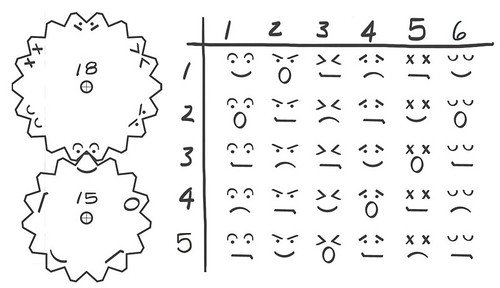 When you need lapware (software for the kid is on your lap), try the PhotoSpiralysis nested fractal maker with your kids. My young guests and I had a lot of fun with it this Thanksgiving.
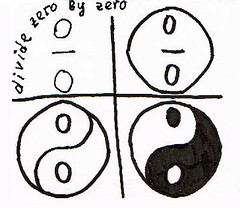
  Michel Paul discovered the zen of dividing zero by zero when he circled an expression on the blackboard. Loren Renee commented: “It’s a “pair of ducks” as my son used to say.”
  Yelena McManaman’s blog post “Fluency or complexity” sparked a discussion at our Facebook page.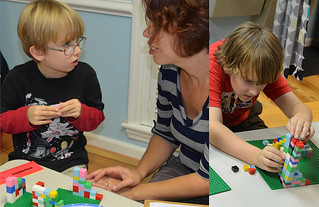
- Yelena: I am very proud of my 6-year old and the math discoveries he makes. Two days ago he came up with a proof that zero is an even number. Yesterday he built something he called “a square that has volume” (a cube), then connected 4 of them into a larger cube. And today, well before I had time to drink my morning tea, he shared his new discovery – turns out, Russian nesting dolls are fractal! I am very concerned about my 6-year old’s struggles with math. He still gets mixed up counting past 10. He is shaky with his math facts. He still needs to use fingers, counting bears or abacus a lot.
- Jeremy Vyska: I imagine it’s much the same way kids can do complex things like riding bicycles, climbing various playground equipment, etc; then have issues of tripping while walking. Practice will make the simpler things resolve/repair over time.
- Malke Rosenfeld: Most of the children I work with (upper elementary) do not yet have the skills they need to learn and perform complex percussive dance steps. I still wanted to give them a sense of what it feels like to dance in my art form, and also to create their own dance steps. How to do this without a lot of technique? I created Jump Patterns which allow children to think, create and communicate within the discipline. Their technical skills are developed on a parallel track.
- Kyle Griffin: Many of us who love chatting with our young children about the ideas of calculus and relativity and such still recognize an enormous gap between “ideas” and ability to do. I personally find that most of the time, one eventually hits a point with the ideas where the inability to do the thing results in an impenetrable barrier. That’s not to say that the idea-set isn’t fun, useful, interesting, and motivational. But it’s also nearly 100% independent of what other folks will care about in a child’s education. “I don’t care if you know the theory of good writing. Can you write well?”
- Peter Appelbaum: The misnomer that counting and arimethmetic is somehow fundamental to other kinds of mathematics really does lead to so many missed opportunities. Think if all of the successful mathematicians who are calculation-phobic. Of course, this is how ideology works. It masquerades as “reality.”
Book news: sharing with friends and math circles
Several people asked for easy ways to order Moebius Noodles: Adventurous Math for the Playground Crowd for a group of friends or a buyer coop. Now you get discounts if you order with a friend or three (2-4 copies), with your math circle (5-10 copies), or with a larger learning coop. You also save a lot on shipping. Happy holidays! 
Sharing
You are welcome to share the contents of this newsletter online or in print. You can also remix and tweak anything as you wish, as long as you share your creations on the same terms. Please credit MoebiusNoodles.com More formally, we distribute all Moebius Noodles content under the Creative Commons Attribution-NonCommercial-ShareAlike license: CC BY-NC-SA  Talk to you again on December 15th! Moby Snoodles, aka Dr. Maria Droujkova
Posted in Newsletter
Infinite thanks!
Infinite thanks to everyone who participates in our math adventures – kids, parents, teachers, readers, developers, artists, writers, researchers! Thank you, friends!

You can make your own fractal words with FractType, and nested fractals with PhotoSpiralysis.
Posted in Make
Inspired by calculus: Friday math circle, Week 3
All the photos from this club | Parent notes
This week we had a high-energy meeting with longer flows. When I run math circles, I prepare about five times more activities than I think I’ll need. Sometimes an activity does not work, and we switch. Other times there is good flow, but it only lasts a short time per activity, and we hop to something else. This “hopping” often happens in new groups, as you could see in Week 1. That’s because I am inviting participants to a new exciting land – a new contextual neighborhood to explore, in this case, looking at infinity, infinite sequences and cycles, infinitesimally small objects, and change. The following weeks, I try to focus on types of activities the kids liked, or questions they asked. To follow the travel analogy: at first I drive kids around on a tour bus. Next, we take day trips to the areas kids pointed out through the bus windows. My design goal is self-organized learning within most of the activities. I may point out an interesting feature to explore (such as slope of rides, when you build an amusement park) – but then kids do most of their own poking around. Some kids want to keep working on activities for a long time. It’s a hard decision to try and invite them to switch tasks, because in general, you want kids to work on what interests them for as long as possible…
Is this unschooling, or Sudbury freeschooling, or Reggio Emilia? Yes and no. Parents and I follow children’s interests a lot, and each kid has the freedom not to do each proposed activity (though there is the group pressure). The big difference is that I do stir kids toward a particular contextual neighborhood. The GPS is rigged to point to calculus. Wherever kids go, there they are near infinity, change in functions, cycles and series… One funny effect many parents report: kids see infinity everywhere! In branching trees, in love that never ends, in generations of families that go on…
Kids are right: calculus is everywhere, because it is a way of describing any object, much like storytelling or photography. You can take a photo or tell a story of anything whatsoever. Or you can make a mathematical model of anything, using a big math area like calculus, or using one powerful concept. When we went on the scavenger hunt for symbols, kids pointed at everything: toy cars (model-symbols of real objects), words (name-symbols of objects), light switches and outlets (action-symbols as means of control, and indicator-symbols), facial expressions or gestures (index-symbols of moods or actions)… “Symbol” for kids – and for mathematicians – is a tool for describing all of the world. Seeing math everywhere is very similar to the magic of pretend-play.
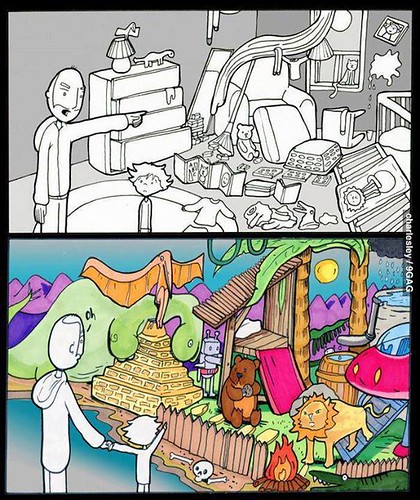
Thanks to Dor Abrahamson, my contextual neighbor, for this week’s discussions and references (1, 2, 3) about children’s symbols.
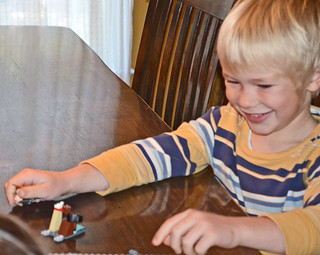
Share your favorite things. We continue to seek math in the favorite things kids bring. It’s a little the circle-starting ritual. In this case, a Lego person fighting a vine! Sure, we could find a lot of numbers, but what about infinity? Wouldn’t it be nice if LEGO blocks went to infinity? “All over the house! All the way up to space!”
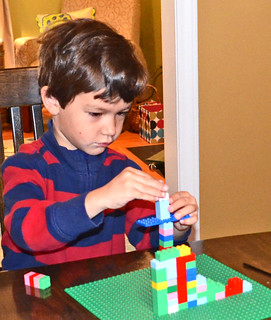
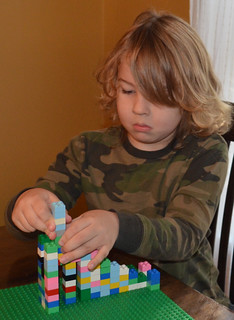
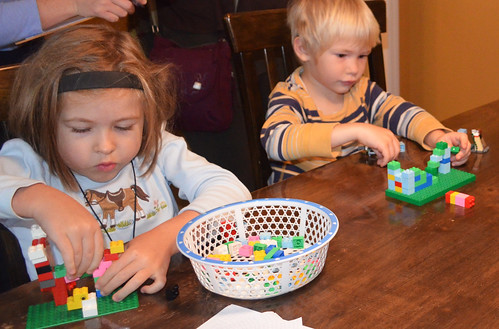
Slopes. Jill the amusement park manager and her trusty droid helper Jack are building some rides. They start with no slope – or rather, zero slope – because it’s the easiest to program. But the park visitors are demanding steeper and steeper slopes…
Kids started with free building (towers, animals, etc.) but as I told the story and built “rides with slopes,” shifted to structures with slopes. Children only need to pay a bit of attention for this shift to happen, maybe 20-30% of their attention, if that. Here we are comparing our slopes:
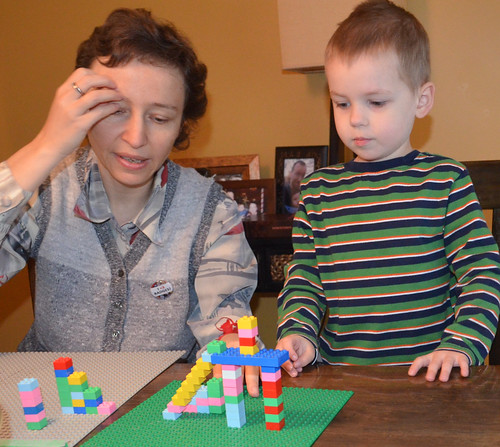
Kids don’t necessarily like constant slopes, or pay enough attention to consistency to keep their slopes constant. In the future, I will probably stress the change of slopes more, and consistency less. We want changing slopes anyway to get to the calculus ideas like tangents and limits! At home: notice slopes!
Symbols. Kids asked about symbol activities from the last time, so we continued. What do you love? Make up a symbol for it! This is a simple but rich task. As most maker tasks, it requires analysis of ideas and some skill with crafting. Kids did not know at first what can symbolize Spiderman, or all animals. “What if I can’t draw any animal?”
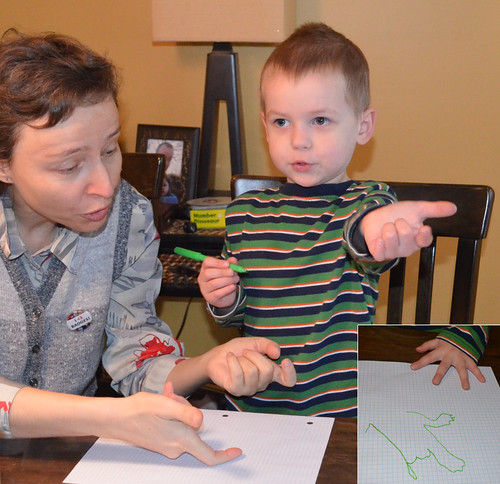
“This is what Spiderman does!”
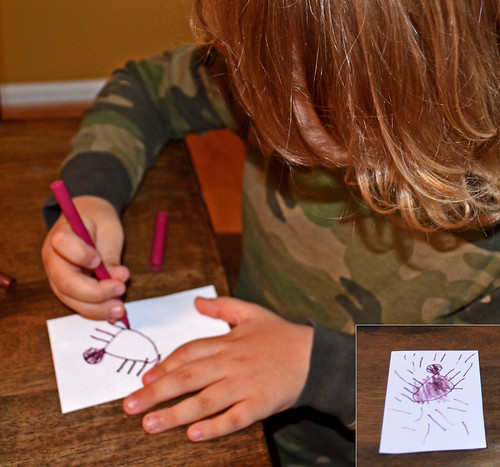
“And the symbols for all the web Spiderman shoots.”
To help those who get stuck with drawing, hold the kid’s hand in yours. Don’t guide any more than the kid wants: you mostly help the kid to keep the hand steady. Talk through the drawing: “We are doing the head first – it’s a big circle. Ears are triangles. Now the body, even bigger and more like a curvy oval…”

At some point, most kids take their hand away and draw on their own. At home: make up all sorts of symbols, and notice symbols. Here are a few types kids like:
- Iconic symbols show what they symbolize, like Batman’s bat silhouette
- Models are toy or simplified versions of objects that stand for real objects in pretend-play
- Names are words. Is “mom” a name symbol?
- Abstract symbols have no connection between their look (or sound) and their meaning, for example, 5 for five objects or five units of length.
- Action-symbols control something, like a light switch
- Indicators show something is going on, for example, most stoves have lights that show the stove is hot
Weird pictures. Kids drew objects, and parents helped them make tree (branching) fractals out of these objects. Or at least enough levels for kids to imagine the structure going to infinity!
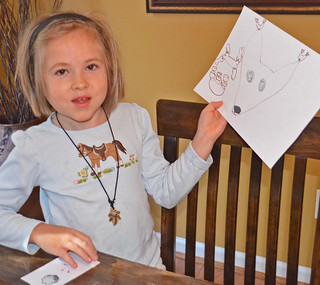
Fractals connect ideas of infinity, cycles, zoom – and are very handy for introducing powers and logarithms. Fractal thinking is a powerful tool for understanding the nature – and for making beautiful art.
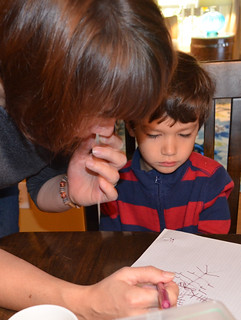
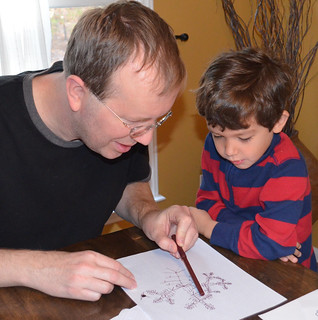
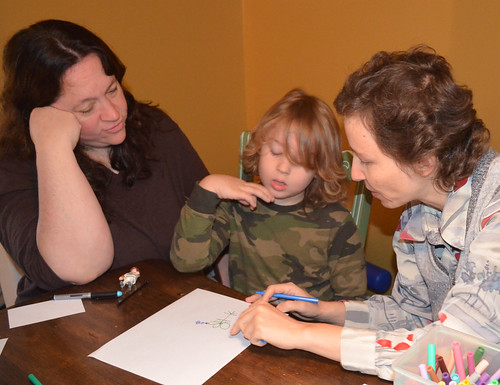
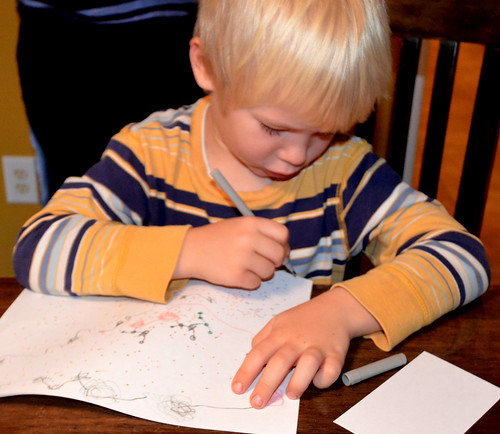
Some kids like to draw abstract shapes. They may tell what shapes mean, or not. It’s okay if children art does not look like anything; consistent abstract patterns are mathematically interesting, and have their own beauty. This abstract piece had a big story to it:
Videos for inspiring fractal art. Fractal hand and Cows&Cows&Cows, by the same author, cyriak.

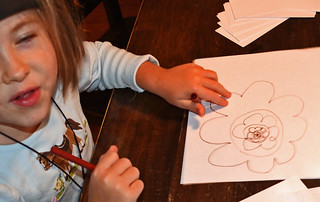
Bonus: a Droste Effect (nested doll fractal) flower.
Posted in Grow


