- Home
- “Yes, And…” Improving Math Play with Improv
- Althea’s Math Mysteries
- Avoid Hard Work, the Workshop
- Avoid Hard Work! …And Other Encouraging Problem-Solving Tips for the Young, the Very Young, and the Young at Heart
- Blocks and Modeling: A Do-It-Yourself Guide to Exploring Geometric Objects – Online Workshop
- Blog
- Books and Goods
- Bright, Brave, Open Minds
- Bright, Brave, Open Minds: A Problem Solving Kaleidoscope. Open online course for parents and teachers
- Camp Logic
- Cart
- Checkout
- Citizen Science Station
- Consulting and Tutoring
- Courses
- Download File
- Easy Complexity and Special Snowflakes Online Math Circle
- Empires: Year-long prealgebra program in a game
- Expedition Everest
- Five Fabulous Activities for Your Math Circle
- Funville Adventures: Math Personified!
- Funville Web Tour
- Hacking Math
- Hiding in Plain Sight: Vyshyvanka Secret Codes
- Home
- HOW do they do it? Creating your own math puzzles
- Inspired by Calculus: Online course for parents, teachers, and their children ages 5-12
- Kingdom On A Wall
- Kingdom on the Wall
- Ko’s Journey Is Discontinued
- Lapware
- Math Books
- Math Cafe
- Math Circles
- Math Circles 1001 Leaders Course
- Math Future event registration
- Math Future: come and talk!
- Math Goggles Challenges
- Math Renaissance
- Math Trek
- Mathematics & Poetry for All
- Meet the authors
- MidSchool Math Digital Math Tools
- Moebius Noodles
- mpsMOOC13: Problem Solving for the Young, the Very Young, and the Young at Heart
- Multiplication Explorers FAQ
- Multiplication Explorers LIVE workshop
- Multiplication Explorers Online Course
- Multiplication Explorers Registration
- Multiplication Explorers, the book
- Multiplication Models Poster
- My Account
- Natural Math Multiplication Course
- Online Logic Summer Camp for Kids!
- Online Summer Calculus for Kids Camp!
- Pay Natural Math
- Playing with Math: Stories from Math Circles, Homeschoolers, and Passionate Teachers
- Reviews of the Moebius Noodles book
- September 25: Math Storytelling Day
- Socks Are Like Pants, Cats Are Like Dogs
- Speaking and events
- Start Here!
- test001
- The Art of Factorization Diagrams
- The Iditarod
- The seven principles of Natural Math
- Transformers: Matrices & Graphs!
- Veronica’s Multiplication: a Natural Math circle online
- WOW! Multiplication – an open course in September 2013
- Ying and the Magic Turtle
- About Natural Math
- Contact Us
- Get Involved
Inspired by Calculus: Friday math circle, week 2

These are notes about young calculus adventures at a family Math Circle, a part of the Inspired by Calculus series. This week, we worked more on iterations and growth functions, and started to look at symbols. Thank you for the notes, Sue and Andrea! Thank you for taking pictures for our gallery, Linda and everybody who helped!
Parents had the quest: collecting data about the level of freedom in children’s activities.

You can download or print the current version of the quest. When I design activities, I aim at one of these three levels of freedom, but sometimes I miss:
- Problem Solving. Students receive problems with known answers. They have the freedom to use, develop, or acquire any method of solving the problems.
- Inquiry. Students receive open-ended problems with infinite possible answers. They have the freedom to interpret the nature of answers, as well as choose methods of solving the problems.
- Self-Organized Learning. Students choose (or accept an offer of) a broad starting area, and pose problems or projects within that area. They have the freedom to make their own problems, to interpret the nature of answers, and to choose methods of solving their problems.
LEGO function machines. Last time, we had a function that added one to inputs. This time, I asked kids to change the rule about differences. As a side note, kids often try to suggest the same exact rule or pattern you have offered before. They may or may not realize it’s the same, because they have “appropriated” your idea for themselves! You can just explore the pattern again. Or you can point out the similarity, and praise the kids for their understanding of the idea. There are three aspects of these activities that have to do with calculus. First, I invite kids to imagine the iterations of the function machine going on and on and on – to infinity. Several kids commented on such infinite growth being difficult, or spooky, which we should acknowledge and discuss. Children don’t have barriers against the depth of math ideas, which is a good thing for learning, but also somewhat dangerous if adults push. Mason: “I can’t imagine that – because I don’t want to go to infinity.” Second, I talk about the outputs of these function machines in terms of differences. When kids suggested the machine that adds two, Traver really got into the spirit of helping with the differences and prepared a whole bunch of two-block towers.

Third, we check if the result is a straight-line slope or not. I use the word “linear.” When I asked for yet another function machine idea, Mason made up the identity function: one block comes in, one block goes out… forever.

This was funny for kids, which is typical of extreme case scenarios (multiplying by one or zero, adding zero, identify function and so on). Well, until we run out of blocks and space. Engineering-minded kids like to point out limitations of our physical space. It is a fun scavenger hunt: what stops us from going to infinity and beyond? At home: come up with rules for your own function machines.
Free building. This took place at the same time as discussions of function machines.

Lucas built pyramids (we checked if the sides were straight lines), Mason made several constructions including a “periodic tower,” and Traver made a square pattern.

I invited kids to grow the square pattern more. We worked on it together for a while, and then I made towers out of layers of the pattern.

Do the towers made out of perimeters of squares have linear growth? Are they supposed to? I think kids got tired by that time, so I doubt they were analyzing the situation much at all, beyond the initial exposure. We will return to these questions later. Free building allows us to continue exploring what kids start – that is, to help them deepen their own ideas. At home: continue to support free play. Find math in what kids do, and point it out for them.
Scavenger hunt for symbols. I gave a couple of examples, and said that symbols are signs that mean something, and off we went around the house to look for some.

The first example was the pumpkin and the word “Halloween” as symbols of Halloween, on a toy Mason brought. I never described or defined symbols in detail, because it does not matter. The idea of symbols is a human universal, meaning that every culture has some sort of symbols. Human universals are everywhere around us, and kids pick them up – even if they don’t know the words. After just a few examples, kids were pointing out all sorts of symbols, such as the word “kiss” for love, a toy truck decal for a particular truck show, a barcode for an apple price, and the upward position of the light switch for turning lights on.
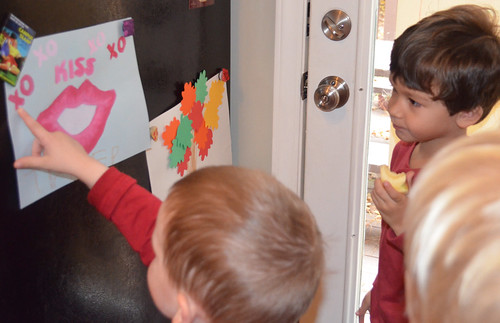
This last is an example of a beautiful aspect of young children’s thinking about symbols. If you ask grown-ups for examples of symbols, they come up with abstract signs (like 5 for five objects) or icons (like wheelchair for handicapped parking). But kids come up with objects as well, like the light switch. Researchers used to connect this with magical thinking (like a shaman using a doll to “cause” rain), but it’s about modern interface design. A button, a switch, or a slider are symbols for actions – but symbols that do cause actions to happen. “Any sufficiently advanced technology is indistinguishable from magic” – Arthur Clarke. At home: seek more symbols!
We had a neat little conversation about symbols when Eric and Traver were helping me bring stuff to the car. Traver gave me an oak leaf and said it means good luck.
- Maria: Is this leaf a symbol of luck?
- Traver: Yes!
- Maria: Why?
- Traver: …
- Eric: What makes you think it is for good luck?
- Traver: … (silence often means you are asking questions that are very far from how kids think)
- Maria: Is there something in the way the leaf looks that makes it lucky? Or is it an abstract symbol – just so symbol?
- Traver: Just so symbol!
You will see kids use abstract symbols for ideas, and make abstract drawings. When we ask kids to explain reasons, or to make their drawings look like objects (representational art), we can close some doors to abstraction. Let’s celebrate just so drawings, just so symbols, and other abstract play.
Apple math. We repeatedly cut an apple in half.

Older kids usually predict that the number of pieces will go 2, 4 – then 6 (since kids are used to counting by twos). Younger kids had no such issue! They saw the situation for what it was, without preconceived notions. It’s typical for kids to compare graphs or other math entities to familiar objects.

The grown-up version of the same mini-game is making pictures out of graphs. Desmos, my favorite grapher, hosts a nice collection.

Video: Infinity elephants. Because most of the kids can’t yet draw or build like Vi Hart, or relate to much of her funny speech, the video was very abstract for them. Yet they watched to the end, and their doodles afterwards were very mathematical. I wonder if our math activities inspire kids to draw more math.
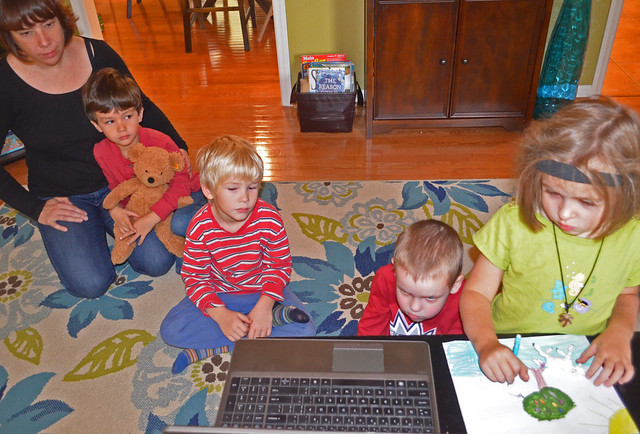
Math-rich doodles. I like to analyze math aspects of children art. For more than ten years, I’ve been collecting kid pictures of grids, like Lucas made. Please send me yours if your kids make them.

If you see math elements in pictures, you can invite kids to do more of the same type of math, at deeper levels. They appreciate it, because you follow their ideas. Here is where I want to invite kids based on their free doodles:
- Mason made many-eyed aliens, Travor made a version of a smiley fractal I drew, and Lizzie made a version of Vi Hart’s Apollonian Gasket noodle. We will do more art based on these ideas of grouping (aliens), branching (smileys) or partitioning (gasket).
- Grids, of course, like Lucas made – they lead to a lot of math, from coordinate planes to integration in calculus. I want to invite kids to make curvy shapes out of square blocks as one version of grid art.
- Mason’s circles within circles is, like grids, another recurring pattern in children art. They remind me of nested dolls. This pattern, and also spirals, has to do with infinity. The nested squares kids built out of LEGO are similar. Lucas had circles within circles going. Trying to completely cover the page with many lines is another recurring train in children art.

- Travor made a Ferris wheel – it’s a variation on a theme with regular intervals, like grids have. We may go on a scavenger hunt for patterns made out of regular intervals, or changing intervals. This can be related to what we are doing with functions.
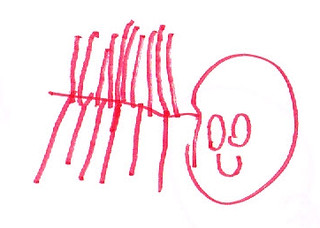
Mason made a spider with “many, many legs” – a similar motif.

I don’t claim kids see these connections, yet. But if grown-ups see the connections, they can start from children’s own art, and take children to bold math adventures.


Posted in Grow
Fluency or Complexity

I am very proud of my 6-year old and the math discoveries he makes. Two days ago he came up with a proof that zero is an even number. Yesterday he built something he called “a square that has volume” (a cube), then connected 4 of them into a larger cube. And today, well before I had time to drink my morning tea, he shared his new discovery – turns out, Russian nesting dolls are fractal!

I am very concerned about my 6-year old’s struggles with math. He still gets mixed up counting past 10. He is shaky with his math facts. He still needs to use fingers, counting bears or abacus a lot.
Where am I going with this? At the last Inspired by Calculus math circle, the kids were building LEGO towers so that the number of blocks in each tower was double the number in the previous tower – 1, 2, 4, 8, 16… It seemed that most of the kids, including my son, struggled with the doubling part. Whether they multiplied or added, they kept making mistakes. The goal of this building activity, by the way, was to check whether such doubling function would be linear or non-linear. Which got me wondering whether I am putting the proverbial carriage ahead of the proverbial horse when it comes to my child’s math education.

When I talk to friends about advanced math for very young kids, one of the first reactions I get is, “This is cool and I’d like to try it with my child just as soon as he learns to count/add/multiply.” When I say that many of the activities can be done with kids who don’t know any of these things yet, or are not fluent yet, the question I get most often is not, “How does it work.” It is, “Wouldn’t it be better to build up their arithmetic skills first?” And frankly, I ask myself this same question whenever I see my child stumbling with his “required skills” work.
Does it really have to be one or another? Is it possible to really understand complex mathematical ideas without firm grounding in basic arithmetic?
Right now, for my son and I it’s a question of enjoyment. He loves going to math circles and problem-solving with friends. I love that he notices math all around him now. He loves that doing math can be funny. (Cats need meat for breakfast, lunch and dinner. Grandpa says he needs meat for breakfast, lunch and dinner. Grandpa is a cat.) I love that he uses math to communicate complex ideas and deep observations. He loves watching Fractal Cows, Infinity Elephants and Sierpinski Dream videos. I love watching these with him.
What do you think? Does exploring deep math very early helps to “get” the fundamentals?
Posted in Grow
Inspired by calculus: Tuesday math circles, Weeks 4 and 5
These are notes about a math circle for kids ages six to ten. Thank you for your write-ups, Kristin and Sally! All photos are in the set on Flickr.
This time, I talk about several activities that did not work as I hoped. In hindsight, I think I know how to fix the experiences, and what to avoid in the future. I am sharing these notes to help parents and designers, and to ask for input. Please tell me what you think on how to improve, and ask your kids. Even knowing such experiences are necessary for innovation, it’s hard for me to write about experiments that fizzle.
There is an endless list of design issues that make activities go south, for example, the room is too small, the rules are too numerous, not enough storytelling to feed the imagination, manipulatives distracting from ideas, and so on. There are many checks and balances between too much and too little of this and that. But if children have enough freedom, and sympathetic adults, most of the time they just self-regulate in all these aspects!
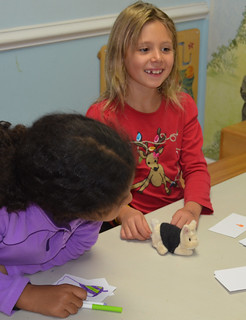
There are three levels of freedom in activities I choose or design. As a side note, the lowest level is more freedom that many textbooks or classes ever give students.
- Problem Solving. Students receive problems with known answers. They have the freedom to use, develop, or acquire any method of solving the problems.
- Inquiry. Students receive open-ended problems with infinite possible answers. They have the freedom to interpret the nature of answers, as well as choose methods of solving the problems.
- Self-Organized Learning. Students choose (or accept an offer of) a broad starting area, and pose problems or projects within that area. They have the freedom to make their own problems, to interpret the nature of answers, and to choose methods of solving their problems.
For example, the task of drawing infinity is at the third level, and the task of drawing Hotel Infinity so that all infinity rooms fit on paper is at the second level. I need to try harder for more third-level tasks. Impose too many restrictions (as in the shape tasks below), and you are in the first level territory, or even lower! Ouch!
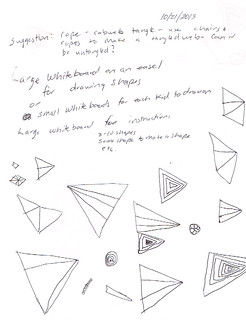
Shape out of similar shapes. The goal of this puzzle is to connect partitioning and grouping. We have been doing a lot of partitioning activities, splitting shapes into infinitely many pieces. Can kids reverse the process? I asked kids to make a shape out of similar shapes, but not infinitely many of them. This was an engaging, meaningful activity that I will use again. The fact it’s rather challenging, and takes a long time, is surprising, since we did a lot of “take shape apart” activities before. But any sort of reversal is challenging for kids. For example, if you introduce addition separately from subtraction, children find subtraction much harder to do. Taking square roots is often harder than squaring. I want kids to see seamless connections between partitioning and grouping, for example, positive and negative powers of ten, or fractions and multiples.

I loved that some kids made shapes out of one single shape, for example, a square made out of one square. This is an example of an extreme case. Looking at extreme cases is a valuable math practice, because you often notice new properties when you look at extreme cases. Kids who love to find loopholes in rules are especially strong at this math practice. Support it.
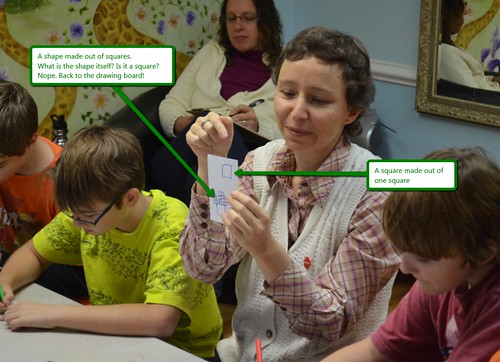
Another emergent behavior was to make “zoom shapes” or “frame shapes” that looked like nested dolls. I have tried the “shape out of shapes” activity with four groups of kids so far, and this idea came up in all four.
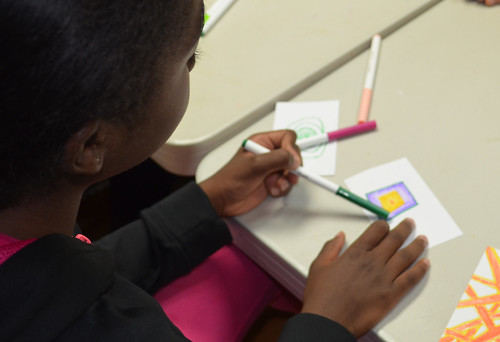
There are two strong math principles behind it. First, it works with absolutely any shape; the idea is powerful because it’s universal. Mathematicians always strife to make conjectures or rules apply to as many things at once as possible. That’s how they figure out how to take square roots of negative numbers, or divide by zero. The second powerful principle is from calculus. A nested shape consists of infinitely many infinitesimal thin strips. The same idea of thin strips is behind numeric integration. I don’t know yet how to turn this into a separate activity, but I will keep thinking about it. Maybe when we get to integration!
Formal rules: shape out of shapes. I told kids the next round of the puzzle will be more challenging. Here were the restriction to up the challenge:
- The big shape has to be the same type (e.g. a rectangle or a triangle) as the little shapes.
- No gaps or overlaps!
- The big shape is made out of two to ten little shapes.
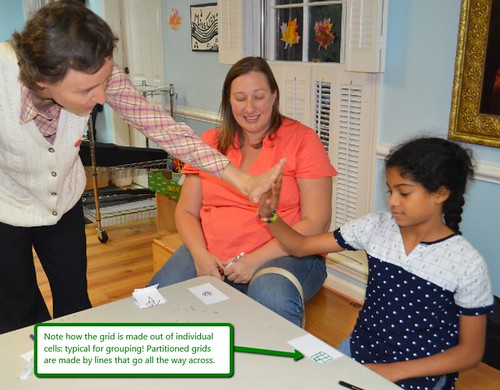
The goal of the restrictions was to approach a particular math topic, namely, decimal fractions and the corresponding fractions in different bases. I wanted to share my fascination with things like .9999…=1 and the whole idea of positional system viewed from the calculus perspective. But these ideas, in the form I tried to approach them, required rather narrow and symbolic path to them. For example, I narrowed down the requirement to make big shapes out of small enough number of little shapes, because I wanted kids to do the sub-divisions again and again and again. This I could not communicate, and so it came across nitpicky and random, and kids just did not follow. They continued with various doodles of infinitesimal shapes.
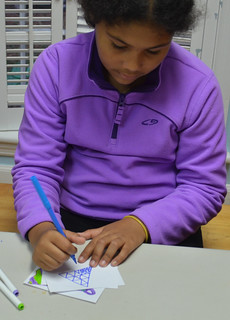
I think they suspected I am trying to take them out of the realm of calculus and into the realm of arithmetic, and resisted that. The three rules became more tedious than challenging. Even the idea of making a movie about the shapes was only momentarily exciting.
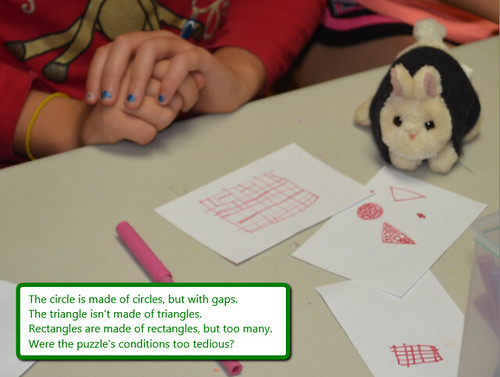
Shapes out of shapes: now with the story and a maker component. The week after, I attempted to salvage the activity by adding two components that generally make activities more alive. First, we tied it to the story of Hotel Infinity. Kids were to draw a group of 1-3 aliens that would go into one of the three hotels. Then kids were to make up a symbol for the type of the rooms within the hotel. It worked better, because stories and making things up are good to have, but there is still room for improvement.
Minuses: making up symbols for counting numbers wasn’t really enough of a maker activity for calculus, and wasn’t puzzling enough to make for strong problem-solving. Conclusion: increase the problem-solving (puzzle) component; clarify and strengthen the idea of symbols; and scaffold children’s attention to the development of the positional systems via a series of puzzles that can lead to better discussions of infinitesimals. Here are my notes for the future:
- First, go on a scavenger hunt for all sorts of symbols. Just telling kids “make up alien symbols” was too sudden, and required too much backtracking into what symbols are, anyway! But hunting for symbols is a fun activity for people of all ages. I’ve done it with groups before. My teen has done it in a philosophy class.
- Stick with one hotel at a time, but invite kids to pick one room instead of a group of rooms. I’ve done a variation of this with a group of kids at the MusArt camp, and it worked fast enough (~10 minutes) and was fun enough that they wanted to keep going longer than I did. So I could introduce multiple hotels next. This would lead kids into their own versions of positional systems with symbols. I think starting with Base 2 would work the best, because you only need to indicate the level within the hotel (the position) – like using 1 in a particular position in a binary number. Then we could make the puzzle harder by using Base 3, Base 5, Base 10… And ask kids to contribute shape ideas when hotels are built, so we can use someone’s favorite shapes.
- Add a stronger maker component focused on sequences and series, infinitesimals, or other related calculus ideas. I am not sure how to do this, yet. I think creating your own sequence may be engaging. At least if you judge by thousands upon thousands of submissions in the Online Encyclopedia of Integer Sequences. I want kids to be creative with what they make – using drawings and models, not just numbers. It’s not clear to me yet how to promote this aspect.
I later noticed that several kids used spatial symbols, for example, Chris used a planet with a ring for the sixths level (hint: Saturn), Ben used a flag to mean the top level, and Calvin used up-arrows to show that the alien can change its size and also needs to occupy the top level.
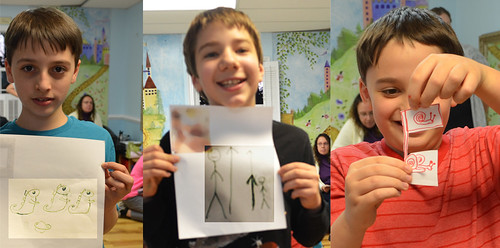
Jason and Kim both used objects to indicate the third level; they discuss their work with one another a lot, and sometimes their ideas develop together.
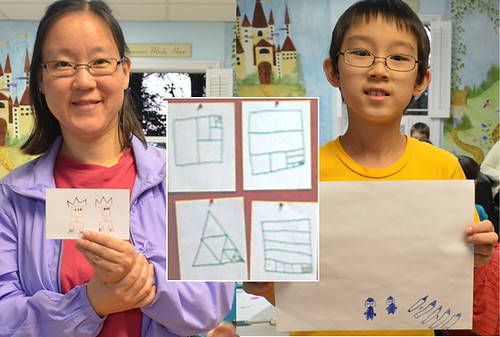
Other kids used number or quantity symbols: Maxime x4, Elena the mirror 1, Kaiya +2 and Asiyah two pumpkins. Stephen used 1 2 3 to indicate the third level.
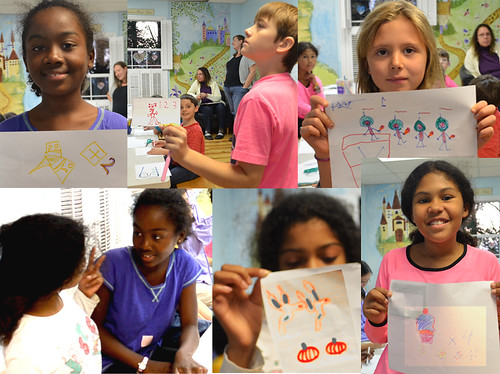
It is a joy to see ideas spread. I am happy the kids pinpointed the essential idea that levels of the power structure can be numbered, and came up with a variety of symbols. At home: come up with symbols for various ideas.
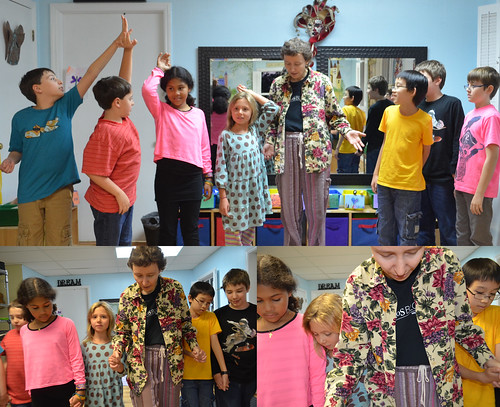
The Zeno walk. Can you reach the camera? What about all the infinity halves you have to pass? Zeno paradoxes are resolved through calculus. For example, the arrow paradox we roleplayed is resolved if you realize infinitely many time intervals can add up to a finite time total. And kids did explain this idea, in their own words. They weren’t very surprised, either. Some of the calculus ideas that baffle adults seem easy, almost trivial to kids. Wow.
Interactive: Universcale. I think the above activities helped kids to engage with the Universcale interactive at a deeper level. At home: find systems that zoom in and out, split or group, such as measurement units.

Posted in Grow
5 Halloween cartoon treats for little geeks
Have you seen kids sort their haul after Halloween? They often set aside their favorite candy – say, chocolate. This is what I did, with cartoons instead of candy, and math instead of chocolate.
1. Reverse costumes

Doctor Popular on Flickr says this really happened. I love it because reversals are challenging, and often clever. Consider: addition is so mundane, your dog can do it. But reverse it into subtraction, and you can invent negative numbers and do all sort of tricks with them, like be rich and in debt at the same time. A number times itself is square, but the reverse of square is even cooler. Just start with a negative number you got earlier, and take a square root (reverse-square). You will boldly go to an imaginary number universe where no one has gone before. At least, before the 16th century. For easier inverse functions, there is always algebra for toddlers at Moebius Noodles: The Book.
2. Math horror movies
Two horrible (pun, intended) puns from the (x, why?) blog, namely, these pages: (1, 2).


Puns take words or their meanings apart, and put parts back together again. A poet will appreciate the smooth rhythm of “Parallelostein.” I just like combinatorics. Among other things, it studies making objects out of parts to satisfy certain criteria, like making your friends groan.
3. Paradoxes
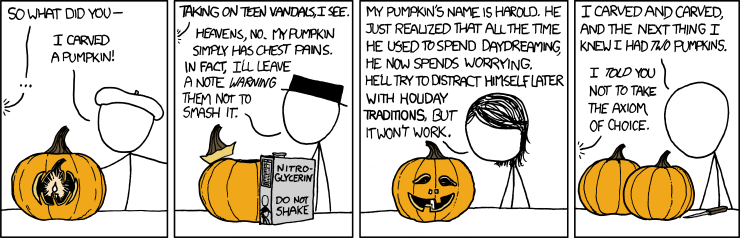
In the first panel of XKCD comic, you will recognize that annoying kid who later becomes a lawyer. It’s also a reference to self-reference paradoxes, for example, “This sentence is a lie” (Or is it?). The reverse psychology is also self-referential, with a sick twist. It works in the second panel, but does not work in the third, because of reasons. We’ll get to those in the graduate school version of this post. Meanwhile, let’s explain all about the Banach-Tarski paradox of the fourth panel. It claims you can cut a sphere into pieces, then rearrange the pieces into two spheres, as large as the original one. (…A 40-minute lecture later). Any questions? No, no, it does not work on spheres made of gold. Or platinum. Or any atoms. I wish!
4. Same costume
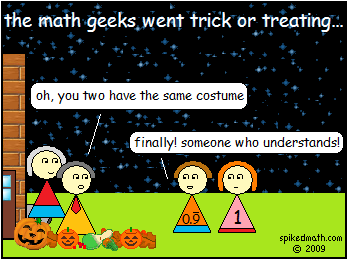
Cartoon by Spiked Math.
Speaking of paradoxes: psychology is full of them. Most adults easily believe that 1/3=0.33333… But multiply this equation by three, and the same people are puzzled, confused, and so angry with you it makes Yoda weep. Try it at a party, but be ready to run for your life. I want to study these strong reactions to .99999…=1 when I am done with my current grant, Contemporary Studies of the Zombie Apocalypse (NSF award #1315412). I think I will call the new grant proposal Decimals: Come To The Dark Side.
5. University is scary
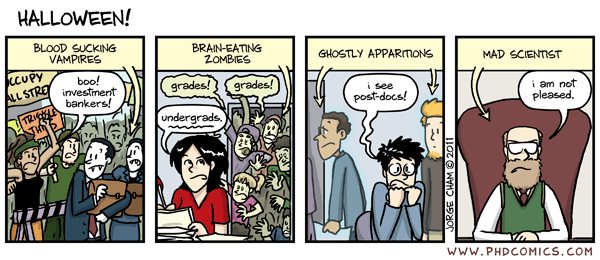
On the spook-o-meter, universities and their denizens rate somewhere between haunted dungeons and investment bankers. Piled Higher and Deeper (PhD) comics warn: if you kids want to be rocket surgeons, raise them to enjoy being scary!
Bonus: Fractal pumpkins
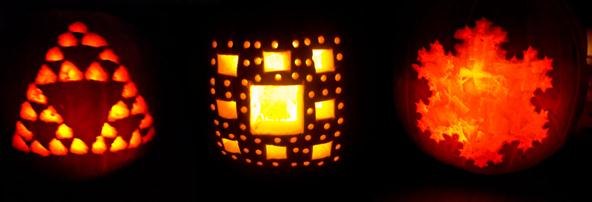
Your math homework from WonderHowTo: make a funny cartoon featuring these pumpkins.
Posted in Grow


