- Home
- “Yes, And…” Improving Math Play with Improv
- Althea’s Math Mysteries
- Avoid Hard Work, the Workshop
- Avoid Hard Work! …And Other Encouraging Problem-Solving Tips for the Young, the Very Young, and the Young at Heart
- Blocks and Modeling: A Do-It-Yourself Guide to Exploring Geometric Objects – Online Workshop
- Blog
- Books and Goods
- Bright, Brave, Open Minds
- Bright, Brave, Open Minds: A Problem Solving Kaleidoscope. Open online course for parents and teachers
- Camp Logic
- Cart
- Checkout
- Citizen Science Station
- Consulting and Tutoring
- Courses
- Download File
- Easy Complexity and Special Snowflakes Online Math Circle
- Empires: Year-long prealgebra program in a game
- Expedition Everest
- Five Fabulous Activities for Your Math Circle
- Funville Adventures: Math Personified!
- Funville Web Tour
- Hacking Math
- Hiding in Plain Sight: Vyshyvanka Secret Codes
- Home
- HOW do they do it? Creating your own math puzzles
- Inspired by Calculus: Online course for parents, teachers, and their children ages 5-12
- Kingdom On A Wall
- Kingdom on the Wall
- Ko’s Journey Is Discontinued
- Lapware
- Math Books
- Math Cafe
- Math Circles
- Math Circles 1001 Leaders Course
- Math Future event registration
- Math Future: come and talk!
- Math Goggles Challenges
- Math Renaissance
- Math Trek
- Mathematics & Poetry for All
- Meet the authors
- MidSchool Math Digital Math Tools
- Moebius Noodles
- mpsMOOC13: Problem Solving for the Young, the Very Young, and the Young at Heart
- Multiplication Explorers FAQ
- Multiplication Explorers LIVE workshop
- Multiplication Explorers Online Course
- Multiplication Explorers Registration
- Multiplication Explorers, the book
- Multiplication Models Poster
- My Account
- Natural Math Multiplication Course
- Online Logic Summer Camp for Kids!
- Online Summer Calculus for Kids Camp!
- Pay Natural Math
- Playing with Math: Stories from Math Circles, Homeschoolers, and Passionate Teachers
- Reviews of the Moebius Noodles book
- September 25: Math Storytelling Day
- Socks Are Like Pants, Cats Are Like Dogs
- Speaking and events
- Start Here!
- test001
- The Art of Factorization Diagrams
- The Iditarod
- The seven principles of Natural Math
- Transformers: Matrices & Graphs!
- Veronica’s Multiplication: a Natural Math circle online
- WOW! Multiplication – an open course in September 2013
- Ying and the Magic Turtle
- About Natural Math
- Contact Us
- Get Involved
Guest post: Math for a budding biologist

Karen Samuel Boley is the education director for Budding Biologist, a science ed company created by parents, for parents. Check out their Kickstarter for an ecological video game.
When we think of the convergence of math and science, we think of engineers designing an airfoil or biologists replicating bacteria. At the elementary school level, we tend to picture basic quantities: How much rain fell last month? How high did we build the block tower? It can be difficult to imagine teaching mathematics along with science and going beyond simple measurement.
Mathematical concepts are actually inseparable from science. So inseparable that we use mathematical concepts without even thinking about them. Activities that connect math and science are easy to do in and around your home.

Symmetry is everywhere in nature. Help your child find the lines of symmetry on leaves, and then try it with animals!

By Ernst Haeckel
Natural objects can also be used to illustrate reflections, rotations, and translations – or flips, turns, and slides. How do you move objects to make patterns and design? Children can find tessellations in nature, whether they are on a pineapple, or made by flipping leaves.

Chemistry uses ratios. If we want to make a larger quantity of a compound, we have to add its ingredients in the same proportion, no matter how much we want to make. To explore ratios, children can help with cooking. If you need one cup of rice to serve two people, how many cups do you need if you want to serve four people?
Many young children are familiar with patterns. You can point to patterns in clothing and ask if your child can figure out what would come next. You can show them patterns on animal skin, scales of a snake, the placement of needles on the branch of a pine tree, veins on a leaf, and even the center of a sunflower.

Ask children where else they can find a pattern. Take them on a pattern hunt outside. Use found objects to make your own patterns!

What would continue this pattern?
Integrating math with science activities will show children the practical and artistic uses for math. Doing so addresses the common complaint, “But I’m never going to USE this for anything!” Imagine your children’s shock when they discover they have been using math all along… and never even knew it!


Posted in Make
SAS family math event, September 26th 2013

- We will be planning a fancy tea party – for math. So we can do math with friends!
- I have several grandparents who may be interested in a Math Circle for their grandchildren. We grandparents have good opportunities for math, because we have dedicated time with the children.
- Can we do something mathy with Minecraft? My kids love it!
- I am worried about my girl. How can we help little girls in mathematics?
These are some of the comments from the meeting Yelena McManaman and I led at SAS. We presented our Early Algebra ideas, talked about baby math a bit, and discussed Math Circles. We sold more book than there were people present, since participants bought gifts for friends.
Again and again, we hear that people need know-how and support for forming local, friendly math groups they can enjoy with their kids. We will be helping SAS parents and grandparents with that. How can we help people elsewhere? We need to build stronger networks!
Thanks to Dana Aberhold for organizing the meeting!
Posted in Grow
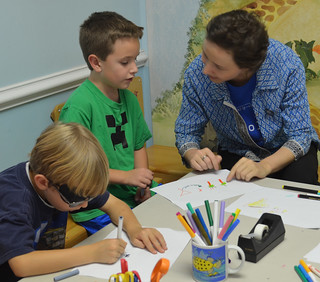
Inspired by Calculus: Thursday Math Circle Week 1
This Math Circle report has three parts. The first part summarizes “whys” behind club activities, and gives ideas on what to do at home. The second part has samples of what the group said and done, from Yelena McManaman. The third part has links to resources.
I will keep adding our pictures to a set on Flickr. Thank you for the photos, Lynna Mattia!
The main three principles:
1 – Make math your own, to make your own math
2 – Have adventures
3 – Do it with friends
Posted in Grow
Do your little kids draw grids?
What do you see when you look at drawings by little kids?
For example, grown-up artists noticed that many young artists draw big heads with legs. The more people talked about these shapes, the more meaning they found. By now developmental psychologists developed big theories of development around these simple observations: “Tadpole drawings appear during the pre-schematic stage…”
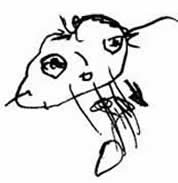
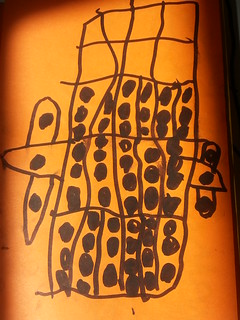
Grown-up mathematicians noticed that many young mathematicians draw grids. Round grids, square grids, grids within grids!
Have you kids made any grids? Please send us pictures and stories!

Here are some masterpieces from Michael Kelly.
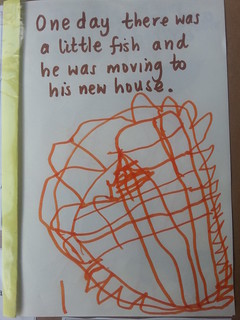

Michael writes:
Our youngest son Francis began drawing pattern grids and intersecting lines when he was about 3 years old. He seemed to draw in a way that resembled his early language learning. He didn’t draw discrete objects but would rather make patterns and connections across the whole space. In a similar way, in his speech he did not repeat individual or ‘favourite’ words, but he often copied the cadences of, or flow within, a sentence.
Strapped into his baby seat in the car he once interrupted a stream of jokes and laughter between four adults which he had been silently witnessing. When he had noticed the pattern he gave his own version of a line of ‘speech’ followed by his own appreciative laughter. His timing was great. Everyone stopped… none of us had considered how a 15 month old child might be making sense of the vocal expressions and social conventions of our adult friendships!
Franny’s drawing showed awareness of relationships between local shapes and overall design, and the negative shapes were sometimes integrated too.
We already have a bit of theory on grids and kids. Grids are to individual cells as paragraphs are to words (in Michael’s example), or songs are to notes. The whole grid is bigger than the sum of its parts, and kids think in terms of the whole of the thing! But some children start by drawing individual cells next to one another, like so:
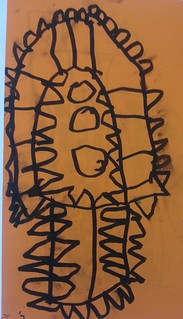
Even older kids and teens may draw individual cells when they work with new grid ideas. Here is another example from Math in Your Feet:
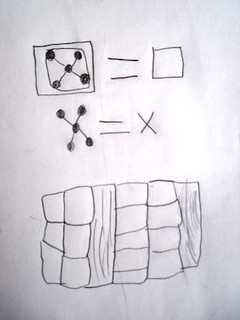
At other times, children make grids by having long lines cross in many places, so the cells multiply:
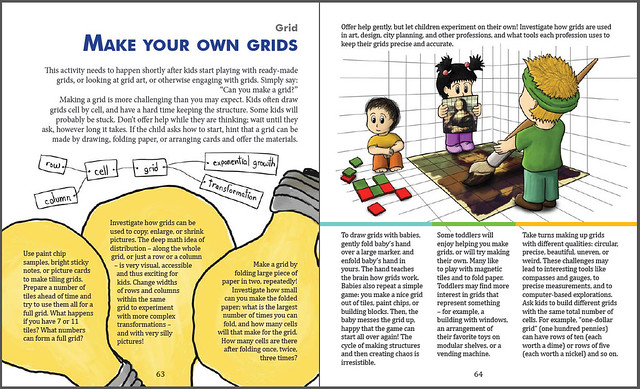
We have four chapters of grid games in the Moebius Noodles: Adventurous Math for the Playground Crowd book. Check them out!
Posted in Make


