- Home
- “Yes, And…” Improving Math Play with Improv
- Althea’s Math Mysteries
- Avoid Hard Work, the Workshop
- Avoid Hard Work! …And Other Encouraging Problem-Solving Tips for the Young, the Very Young, and the Young at Heart
- Blocks and Modeling: A Do-It-Yourself Guide to Exploring Geometric Objects – Online Workshop
- Blog
- Books and Goods
- Bright, Brave, Open Minds
- Bright, Brave, Open Minds: A Problem Solving Kaleidoscope. Open online course for parents and teachers
- Camp Logic
- Cart
- Checkout
- Citizen Science Station
- Consulting and Tutoring
- Courses
- Download File
- Easy Complexity and Special Snowflakes Online Math Circle
- Empires: Year-long prealgebra program in a game
- Expedition Everest
- Five Fabulous Activities for Your Math Circle
- Funville Adventures: Math Personified!
- Funville Web Tour
- Hacking Math
- Hiding in Plain Sight: Vyshyvanka Secret Codes
- Home
- HOW do they do it? Creating your own math puzzles
- Inspired by Calculus: Online course for parents, teachers, and their children ages 5-12
- Kingdom On A Wall
- Kingdom on the Wall
- Ko’s Journey Is Discontinued
- Lapware
- Math Books
- Math Cafe
- Math Circles
- Math Circles 1001 Leaders Course
- Math Future event registration
- Math Future: come and talk!
- Math Goggles Challenges
- Math Renaissance
- Math Trek
- Mathematics & Poetry for All
- Meet the authors
- MidSchool Math Digital Math Tools
- Moebius Noodles
- mpsMOOC13: Problem Solving for the Young, the Very Young, and the Young at Heart
- Multiplication Explorers FAQ
- Multiplication Explorers LIVE workshop
- Multiplication Explorers Online Course
- Multiplication Explorers Registration
- Multiplication Explorers, the book
- Multiplication Models Poster
- My Account
- Natural Math Multiplication Course
- Online Logic Summer Camp for Kids!
- Online Summer Calculus for Kids Camp!
- Pay Natural Math
- Playing with Math: Stories from Math Circles, Homeschoolers, and Passionate Teachers
- Reviews of the Moebius Noodles book
- September 25: Math Storytelling Day
- Socks Are Like Pants, Cats Are Like Dogs
- Speaking and events
- Start Here!
- test001
- The Art of Factorization Diagrams
- The Iditarod
- The seven principles of Natural Math
- Transformers: Matrices & Graphs!
- Veronica’s Multiplication: a Natural Math circle online
- WOW! Multiplication – an open course in September 2013
- Ying and the Magic Turtle
- About Natural Math
- Contact Us
- Get Involved
6 BIG adventures in #StreetMath

I am volunteering at elementary school recess, and was wondering if you can recommend some math games for outdoors – Anna Belaschenko, via the Moebius Noodles newsletter.
Here is a collection under the #StreetMath tag from our Facebook updates.
1. Sequence hopscotch
Use the old favorite to play with new sequences. How about counting in binary, or using Fibonacci?
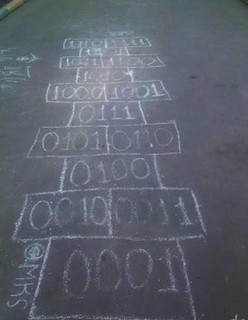
Invite kids to make up their own sequences and hopscotch patterns.
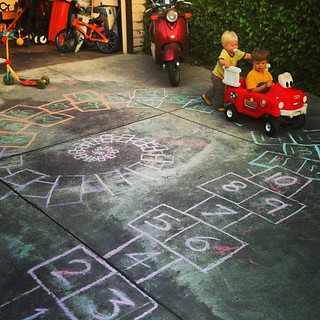
Pictures by Dave & Anna Douglas and Dr. Mike’s Math Games for Kids.
2. Murals or graffiti
Make a bold statement that math owns the place! Draw large math diagrams, fractals, or Fibonacci spirals on walls. If you don’t want a permanent graffiti, prop up a particle board or cardboard next to the wall, or simply tape large paper to the wall. Even easier, you can draw sidewalk murals in chalk.

Ellie Balk writes on good.is:
For the last four years, Green School math teacher Nathan Affield and I have teamed up to create murals that combine art and mathematics to empower students and connect them to their communities in Brooklyn, New York. In 2011, Affield and I created a project where a math class surveyed the whole school on how they were feeling, what color that feeling represented, where that feeling fell on a scale between one and 10, and what time of day the data was recorded. The students then aggregated and color-coded the data to create a 150 histogram covering the back wall of the school. At first glance, the mural looks like an abstract, colorful cityscape. It is only when the mural is “read”, that the data can be understood.
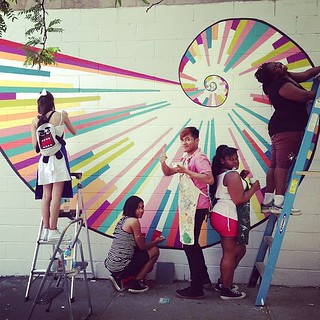
Pictures by Ellie Balk and Visualize Pi Project.
3. Geometric paths
Invite kids to build spiral or labyrinthine paths between pretend-play houses, or within pretend-play parks.
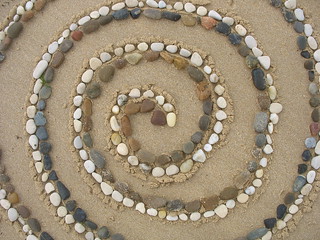
Children can draw their paths in chalk, mark them by hand or foot in sandboxes, or line up branches and pebbles.
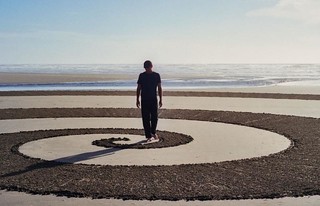
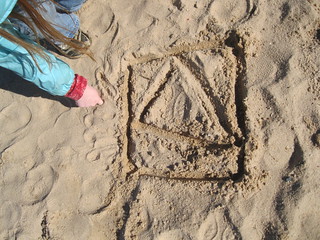
The paths can be large enough for kids to walk, or small enough for pretend-play with toys. Gently introduce inspiring “math building codes,” such as fractal branching paths or classical labyrinths.
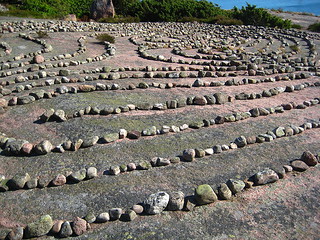
Pictures by Joseángel Murcia of Tocamales, Mick Kelly and Wikipedia.
4. Scavenger hunts and Math Treks
Help the kids grow their math eyes!
Pick a math concept and invite everyone to find it. Can you see multiplication in how tree branches grow, in rows of windows, or in kids’ own fingers ( hands times 5)? Alternatively, invite kids to find as many math ideas as they can in one object.

Beside multiplication, trees also have symmetry (in leaves), fractal-like branching, tessellations of cells or bark and so on. Invite kids to show the ideas they find with gestures or “human sculptures” for awesome photo-ops!
Architecture can be particularly mathy!

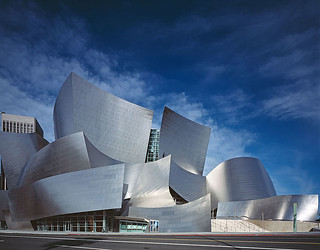
Pictures by Mathematical Association of America and Wikipedia. Video by Natural Math.
5. Play with yarn, fabric, and ropes
Develop spatial reasoning: turn one-dimensional and two-dimensional materials (yarn, fabric) into three-dimensional creations.
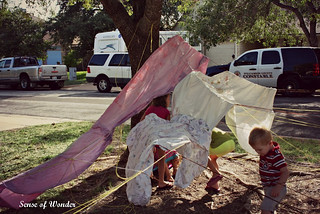
After kids explore freely for a while, you can introduce mathy inspirations, such as macrame patterns or formula-based string art.

Check out pictures and videos of yarn bombing, a community movement to cheer up local spaces.
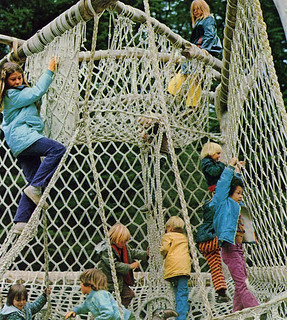
Pictures by Cathy of California, Sense of Wonder and Wikipedia.
6. Build giant models
Math feels different when you can climb it! Math is ten times cooler when it takes ten people to lift it!
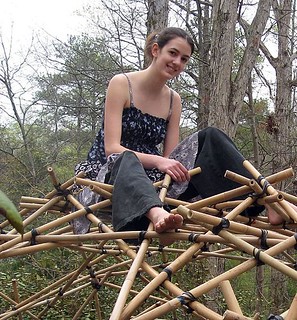
Learning through the whole body activates more areas of the brain. You can bring boards and large boxes, or use found objects such as tree branches. Paper works too. Kids can invent their own shapes, or build models of surfaces and polygons that are famous for their beauty.
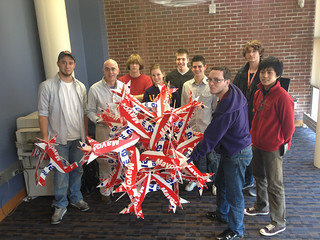
Pictures by Albion College and Vi Hart on Wikipedia.


Posted in Grow
Inspired by Calculus: Tuesday Math Circle Week 1
This is a quick report about our new local Math Circle. To all who asked, yes, we will produce online courses and organized materials for this content! Meanwhile, there will be these reports.
On the first meeting, Circle participants introduced themselves and started to explore infinity. Here are some purposes (whys) that drive our activities. I also suggest things to do at home – IF you feel like it, and IF it comes up. Be gentle, have fun.
The main three principles:
1 – Make math your own, to make your own math
2 – Have rich adventures
3 – Do it with friends
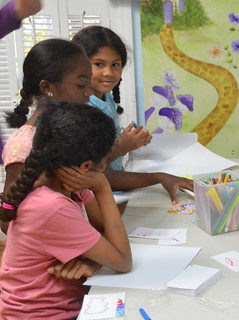
I will put all photos into this set on Flickr: http://www.flickr.com/photos/26208371@N06/sets/72157636116988425/
Posted in Grow
WOW! Multiplication Observer: A few conclusions
Thank you everyone who participated in the WOW! Multiplication open course. We will aggregate questions and answers from the Introduction thread, as well as other course resources, into a book on multiplication. As all our materials, it will be an open resource under a Creative Common licence. Thank you for contributing!
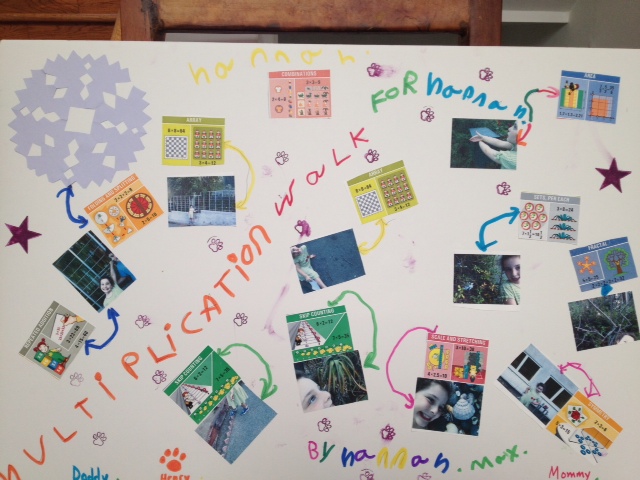
Picture: Multiplication Walk poster by Nannan (6) and Keetgi
Here are a few conclusion from the data from course participants. It will help running online courses in the future.
- For a short course, three forum threads are enough: Introduction, Action, and Help/Resources. As much as we want a planning thread (before action) and a reflection thread (after), it messes up the flow and confuses people. The main Action thread has to be “the thing and the whole of the thing” (Terry Pratchett) – planning questions and reports in one space.
- We need a clear place that lists everything there is in the course. New happenings can’t just come by email. Major course tasks – all of them – have to appear right away when the course starts, and can’t be “unlocked” later. Otherwise, people have doubts about the flow.
- For the task design, the Make tasks need to come before Solve/Search tasks. For example, making snowflakes will help people find symmetry models of multiplication during their scavenger hunts. We must explain what this task order does.
- We need an easy, uniform way to share pictures and stories after the main action is done. Participants suggested voice-over tools where kids can explain their photos, for example. We may run a mini-conference for participants, where they do short-short presentations together.
- The mixed age activities remain unclear for many people. We need explicit instructions for adapting activities by age, and for running mixed-age Math Circles.
Happy math adventures, everyone!
Posted in Grow
Binary hopscotch and six-year-olds inspired by calculus: Newsletter September 30, 2013
I am Moby Snoodles, and this is my newsletter. I love to hear from you at moby@moebiusnoodles.com

Blogs and networks
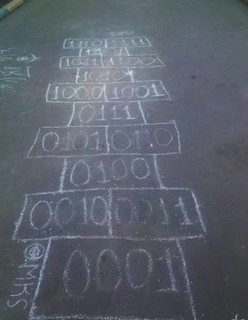
In the #StreetMath collection at our Facebook page, check out binary hopscotch from Dr. Mike’s Math Games. Do try it at home, and share your cute hopscotch ideas with us!

Denise of Let’s Play Math came up with a mirror activity for her Math Circle during our WOW! Multiplication online course. Denise writes:
As usual, the moms enjoyed the activities at least as much as the kids. One expressed surprise at how easily her son understood the basic idea of multiplication, which she had expected would be too hard for a 1st grader. We talked a bit about how much the kids enjoy learning through activities, and yet how prone we all are (especially when we get tired or too busy) to return to the idea that filling out a workbook page is “doing math.”
Are you a blogger? This October, Moebius Noodles will be hosting the 67th Math Teachers at Play blogger carnival. It’s a virtual celebration of your blog posts about math play with kids! By October 10th, submit your blog post via a 2-minute form.
Inspired by Calculus begins October 2 in Apex, NC. Start a local group too!
The first Math Circles for our young calculus program are launching at Apex, NC. Drop us a line if you are interested in making a Circle happen for your kids. Meanwhile, here is information about the two Circles we organized.
Why: Make math your own, to make your own math!
Where: Camp MusArt, 616 West Chatham, Apex.
Who and when: Tuesdays October 1, 8, 15, 22, 29, and November 5, 5:45-6:45 pm for 9-11 year old children. Thursdays October 3, 10, 17, 24, Friday November 1, and Thursday November 7 5:45-6:45 pm for 6-8 year old children. Parents are welcome to help.
Price: $95. Need-based scholarships by application.
Register: 6-8 year olds or 9-11 year olds.
What is bigger than infinity? Can I build an arch or a spiral staircase with Lego blocks? How could Zeno not see that a fast runner will definitely catch up to a slow turtle? Why does the Fibonacci sequence pop up in nature? How can I draw beautiful fractal doodles?
Kids ask the same general questions that inspired the invention of Calculus. With a bit of hands-on exploration, children begin to appreciate finer points of fast and slow motion, series of shrinking and growing things, or curved shapes made of non-curvy blocks.
Join our young calculus adventures this October and November. Our Math Circles are for curious, inquiring, playful families. Children will do a lot of drawing (such as a portrait of infinity), make models out of paper and blocks (such as a Lego parabola roller coaster), and pretend-play (to resolve Zeno’s turtle paradox once and for all). We invite you and your kids to be inspired by calculus!
Sharing
You are welcome to share the contents of this newsletter online or in print. You can also remix and tweak anything as you wish, as long as you share your creations on the same terms. Please credit MoebiusNoodles.com
More formally, we distribute all Moebius Noodles content under the Creative Commons Attribution-NonCommercial-ShareAlike license: CC BY-NC-SA

Talk to you again on October 15th!
Moby Snoodles, aka Dr. Maria Droujkova
Posted in Newsletter


