- Home
- “Yes, And…” Improving Math Play with Improv
- Althea’s Math Mysteries
- Avoid Hard Work, the Workshop
- Avoid Hard Work! …And Other Encouraging Problem-Solving Tips for the Young, the Very Young, and the Young at Heart
- Blocks and Modeling: A Do-It-Yourself Guide to Exploring Geometric Objects – Online Workshop
- Blog
- Books and Goods
- Bright, Brave, Open Minds
- Bright, Brave, Open Minds: A Problem Solving Kaleidoscope. Open online course for parents and teachers
- Camp Logic
- Cart
- Checkout
- Citizen Science Station
- Consulting and Tutoring
- Courses
- Download File
- Easy Complexity and Special Snowflakes Online Math Circle
- Empires: Year-long prealgebra program in a game
- Expedition Everest
- Five Fabulous Activities for Your Math Circle
- Funville Adventures: Math Personified!
- Funville Web Tour
- Hacking Math
- Hiding in Plain Sight: Vyshyvanka Secret Codes
- Home
- HOW do they do it? Creating your own math puzzles
- Inspired by Calculus: Online course for parents, teachers, and their children ages 5-12
- Kingdom On A Wall
- Kingdom on the Wall
- Ko’s Journey Is Discontinued
- Lapware
- Math Books
- Math Cafe
- Math Circles
- Math Circles 1001 Leaders Course
- Math Future event registration
- Math Future: come and talk!
- Math Goggles Challenges
- Math Renaissance
- Math Trek
- Mathematics & Poetry for All
- Meet the authors
- MidSchool Math Digital Math Tools
- Moebius Noodles
- mpsMOOC13: Problem Solving for the Young, the Very Young, and the Young at Heart
- Multiplication Explorers FAQ
- Multiplication Explorers LIVE workshop
- Multiplication Explorers Online Course
- Multiplication Explorers Registration
- Multiplication Explorers, the book
- Multiplication Models Poster
- My Account
- Natural Math Multiplication Course
- Online Logic Summer Camp for Kids!
- Online Summer Calculus for Kids Camp!
- Pay Natural Math
- Playing with Math: Stories from Math Circles, Homeschoolers, and Passionate Teachers
- Reviews of the Moebius Noodles book
- September 25: Math Storytelling Day
- Socks Are Like Pants, Cats Are Like Dogs
- Speaking and events
- Start Here!
- test001
- The Art of Factorization Diagrams
- The Iditarod
- The seven principles of Natural Math
- Transformers: Matrices & Graphs!
- Veronica’s Multiplication: a Natural Math circle online
- WOW! Multiplication – an open course in September 2013
- Ying and the Magic Turtle
- About Natural Math
- Contact Us
- Get Involved
Multiplication course; functions and functionals; playful calculus – Newsletter August 15

I am Moby Snoodles, and this is my newsletter. I love to hear from you at moby@moebiusnoodles.com

WOW – Multiplication! An open online course for parents and teachers
To sign up or for more info, email moby@moebiusnoodles.com
Multiplication and division are areas where many kids lose their fight against dreary, rote methods of teaching mathematics. Most children who start to believe they aren’t good at math never recover enough to go into science, technology, or engineering fields. How can you change that for your kids and their friends?

In the first week of the course, we will discuss researcher-developed, parent-tested activities where multiplication is meaningful, beautiful, and fun. In the second week, you will gather your kids and their friends in a casual Math Circle, and then answer a few questions about the experience.
As with most of our courses, we have adapted the activities for all ages from toddlers to adults. Where young ones go on a scavenger hunt for pretty snowflakes and cool truck wheels, older kids build bridges from multiplication to symmetry, spatial transformations, and proportions.

WOW – Multiplication! is a pilot study for a citizen science project for mathematics education. By actively participating in the course, you help us learn what support parents and teachers need to start informal Math Circles, and how to adapt materials for each learner’s unique needs. We are excited to invite you to contribute to original scientific research!
We are starting the course on Monday, September 9. The course is for parents, teachers, and leaders of math playgroups and Math Circles with children of any age. The goal is to learn deep structures that are the foundation of multiplication – through quick games you can play for years.
You can expect to spend about two hours a week on the course, including reading, forum discussions, and activities with children. There will be optional live meetings online.
If this sounds like a course for you and yours, e-mail moby@moebiusnoodles.com
A young girl reinvents functionals
Katie and her adventurous mom are inventing functions, compositions of functions, and even functionals (functions of functions)!
A few days ago I introduced the concept of a function to Katie, and again the credit for the idea goes to Moebius Noodles, this time the book. Since I wanted Katie to right away think that functions are really cool, my first example was: girls can go in and princesses come out. Katie was in disbelief. ‘That doesn’t exist,’ she said. I told her that functions can be real or make believe.
One of the coolest aspects of math is making your own imaginary worlds. Pretend-play leads into mathematical “What if?” inventions:
My three favorites from her were: 1) boys go in and boys come out (the identity function!), 2) goats go in and sheep come out, sheep go in and goats come out, and 3) one function goes in and another one comes out.

Picture: two pages from the Moebius Noodles book.
Playful explorations inspired by calculus
We are starting to collect young calculus activities, at our Facebook page and at a math ed LinkedIn group we frequent. Our math ed friends have a lot of questions and fears about “calculus for five-year-olds” – and even more inspired ideas! Growth and toy roller-coasters for kids? Joseph Austin writes:
As for “teaching” differential equations to children, I would start with the “exponential growth” equation: y’ = ky. You could teach this with a game based on the “each one teach one” principle, doubling the number at each iteration.
Next, I’d introduce the concept of velocity and acceleration, that is, “speed” and “increasing speed”: “how fast is the car or bicycle or snowball speeding up as it rolls down the hill?” If you do it in reverse, you get Zeno’s paradox!
Tony Cron offers an interactive polygon limit exploration. See a similar idea at Guillermo Batista’s “Intuitive introduction to limits.”

Jeanie Clemmens has another idea about limits.
This is fun, thinking like a five year old and an adult math person at the same time. What if ten children divide one pie equally, then a hundred children, then a thousand divide the same pie equally. Children should see that the size of the pieces gets smaller and smaller approaching zero. Likewise, ten children returning their pieces to the pan, or a hundred, etc. never adds up to more than one pie, i.e. there is a limit both ways.
Share your young calculus ideas at our question and answer hub!
WRAL interview in the Go Ask Mom series

Sarah Hall wrote the story and made a short video clip of us talking about the Moebius Noodles book.
The two authors say collaboration between parents and kids is an important part of the process. They’d love to see math games and activities become a regular part of family life just like bedtime stories or playing catch. In many cases, they’ve heard from parents who say they’re learning right along with their kids as they play the games.
Sharing
You are welcome to share the contents of this newsletter online or in print. You can also remix and tweak anything as you wish, as long as you share your creations on the same terms. Please credit MoebiusNoodles.com
More formally, we distribute all Moebius Noodles content under the Creative Commons Attribution-NonCommercial-ShareAlike license: CC BY-NC-SA

Talk to you again on August 30th!
Moby Snoodles, aka Dr. Maria Droujkova


Posted in Newsletter
The mass movement of early math: Designing for behavior change
This week, I attended an O’Reilly webinar by Stephen Wendel about his upcoming book, Designing for Behavior Change. O’Relly’s staged publishing process is one of the inspirations for how we do things at Moebius Noodles. The feedback from the webinar will be incorporated into the next draft of the book.

We would like many, many, MANY families to do rich math with their kids. This problem is different from helping people to exercise or to manage personal finances (Stephen’s specialty at Hello Wallet). The difference is that most people already believe that some exercise or some attention to money are beneficial activities. Stephen had a good piece of advice for me. Here’s what he said.
Alright next question. This is nice! Maria asked: “How do we invite people to go where, quote, almost nobody has gone before?” Algebra for three-year-olds in this case, and other early advanced math. There’s almost no knowledge out there. There are a couple of interesting parts here: one part is almost nobody does it, and that’s a statistical fact, sure. But from an individual perspective it’s our local network that matters the most. That’s how we set our reference point: what’s normal. It’s called “descriptive norms”. Describing what’s normal in our environment. And so, hey, if someone is able to take an action, and have the ability, have the desire, you can help set the environment where this is a normal thing to do! Other smart kids like you. Other people who are advanced and have all this experience, and they’re doing it – that’s great. The fact that perhaps the average person, statistically, of the overall US population, doesn’t do it, that really doesn’t matter. What matters is: who do we look to for examples. To find that example is a mentally powerful technique. Descriptive norms; governor Rogers talked about this, in a political space it’s a widely used technique, and something we actually use at Hello Wallet as well.
This validates the main direction we are taking: supporting local Math Circles, math playgroups, learning coops, or simply groups of friends doing math together!
Here is the piece in voice.
Posted in Grow
Make math mistakes in public!

Looking at many polished photos of other people’s gorgeous vacations leads to depression, as Jessica Winter summarizes in Selfie-Loathing. What happens when students keep looking at perfectly solved problems, smooth proofs of theorems, and flawless geometric constructions? They get math anxiety!
In his public service announcement, “Don’t learn the solutions before class!” and in the comments, Gordon Hamilton explains how teachers’ mistakes help students.
Teachers should be the same species as their students. Too often we have teachers who want to know all of the solutions of problems before the class begins. This is setting them up to be birds teaching bats. The students are flying blind. Learning the solutions puts you in a less favorable space to teach your students. Set up a classroom where the stigma of failure has been removed. The best way to do that is to start with yourself.

Posamentier and Lehmann make another point in their new book: mistakes can lead to new insights and discoveries. It works for professional mathematicians and for young kids making their first steps in math. Here is a part of the introduction:
We can also consider how the “proof” that 1 = 0 leads us to a most important mathematical concept: that division by zero is not permissible. Follow along as we show this interesting little “proof.” We begin with our given information that x = 0. We then multiply both sides of this equation by x – 1 to get x(x – 1) = 0. Now dividing both sides by x leaves us with x – 1 = 0, which in turn tells us that x = 1. However, we began with x = 0. Therefore, 1 must equal 0. Absurd! Our procedure was correct. So why did we end up with an absurd result? Yes, we divided by zero when we divided both sides of the equation by x. Division by zero is not permitted in mathematics, as it will lead us to silly conclusions. This is just one of many such entertaining mistakes that give us a more genuine understanding of the rules of mathematics.
These examples may seem entertaining, and they are. Yet through these entertaining illustrations of mistakes a lot is to be learned about mathematical rules and concepts. For example, when we “prove” that every triangle is isosceles, we are violating a concept not even known to Euclid – that of betweenness. When we show that the sum of the lengths of two legs of a right triangle is equal to the length of the hypotenuse – clearly violating the time-honored Pythagorean theorem – we will be showing a misuse of the concept of infinity. Yet, it is the unique value of these mistakes – providing a better understanding of the basic concepts of mathematics – that makes these mistakes magnificent. Lest we forget, youngsters – and we dare say, adults as well – learn quite a bit from mistakes. We expect that through the playful style in which we present these mistakes the reader will be delightfully informed! We shall also compare mathematical mistakes with those in everyday life and notice what can be learned from these.
We expect that the readers will enjoy these examples, and during this delightful excursion they should appreciate the many aspects or nuances of mathematics that sometimes go unnoticed until they lead one astray. We invite you now to begin your journey through these many magnificent mistakes in mathematics.
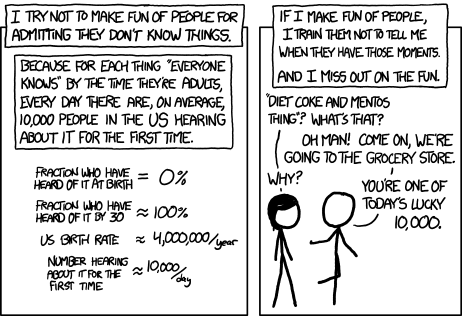
Do show your students imperfect, human, live math! Celebrate their mistakes by exploring the possibilities together. You can also rejoice in what students don’t know, as XKCD illustrates. Learning is exciting. But before you learn, you need to – not know!
Captain Sheridan of Babylon V (a sci-fi series) gives his signature good-luck speech whenever he assumes command. The speech has some of the most important lessons he learned in his life:
When I was 21, I visited Tibet. I went to see the new Dalai Lama. Uh, you do that sort of thing when you’re 21 and the son of a diplomatic envoy. We had a simple dinner. Rice, raisins, carrots—steamed, not boiled—and green tea. When it was over, he looked at me and said, “Do you understand?” I said no, I didn’t. “Good beginning,” he said. “You’ll be even better when you begin to understand what you do not understand.”
One of my favorite math exercises is to invite students to make as many mistakes in a problem as they possibly can. Can you make ridiculous mistakes? Funny mistakes? Big huge mistakes? Subtle mistakes that are hard to notice? This exercise and the math discussions it starts is worth a stack of worksheets for how much math students learn. Making mistakes on purpose also helps students laugh, relax, and carry on their challenging math journeys.
Posted in Grow
The last mpsMOOC13 Observer: Thanks and lessons learned
Read past issues | Visit the course page | Follow Moebius Noodles on Facebook
Time flies when you do math! Our open online course Problem Solving for the Young, the Very Young and the Young at Heart is almost over. This is the final issue of the course newsletter.
Thank you!
To everyone who signed up: thank you! When we planned this course, we thought we’d have a dozen families and groups. We got seven times as many! Which tells us there is a need and a desire for this sort of math.
To everyone who did at least one task: THANK YOU VERY MUCH! We got great stories for the book, and good data for the citizen science project (see Lessons Learned section below). The best part: the course invited many kids all around the world to try a Math Circle experience with parents and friends!
What’s next?
Now that you’ve tried mathematical problem solving with your children, will you continue? If yes, we would love to support you. Here’s what you can do:
- Ask questions and share your experiences on our Ask platform. It is open to you and every question gets an answer!
- Schedule a live Q&A session for your group of friends or a Math Circle. Contact us to arrange date/time.
- Write to us at moby@moebiusnoodles.com to let us know how we can help you.
- Sign up for the next open mini-course with us. We will run it in a few weeks. The details of the course and other such news will appear in our regular Moebius Noodles newsletter, which the course participants will receive twice a month.
- Continue running Math Circles. The National Association of Math Circles grants $2000 to support new Circles in the US. The application form is just a couple of pages – very doable! The deadlines are September 1 and February 1: https://www.mathcircles.org/content/math-circle-grants
If you are wondering what’s next for us, we will continue working on the draft of the Problem Solving book. We will write regular updates about our progress.
Now for some Lessons Learned. We would love to hear yours!

Lessons learned: on running courses like this
- The beginning voice conversation (initial interview) helps to share math values and to get to know one another. But video processing and scheduling is about ten times more work than we expected. We will use different software; do it in groups; and meet after participants have looked at the first assignments, to answer questions.
- We need smaller assignments, and fewer. For our next course, we’re thinking of one problem per week, not three “do it” problems plus three “plan it” problems.
- Participants wanted more discussions and collaboration. We need more tools and assignments for social mixing.
- Many people asked for live group events. We’ll have that in the future.
- We need to provide optional know-how (reading, videos) on getting started and addressing typical difficulties. Several people in this course made handouts, which we will include in the book and adapt for future courses.

Lessons learned: citizen science study pilot
There is a lot of education research on some of these items, such as the use of symbol and signs. Why do we want more studies? Because the context matters. We need to see how things work in the context of small groups and families. That context isn’t studied much at all.
- Data collection worked. We got a good preliminary data set on dimensions of adaptation. We need more scaffolding to invite people for data analysis.
- Toys and manipulatives help young or hesitant students to get started, and add diversion and width to the experience. Toys easily lead kids into open exploration or free play (which may be good), and away from goal-oriented activities (which may be bad). Using whole bodies to physically enact the problem works differently from using just toys.
- Stories, in words or visuals, make or break problems for a significant number of kids. Some people had recurring characters, settings, and themes in their stories, which helps to focus on math (since the context is already familiar).
- Computer tools seem to be more generic, in that they don’t require problem adaptation or preparation as much as physical manipulatives. This is different from using topic-specific computer games, such as Free Flow (spatial connections) or DragonBox (equations).
- Many people reported kids getting frustrated, and then dealing with frustrations, or taking a break. Causes and remedies need more study.
- We need some scaffolds and advice on how to collect data. For example, running a Math Circle with more than a couple of young kids and taking pictures or notes takes two people, not one.
- “It’s funny how our meeting turned into math club for the parents by the end!” And: “Are they spectators or facilitators? If they are to help, how might they do so? Do all parents need to be on board with the lesson plan and goals?” One type of adaptation is to focus on parents and their interests. For example, working with math-phobic friends: “She confided that she had had nightmares the previous night about not being able to do the problems.”
- Symbols and signs (for example, for directions in the gear problem) is a big dimension of adaptation. So is helping kids come up with their own terms, and to use these unconventional terms consistently.
- The very fact of adapting problems bothers some kids as “cheating.” We need to address that, maybe by inviting kids to be citizen scientists too, instead of “just students.
- How do you make problems more open-ended? James Tanton has a lot of advice. So do all those kids who followed rabbit trails all over the place!
Thank you for promoting meaningful, beautiful, playful math! See you online!
Posted in Grow


