- Home
- “Yes, And…” Improving Math Play with Improv
- Althea’s Math Mysteries
- Avoid Hard Work, the Workshop
- Avoid Hard Work! …And Other Encouraging Problem-Solving Tips for the Young, the Very Young, and the Young at Heart
- Blocks and Modeling: A Do-It-Yourself Guide to Exploring Geometric Objects – Online Workshop
- Blog
- Books and Goods
- Bright, Brave, Open Minds
- Bright, Brave, Open Minds: A Problem Solving Kaleidoscope. Open online course for parents and teachers
- Camp Logic
- Cart
- Checkout
- Citizen Science Station
- Consulting and Tutoring
- Courses
- Download File
- Easy Complexity and Special Snowflakes Online Math Circle
- Empires: Year-long prealgebra program in a game
- Expedition Everest
- Five Fabulous Activities for Your Math Circle
- Funville Adventures: Math Personified!
- Funville Web Tour
- Hacking Math
- Hiding in Plain Sight: Vyshyvanka Secret Codes
- Home
- HOW do they do it? Creating your own math puzzles
- Inspired by Calculus: Online course for parents, teachers, and their children ages 5-12
- Kingdom On A Wall
- Kingdom on the Wall
- Ko’s Journey Is Discontinued
- Lapware
- Math Books
- Math Cafe
- Math Circles
- Math Circles 1001 Leaders Course
- Math Future event registration
- Math Future: come and talk!
- Math Goggles Challenges
- Math Renaissance
- Math Trek
- Mathematics & Poetry for All
- Meet the authors
- MidSchool Math Digital Math Tools
- Moebius Noodles
- mpsMOOC13: Problem Solving for the Young, the Very Young, and the Young at Heart
- Multiplication Explorers FAQ
- Multiplication Explorers LIVE workshop
- Multiplication Explorers Online Course
- Multiplication Explorers Registration
- Multiplication Explorers, the book
- Multiplication Models Poster
- My Account
- Natural Math Multiplication Course
- Online Logic Summer Camp for Kids!
- Online Summer Calculus for Kids Camp!
- Pay Natural Math
- Playing with Math: Stories from Math Circles, Homeschoolers, and Passionate Teachers
- Reviews of the Moebius Noodles book
- September 25: Math Storytelling Day
- Socks Are Like Pants, Cats Are Like Dogs
- Speaking and events
- Start Here!
- test001
- The Art of Factorization Diagrams
- The Iditarod
- The seven principles of Natural Math
- Transformers: Matrices & Graphs!
- Veronica’s Multiplication: a Natural Math circle online
- WOW! Multiplication – an open course in September 2013
- Ying and the Magic Turtle
- About Natural Math
- Contact Us
- Get Involved
Multiplication, homeschool conference, Kaprekar: Newsletter July 30, 2013

I am Moby Snoodles, and this is my newsletter. I love to hear from you at moby@moebiusnoodles.com

Next course: Wow, Multiplication!
We are working on designing a series of short high-energy courses for parents, Math Circle leaders, and other innovative educators. Our first such micro-course will be about multiplication. We will introduce two highly addictive, deep, mixed-age games that you can play for 10 seconds or 10 years. We will also have a course forum for discussions and hot questions that worry and excite, such as, “How come some mathematicians never memorized their times tables, and do kids have to?” or, “Is multiplication just repeated addition?” Let us know if you are interested!
Mathematical values, mastery, and flow transform children. The transformations are reflected in their faces. Check out the math faces from our previous course.

Homeschooling and democratic learning conference
Please join us in a free, online conference for independent learners, The Homeschool Conference (http://www.homeschoolconference.com/). It runs live on Aug. 23-24 and will then be available as free downloads. You can submit proposals until August 20th.

Blogs and networks
Our Facebook page has grown to 500 fans. Eric Hamilton pointed out that 500 is no more special than many other numbers, which inspired us to play a little game of math facts. As a result, the new fans got their own mini-cards with curious facts about their numbers. If you want a card like that about your number, let us know on Facebook.

Sharing
You are welcome to share the contents of this newsletter online or in print. You can also remix and tweak anything as you wish, as long as you share your creations on the same terms. Please credit MoebiusNoodles.com
More formally, we distribute all Moebius Noodles content under the Creative Commons Attribution-NonCommercial-ShareAlike license: CC BY-NC-SA

Talk to you again on August 15th!
Moby Snoodles, aka Dr. Maria Droujkova


Posted in Newsletter
6 pictures that tell surprising stories: symmetry
Symmetry is beautiful. But why? Information processing theory claims it’s because symmetry saves us efforts, memory, and attention. When you look at a symmetric face, your mind only needs to process a half of it! With a snowflake, a sixth suffices.

You can help kids become more aware of symmetry by playing folding, cutting, and scavenger hunt games. We have four chapters of ideas in the Moebius Noodles book.

Pictures in this collection surprise us. They are still symmetric. But stories of their visually similar parts are completely different!
1. What every good teacher knows

2. A visual pun

An ad for audio books by Ogilvy and Mather
3. A Valentine
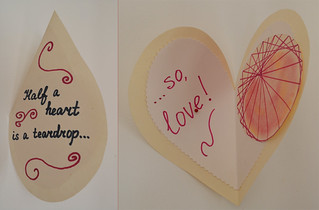
My kid and I made this several years ago.
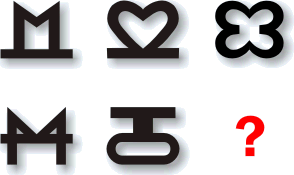
4. Hint: the little kids learning A-B-Cs and 1-2-3s solve this classic puzzle easier than adults
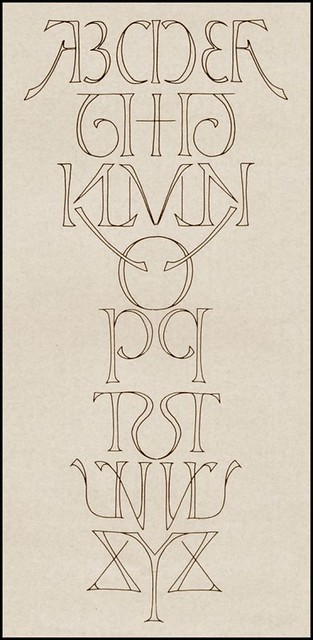
5. Speaking of A-B-Cs
6. Speaking of what the little kids know

Bonus!
Made with keep calm and make posters.

Do you know more pictures like this?
Posted in Grow
mpsMOOC13 Observer July 23: Math faces; lack of ease
Subscribe to receive the mpsMOOC13 Observer by email | Read past issues | Visit the course page | Follow Moebius Noodles on Facebook
This is the news from the open online course Problem Solving for the Young, the Very Young, and the Young at Heart.
ASSIGNMENTS
Last tasks of the course!
Share stories about problems 7-10: http://ask.moebiusnoodles.com/questions/624/assignment-6-share-your-stories-about-problem-grou.html
Citizen science 2: http://ask.moebiusnoodles.com/questions/630/lack-of-ease.html
Earlier tasks:
Share stories about problems 4-6
Share stories about problems 1-3.
Math faces
My favorite part of the course is reading people’s stories and looking at “math faces.” Mathematical values, mastery, and flow transform children. The transformations are reflected in their faces. This is what it is all about!
Pictures by Rodi, Denise, Brendan, Liza
Prep:math = 1:1 – or is it?
There is plenty of research showing that preparation and reflection makes us better at helping kids do math. But too much prep makes us reluctant to do math at all!
One of our aims for the course was to have one hour of preparation and reflection per hour of problem solving with kids. I think we achieved more ease than the hardcore math circles, where leaders report ten hours of prep/reflection per hour with kids. We did not achieve our aim, though.
A lot of preparation has to do with adapting materials for your kids. We tried to make that part easier by providing three or four starter adaptations for each activity. Yet I see that many people who signed up could not get going. For many active participants, three problems per week was too much.
Next time around, how can we make the experience easier? Share your thoughts: http://ask.moebiusnoodles.com/questions/630/lack-of-ease.html
Posted in Grow
mpsMOOC13 Observer July 16: Adapting by time; play and freedom
Subscribe to receive the mpsMOOC13 Observer by email | Read past issues | Visit the course page | Follow Moebius Noodles on Facebook
This is the news from the open online course Problem Solving for the Young, the Very Young, and the Young at Heart.
Timelines
Several people told us that the course is too fast for them. We will continue to make assignments available as we planned. However, do slow down if you kids need it! Just write something about the pace, because it will help the study of adaptations.
ASSIGNMENTS
Thank you for your fantastic stories, pictures, and videos. Together, we are gathering great data for the pilot study, and rich stories for the book!
New this week:
Citizen science task 1: comment on one another’s stories. The course organizers will be actively doing this task as well. http://ask.moebiusnoodles.com/questions/571/citizen-science-1-ask-about-adapting-problems.html
Share your stories about problems 4-6. Write about what happened and how it felt. Most people’s math dreams were about feelings: love, excitement, calm. http://ask.moebiusnoodles.com/questions/574/assignment-4-share-your-stories-about-problem-grou.html
Plan to adapt problems 7-10. http://ask.moebiusnoodles.com/questions/575/assignment-how-do-you-plan-to-adapt-problem-groups.html
Video by Brendan
Earlier tasks:
Share stories about problems 1-3.

Photo by Liza
How much freedom?
Play is freedom. How much play, how much freedom, do you need for math?
Several groups and families had kids engage in very free play:
The younger kids really enjoyed moving the animals, they quickly caught on to the idea of changing the arrangement of the parent animals. In fact they were more interested in finding different arrangements than in solving the problem! The strategy of getting the kids physically involved in acting out the problems worked great in terms of engaging them – they loved it. But it also gave them ample opportunity for distraction and play – they were not vastly invested in solving the problem, and needed frequent nudges from me to get very far in reaching an answer. I think it worked for open ended problems, but not so much for getting from a to b. A bit like trying to walk somewhere with young children in fact! It would be interesting to see how far they would have got without my prodding, although I suspect it would have ended up in piles of giggling children! – Miranda
All of my students already had the concept of the gears moving in different directions, so when I gave them physical gears to work with, they got more wrapped up in either playing with them (not necessarily towards the direction issue–like rolling them across the table) or getting frustrated if they didn’t work perfectly that they didn’t want to do the problems. They were much more focused on working on the problems/looking at the directions of the gears when I removed the physical gears from the workspace. – Carol
Parsa drew a line and asked: “Amir what is it? What are possibilities?” Then Parsa told that it can be a triangle! a triangle with one 180 degree angle and two zero angles! – Ali
Children didn’t ask anything, just enjoyed the pulling the rope. I tried to pay their attention to the fact of different ways of the rope to rise up the bucket but they were busy enough just pulling the rope up, the higher is the better. – Liza
Other participants reported episodes when there was no play at all, at least for a while:
“I don’t like this strategy of wishful thinking,” R pouted. She just couldn’t get past her preconceived notions of the question. She also stated “I don’t want to cheat.” To her, changing the problem is cheating. – Rodi
One of the kids has had a moment of enlightenment with 20 pages, and it was great to see his face and hear him cry “Aha!!” For others it was difficult to get the idea – why are we questioning about odd or even sum at all? They were staring at the book without any idea, and after some time of talking about sums the’ve got bored. – Marianna
The biggest take-away for me from the first set of problems is to not over-plan with my kids. The 6-year-old can smell “official math problem” a mile away and becomes immediately resistant. The key for me to engage him is to be playful. Problem #1 For the book-page numbers, he shut down quickly when we started adding page numbers together. Later, I tried the card game on him and it was a hit. (From the plans: I’ll ask him to pick a playing card out of a deck. He’s really interested in playing cards right now. We will look at the card together and notice whether the number is odd or even.) – Rose
At the first glance, toys add freedom, while formal math reduces it. We need more data, though!
The strong problem-solving flow requires a balance. Then we can grow, and reach higher levels of math freedom and math order. The balance is always dynamic, like riding a bike. You lean left and right all the time, but overall, you stay in the seat. How can we help students learn to steer toward their own optimal balance?

Posted in Grow


