- Home
- “Yes, And…” Improving Math Play with Improv
- Althea’s Math Mysteries
- Avoid Hard Work, the Workshop
- Avoid Hard Work! …And Other Encouraging Problem-Solving Tips for the Young, the Very Young, and the Young at Heart
- Blocks and Modeling: A Do-It-Yourself Guide to Exploring Geometric Objects – Online Workshop
- Blog
- Books and Goods
- Bright, Brave, Open Minds
- Bright, Brave, Open Minds: A Problem Solving Kaleidoscope. Open online course for parents and teachers
- Camp Logic
- Cart
- Checkout
- Citizen Science Station
- Consulting and Tutoring
- Courses
- Download File
- Easy Complexity and Special Snowflakes Online Math Circle
- Empires: Year-long prealgebra program in a game
- Expedition Everest
- Five Fabulous Activities for Your Math Circle
- Funville Adventures: Math Personified!
- Funville Web Tour
- Hacking Math
- Hiding in Plain Sight: Vyshyvanka Secret Codes
- Home
- HOW do they do it? Creating your own math puzzles
- Inspired by Calculus: Online course for parents, teachers, and their children ages 5-12
- Kingdom On A Wall
- Kingdom on the Wall
- Ko’s Journey Is Discontinued
- Lapware
- Math Books
- Math Cafe
- Math Circles
- Math Circles 1001 Leaders Course
- Math Future event registration
- Math Future: come and talk!
- Math Goggles Challenges
- Math Renaissance
- Math Trek
- Mathematics & Poetry for All
- Meet the authors
- MidSchool Math Digital Math Tools
- Moebius Noodles
- mpsMOOC13: Problem Solving for the Young, the Very Young, and the Young at Heart
- Multiplication Explorers FAQ
- Multiplication Explorers LIVE workshop
- Multiplication Explorers Online Course
- Multiplication Explorers Registration
- Multiplication Explorers, the book
- Multiplication Models Poster
- My Account
- Natural Math Multiplication Course
- Online Logic Summer Camp for Kids!
- Online Summer Calculus for Kids Camp!
- Pay Natural Math
- Playing with Math: Stories from Math Circles, Homeschoolers, and Passionate Teachers
- Reviews of the Moebius Noodles book
- September 25: Math Storytelling Day
- Socks Are Like Pants, Cats Are Like Dogs
- Speaking and events
- Start Here!
- test001
- The Art of Factorization Diagrams
- The Iditarod
- The seven principles of Natural Math
- Transformers: Matrices & Graphs!
- Veronica’s Multiplication: a Natural Math circle online
- WOW! Multiplication – an open course in September 2013
- Ying and the Magic Turtle
- About Natural Math
- Contact Us
- Get Involved
Outdoors and body-scale math collection

What does your children’s summer math time look like? Perhaps it is filled with worksheets and arithmetic drills similar to what they get to do the rest of the year. If that’s the case, it is time to get outside, and try mathematics that is playful, adventurous, creative, and lively! Try these ideas from our growing collection.
Follow Natural Math’s board Outdoors & body-scale math on Pinterest.


Posted in Make
Science Cafe, chats, problem solving: Newsletter July 15, 2013
I am Moby Snoodles, and this is my newsletter. I love to hear from you at moby@moebiusnoodles.com

Have us over for a chat!
This week, Maria Droujkova and Yelena McManaman presented a Science Cafe talk at the North Carolina Museum of Natural Sciences. It feels like being a special guest at a dinner party. We started with a short presentation about the science behind the baby algebra, answered questions at the podium for about an hour, and then chatted at the tables.
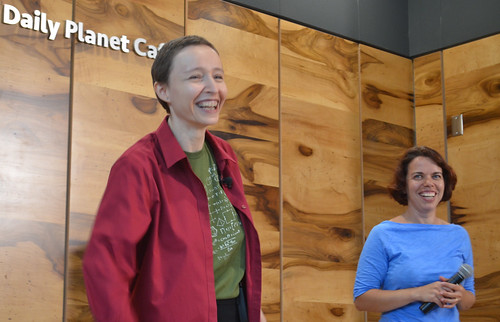
We have been going to Science Cafes for many years. But with math, always expect the unexpected! In this case, most visitors preceded their questions with short stories of their personal math horrors. Nothing like that had happened with other Cafe topics. People said it was very therapeutic to talk about fractions never making sense, or mindless timed drills, or being told girls can’t do math. Here is the full recording:
In the following months, we will be visiting Math Circles, parent groups, and homeschool coops to chat about playful, advanced math with young kids. Get a few friends together, and we can discuss your dreams, your worries, and cool math ideas. It only takes one computer with the internet to arrange that! Drop us an email if you want to learn more.
Problem Solving for the Young, the Very Young, and the Young at Heart
Our open online course on problem solving is finishing its second week. It will help to gather data on how to start Math Circles with local friends. People discuss how to adapt problems:
I had issues with some of the weaker math students not being able to figure anything out on their own, and/or in just giving up once someone else had figured out the problem. So something I’m doing with the next set is that I’ve created two sheets to hand out to everyone with the problems (I’m working with teens, so we’re mostly just working on paper). One is the list of problem-solving techniques from this MOOC (the ones we have so far, at least), and the other is my adaptation of Tanton’s problem-solving process from his Curriculum Inspiration essays. I’m hoping this will help some of the less-confident students to get beyond their “I don’t know how to do this” blockage. – Carol
From a teaching standpoint, I noticed that it is tricky to offer the kids guidance and support without leading them directly to the answer I wanted them to find. Asking open ended questions is not as easy as it sounds! – Andy
One very common issue is “too much exploration”! Children get very involved, first in posing versions of problems (rather than solving any), then in free play:
The strategy of getting the kids physically involved in acting out the problems worked great in terms of engaging them – they loved it. But it also gave them ample opportunity for distraction and play – they were not vastly invested in solving the problem, and needed frequent nudges from me to get very far in reaching an answer. I think it worked for open ended problems, but not so much for getting from a to b. A bit like trying to walk somewhere with young children in fact! It would be interesting to see how far they would have got without my prodding, although I suspect it would have ended up in piles of giggling children! – Miranda
Sharing
You are welcome to share the contents of this newsletter online or in print. You can also remix and tweak anything as you wish, as long as you share your creations on the same terms. Please credit MoebiusNoodles.com
More formally, we distribute all Moebius Noodles content under the Creative Commons Attribution-NonCommercial-ShareAlike license: CC BY-NC-SA

Talk to you again on July 30th!
Moby Snoodles, aka Dr. Maria Droujkova
Posted in Newsletter
mpsMOOC13 Observer July 8: Problems 4-6, Minecraft, the Cat, paper dolls
Subscribe to receive the mpsMOOC13 Observer by email | Read past issues | Visit the course page | Follow Moebius Noodles on Facebook
This is the news from the open online course Problem Solving for the Young, the Very Young, and the Young at Heart.
ASSIGNMENTS
By July 14:
Share stories about problems 1-3: http://ask.moebiusnoodles.com/questions/504/assignment-2-due-july-14-share-your-stories-about.html
Plan problems 4-6 and share the plans: http://ask.moebiusnoodles.com/questions/506/assignment-3-due-july-14-how-do-you-plan-to-adapt.html
Earlier tasks:
Plan problems 1-3 and share the plans. We updated the PDF file to have better links to the young adult level of problems.
Sign-up tasks will close down July 10.
- Log in to the question and answer hub Ask Moby Snoodles.
- Leave a comment with your answers to the four questions.
- Schedule a short video or voice conference. – There are time slots for July 7-11
A variety of problem adaptations
I’m thinking about how I bring these ideas to my son who recently turned 4 and involve my daughter at the same time. I am thinking of using pennies (or another counter, but pennies are always available) and presenting even numbers as “friendly” numbers because of the way they pair up and odd numbers as “lonely” numbers because of the one left out. – Angela V. (faroop)
Or maybe using paper dolls – my oldest is very keen on those, she could make some for me! And I’d like to prepare sheets to fill in any patterns we see, just a basic table with number of pins/dolls, number of meeting points etc. – Miranda J. (mirandamiranda)
Problem 2 – my son that likes Minecraft said that in creative mode, you can place a piston that has a brown end and a gray end and then place a certain number of pistons until you have the number you want, you can try it again in another area with the same number of pistons but using different orders. You could use a half block to mark each green to green match. – Michelle G. (mgrunk)

Minecraft Menger Fractal from the Fractal Explorer
Comment!
You can respond to individual people to offer help, or to ask questions. The button is at the bottom right of every answer:

Resources
Share your favorite resources with everybody at the books and links thread. Write a phrase or so on why you like the resource.
Out of the Labyrinth, by Robert and Ellen Kaplan, and ANYTHING by James Tanton. – Rodi Steinig
The Cat in Numberland; The Adventures of Penrose the Mathematical Cat. – Hong L. (hliu123)
P.S. We are working with Ivar Ekeland, the author of The Cat in Numberland, to produce a sequel. We are collecting the sequel ideas on the same forum we use for this course: http://ask.moebiusnoodles.com/questions/263/where-should-the-cat-go-after-numberland.html. Ivar also made the first book available at Moebius Noodles, at the cover price.
Posted in Grow
mpsMOOC13 Observer July 5: Sign-up; why and how; calculus for seven-year-olds
Subscribe to receive the mpsMOOC13 Observer by email | Read past issues | Visit the course page
This is the news from the open online course Problem Solving for the Young, the Very Young, and the Young at Heart.
ASSIGNMENTS
By July 7: Plan the first three problem groups and share the plans. You need to do the sign-up tasks to become a course participant, then you can post your plans here: http://ask.moebiusnoodles.com/questions/392/how-do-you-plan-to-adapt-problem-groups-1-2-and-3.html
Sign-up tasks:
- Log in to the question and answer hub Ask Moby Snoodles.
- Leave a comment with your answers to the four questions.
- Schedule a short video or voice conference. – There are time slots for July 7-11
Forum news
Only participants who answered the sign-up questions can post on the forums, but everybody can read.
Post your questions or ideas to the question and answer forum.

Discuss videos with beautiful math dream of Mellany, Sally, Alyssa + Taryn + Dianne + Andy, and Hong, and check out their questions. How do you make more complicated math and its techniques approachable? How can you do math without the kid getting frustrated? How can you focus on “Why” and not just “How”? How can we help a seven-year-old do calculus?
Share your favorite resources with everybody at the books and links thread.
Posted in Grow


