- Home
- “Yes, And…” Improving Math Play with Improv
- Althea’s Math Mysteries
- Avoid Hard Work, the Workshop
- Avoid Hard Work! …And Other Encouraging Problem-Solving Tips for the Young, the Very Young, and the Young at Heart
- Blocks and Modeling: A Do-It-Yourself Guide to Exploring Geometric Objects – Online Workshop
- Blog
- Books and Goods
- Bright, Brave, Open Minds
- Bright, Brave, Open Minds: A Problem Solving Kaleidoscope. Open online course for parents and teachers
- Camp Logic
- Cart
- Checkout
- Citizen Science Station
- Consulting and Tutoring
- Courses
- Download File
- Easy Complexity and Special Snowflakes Online Math Circle
- Empires: Year-long prealgebra program in a game
- Expedition Everest
- Five Fabulous Activities for Your Math Circle
- Funville Adventures: Math Personified!
- Funville Web Tour
- Hacking Math
- Hiding in Plain Sight: Vyshyvanka Secret Codes
- Home
- HOW do they do it? Creating your own math puzzles
- Inspired by Calculus: Online course for parents, teachers, and their children ages 5-12
- Kingdom On A Wall
- Kingdom on the Wall
- Ko’s Journey Is Discontinued
- Lapware
- Math Books
- Math Cafe
- Math Circles
- Math Circles 1001 Leaders Course
- Math Future event registration
- Math Future: come and talk!
- Math Goggles Challenges
- Math Renaissance
- Math Trek
- Mathematics & Poetry for All
- Meet the authors
- MidSchool Math Digital Math Tools
- Moebius Noodles
- mpsMOOC13: Problem Solving for the Young, the Very Young, and the Young at Heart
- Multiplication Explorers FAQ
- Multiplication Explorers LIVE workshop
- Multiplication Explorers Online Course
- Multiplication Explorers Registration
- Multiplication Explorers, the book
- Multiplication Models Poster
- My Account
- Natural Math Multiplication Course
- Online Logic Summer Camp for Kids!
- Online Summer Calculus for Kids Camp!
- Pay Natural Math
- Playing with Math: Stories from Math Circles, Homeschoolers, and Passionate Teachers
- Reviews of the Moebius Noodles book
- September 25: Math Storytelling Day
- Socks Are Like Pants, Cats Are Like Dogs
- Speaking and events
- Start Here!
- test001
- The Art of Factorization Diagrams
- The Iditarod
- The seven principles of Natural Math
- Transformers: Matrices & Graphs!
- Veronica’s Multiplication: a Natural Math circle online
- WOW! Multiplication – an open course in September 2013
- Ying and the Magic Turtle
- About Natural Math
- Contact Us
- Get Involved
Math+Art photography <== Scientific American <== Moebius Noodles


Seeking shapes, surfaces, and curves in nature is a favorite game for mathematicians – and for young kids! The Seattle lifestyle photographer Alex Nguyen reports on an art project about flowers. It was inspired by the Budding Scientist blog, where we recently made a guest post.
This reminded me of the new Mathematical Imagery gallery from the American Mathematical Society, which we featured a couple of times under the #MathScavengerHunt tag on Facebook.


Posted in Make
Problem Solving for the Young, the Very Young, and the Young at Heart: Newsletter June 15, 2013
I am Moby Snoodles, and this is a special issue of my newsletter. You are invited to participate in our next book-making effort. It is also a course, and a citizen science project. For sign-up information, email me at: moby@moebiusnoodles.com

Problem Solving for the Young, the Very Young, and the Young at Heart
Join a cozy mini-MOOC with Dr. James Tanton, Dr. Maria Droujkova, and Yelena McManaman!

Take the course, make a book, contribute to citizen science
The term “problem solving” sounds scary. Who wants problems? Why do we want to subject ourselves and youngsters to problems?
The word “problem” comes from the word “probe” meaning “inquiry.” Inquiry is a much more interesting and friendlier idea. Rather than “attack a problem that has been given to us” let us “accept an invitation to inquire into and explore an interesting opportunity.” Even very young, preverbal children excel at inquiring and at investigating the world around them.
Will this curiosity extend to math learning? Yes, as long as the inquiries remain playful!

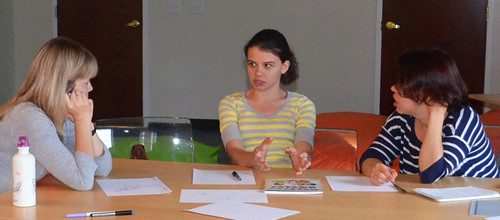
This course will help you to support the joyful intellectual play of youngsters in the context of upper-level mathematics. Over three weeks we will discuss the ten key problem solving techniques and show how they can be of relevance and help to the very young. Each technique comes with an interesting query to think about. As the adult leader, you supply scaffolding where students stand while they construct their solutions. In other words, techniques are not only for you to read, but also for you to then translate for the children!
But wait, there is more! This course is a pilot study for a citizen science project for mathematics education. How can we adapt materials for each learner’s unique needs? How can we pick and choose what math to do when? We are excited to invite you to contribute to original scientific research, and to discover new ways of helping children learn!
Course Syllabus
This course is for parents, leaders of math playgroups, and math clubs – with children of any age. The goal is to adapt the same set of materials to different levels and interests. We will publish the materials as a professionally edited, Creative Commons book, with all course members’ names or aliases as contributors. You can see an example at https://test.naturalmath.com/TheBook
The sign-up tasks will be available on July 1, 2013. You can expect to spend about two hours a week on the course. Each week, you will plan for the next week, tell brief stories of what you did this week, and start analyzing other people’s stories. We will provide more details and guidance on the sign-up site.

Before July 7: sign-up and preparation
- Sign-up interview (Skype or Google+): What are your math dreams for your kids?
- Prepare micro-plans: problems 1, 2, 3
Week 1, July 8-14
- Do and report: stories about problems 1, 2, 3
- Prepare micro-plans: problems 4, 5, 6
- Sort and analyze the data in reports
Week 2, July 15-21
- Do and report: problems 4, 5, 6
- Prepare micro-plans: problems 7, 8, 9, 10
- Sort and analyze the data in reports
Week 3, July 22-28
- Do and report: problems 7, 8, 9, 10
- Sort and analyze the data in reports
Exit question
- What did you and others do to adapt problems?
Participant pledge
We expect each participant to adapt the ten problems, to try them with kids, to report the results online, and to help analyze the reports. You can share you stories by text, video, or audio.
Frequently Asked Questions
Does my child need to count well, remember times tables, and so on?
Not at all. There are no prerequisites. You can adjust problems for very young kids, but also to the high school level.
What resources will I need for this class?
You need the internet to participate, and usual household objects (paper, markers, toys) to do math. We will provide free, open media to support the course.

Can I get a certificate after completing this course?
Yes, you will receive a digital certificate of participation from the course authors and our mascot Moby Snoodles, the math-loving whale.
What is citizen science?
Citizen science is research conducted by large groups of non-professionals, together with some scientists. In this course, participants will contribute to a pilot study in mathematics education. We will tackle a tough question: How can mathematical topics be adapted to radically different students, mixed-age groups, and everybody’s diverse interests?
What’s a mini-MOOC?
A Massive Open Online Course (MOOC) is an online course with interactive participation and open access. Our course uses all our favorite design principles of MOOCs: openness, aggregating free information, and remixing everybody’s ideas. In addition, we aim for a connected, personal experience for every participant. That’s why we only announce our courses in highly relevant communities, talk to every participant as a part of the sign-up, and provide much personal support along the way. We also keep the course short enough for everybody to be able to participate in all the activities. To summarize, our course is a cozy, personal, short and sweet MOOC.

What is it all about?
- Make your own math: DIY, agency, self-regulation, exploration
- Play and let the kids play freely: spaces for exploration, self-regulation, agency, research of what kids would do
- Not all who wander are lost: connections; sorting, classifying and mapping the big picture of math, big and deep ideas, inquiry, connections
- Be the littlest kid: child leadership, child agency, adults as fellow explorers
- Make and share stories: continuity, adding valor and adventure to kids’ actions, research and reflection on the data in the stories, helping others learn from your experiences
How do I sign up?
Email moby@moebiusnoodles.com
Sharing
You are welcome to share the contents of this newsletter online or in print. You can also remix and tweak anything here as you wish, as long as you share your creations on the same terms. Please credit MoebiusNoodles.com
More formally, we distribute all Moebius Noodles content under the Creative Commons Attribution-NonCommercial-ShareAlike license: CC BY-NC-SA

Talk to you again on June 30th!
Moby Snoodles, aka Dr. Maria Droujkova
Posted in Newsletter
Paper Weaving and Grid Games

Patrick Honner’s Moebius Noodles guest post on mathematical paper weaving was very inspiring to me. Mathematical weaving employs one of my favorite making materials – colored paper! It was actually sort of challenging to get started, but after playing around I landed on some solutions which became a nice little unit of paper weaving and grid games with and for young children.
I am imagining that the weaving and the games can be completed in an enjoyable collaboration between adult and child over the course of a day or two. Here are some ideas for setting up the experience and playing the games.
After experimenting a little, a 3/4″ width for vertical and horizontal strips makes a more pleasing final product to my eyes than 1″. To make the vertical strips fold a piece of paper in half and use a paper cutter to cut 3/4″ strips from folded edge to about 3/4″ away from the open edges. Essentially, you are creating a paper warp that is still essentially one piece of paper.

As you can see, below, the horizontal strips weave in very nicely and don’t need any glue or tape to keep them in place if you focus on pushing them gently, but snugly, downward. For the young ones, at least, a basic over/under/over/under weave is challenging enough. Using two horizontal colors creates visual interest and perhaps even a conversation about the patterns you see: alternating colors both vertically, horizontally and diagonally. You can also make a connection to odd and even numbers. Yellow squares in the design show up 2nd, 4th, 6th… places. Green squares are 1st, 3rd, 5th…

The minute I finished the piece above I thought – A GRID! It’s a grid! Over the last couple years I have received mountains of inspiration from the Moebius Noodles blog especially as source of grid games (my favorite so far is Mr. Potato Head is Good at Math). As a result, grids are always in the back of my head. Here are some of the ideas I came up with using a newly woven paper mat/grid and one of my favorite math manipulatives — pennies!

Adult: Oh look! There are three different colors of squares in our woven grid. I’ve got some pennies — I wonder if we could make a square by putting pennies down on only one of the colors?
Adult: That does look like a square. Let’s count and see if there are the same number of little squares (yellow, blue, yellow, blue…) that make up each side? There are! How many little squares are there on each side?
Adult: But, wait! Look what happens when I push a corner penny in toward the center! Yep, it lands on a green square! Let’s do it with the rest of the corners and see what we get. Oh, lovely. A rhombus.

Adult: The corners on the rhombus are on the yellow squares. I wonder what would happen if we pushed them one square toward the middle? Ooooh, look! We have another square. Is it bigger or smaller than our first square? Each side on our first square was six little squares long. This square has sides that are…three little squares long. Cool.

Another exploration, this time growing patterns and a tale of some square numbers who also wanted to get bigger? What little kid doesn’t want to grow up?

And, here’s my favorite. It’s a ‘let’s make a rule’ kind of game. The first penny goes in the bottom left hand corner, and you start counting from there. The first rule here (pennies) was two over, one up. Each time you repeat the rule, you start counting from the last token on the grid.

You’re probably wondering about the buttons? Well, that’s a different rule: one over, one up. Isn’t it cool how they overlap, but not always? Kids can make up their own rules after a little modeling or you can challenge them to guess a rule you made up and keep it going.
And then, of course, the final thing would be to leave the pennies and the paper grid mat out to explore at leisure. Have fun making math!
p.s. After this first foray into mathematical paper weaving, I explored it a little more. Here are more posts on my blog: Weaving Inverse Operations, Multiples and Frieze Patterns – Weaving Fibonacci – Weaving Geometric African Motifs Part 1 and Part 2.
Posted in Make
“Little people, big play, and big mathematical ideas” by Robert Hunting
Robert Hunting’s paper I read this week is a part of MERGA (Mathematics Education Research Group of Australia) symposium on the role of play in mathematics (full text PDF). Robert makes a subversive statement about two types of big ideas:
To simplify, allow me to identify two poles or extreme positions representing this matter – what might be called the soft big idea and the hard big idea. The soft big idea is essentially to accept the status quo of school mathematics curriculum as we have experienced it for the past 100 years or so, and identify major curriculum topics that warrant attention. Examples might be: fractions, place value, long division, ratio and proportion, and so on. We call this meaning soft because of acceptance of the general belief that the selection and sequencing of school mathematics topics is the way we have always done it, based primarily on a logical analysis of elementary mathematics from an adult point of view, in the face of demonstrable overall failure to achieve success in teaching these. The hard big idea is to first ask what conceptual tools professional mathematicians have found to be fundamental and potent in the history of mathematics, and in their own mathematical education. Once established, attempt to develop ways and means to establish preparatory foundations at school level, mindful that children’s mathematics and mathematical thinking is not the same as that of the adult (NAEYC & NCTM, 2002). Examples of hard big ideas include variability and randomness in chance processes, the notion of unit system, scale and similarity, boundary and limit, function, equivalence, infinity, recursion, and so on. The intersection between soft and hard big ideas is by no means the null set.
The terms “hard” and “soft” are analogies to hard and soft sciences.
Each of the eighteen chapters of the Moebius Noodles book has a mini-map of big ideas. For example, this chapter deals with composition of functions:

Each chapter is a stand-alone piece. You can use them in any order, one at a time, because it’s important for each person to choose what math to do. But if you use more than one chapter, you will see more connections among ideas. Chapters “talk” to one another via shared deep ideas! The more chapters you use, the more connections you see.
Here is the map connecting all the big ideas in the book. The intersection with Robert’s list is not the null set.

What if we kept extending this map to more and more materials that make advanced math accessible to babies, toddlers and young kids? Imagine the possibilities!
Posted in Grow


