- Home
- “Yes, And…” Improving Math Play with Improv
- Althea’s Math Mysteries
- Avoid Hard Work, the Workshop
- Avoid Hard Work! …And Other Encouraging Problem-Solving Tips for the Young, the Very Young, and the Young at Heart
- Blocks and Modeling: A Do-It-Yourself Guide to Exploring Geometric Objects – Online Workshop
- Blog
- Books and Goods
- Bright, Brave, Open Minds
- Bright, Brave, Open Minds: A Problem Solving Kaleidoscope. Open online course for parents and teachers
- Camp Logic
- Cart
- Checkout
- Citizen Science Station
- Consulting and Tutoring
- Courses
- Download File
- Easy Complexity and Special Snowflakes Online Math Circle
- Empires: Year-long prealgebra program in a game
- Expedition Everest
- Five Fabulous Activities for Your Math Circle
- Funville Adventures: Math Personified!
- Funville Web Tour
- Hacking Math
- Hiding in Plain Sight: Vyshyvanka Secret Codes
- Home
- HOW do they do it? Creating your own math puzzles
- Inspired by Calculus: Online course for parents, teachers, and their children ages 5-12
- Kingdom On A Wall
- Kingdom on the Wall
- Ko’s Journey Is Discontinued
- Lapware
- Math Books
- Math Cafe
- Math Circles
- Math Circles 1001 Leaders Course
- Math Future event registration
- Math Future: come and talk!
- Math Goggles Challenges
- Math Renaissance
- Math Trek
- Mathematics & Poetry for All
- Meet the authors
- MidSchool Math Digital Math Tools
- Moebius Noodles
- mpsMOOC13: Problem Solving for the Young, the Very Young, and the Young at Heart
- Multiplication Explorers FAQ
- Multiplication Explorers LIVE workshop
- Multiplication Explorers Online Course
- Multiplication Explorers Registration
- Multiplication Explorers, the book
- Multiplication Models Poster
- My Account
- Natural Math Multiplication Course
- Online Logic Summer Camp for Kids!
- Online Summer Calculus for Kids Camp!
- Pay Natural Math
- Playing with Math: Stories from Math Circles, Homeschoolers, and Passionate Teachers
- Reviews of the Moebius Noodles book
- September 25: Math Storytelling Day
- Socks Are Like Pants, Cats Are Like Dogs
- Speaking and events
- Start Here!
- test001
- The Art of Factorization Diagrams
- The Iditarod
- The seven principles of Natural Math
- Transformers: Matrices & Graphs!
- Veronica’s Multiplication: a Natural Math circle online
- WOW! Multiplication – an open course in September 2013
- Ying and the Magic Turtle
- About Natural Math
- Contact Us
- Get Involved
Toddlers in seven-league boots

Seven-league boots is an element in European folklore. The boot allows the person wearing them to take strides of seven leagues per step, resulting in great speed. The boots are often presented by a magical character to the protagonist to aid in the completion of a significant task.

Photo credit: www.zoedevries.nl
Moby Snoodle’s friend Thys van der Veer is originally from Kimswerd, Netherlands, population 608 when Thys visits from the city. He dreams of every toddler and young kid in his village playing adventurous math games. Thys sent me the picture of Zoe in magic boots, and I added Frisian to the crowd-translation list of languages for Moebius Noodles. Let’s see what happens!


Posted in Grow
Where on Earth is Moby Snoodles? Some of this week’s travels
Here are some fine sites mentioning us this week. Nice to meet you, people of good will interested in math education! /waves

“Latest lesson” hand-picks and reviews best education content. This is what they say about our book.
Moebius Noodles: A Mathematical Playground for Young and Old
Contrary to popular belief, mathematics is not an activity that requires textbooks, calculators, and years of training. Because it consists of such fundamental notions as symmetry, classification, counting, and geometric transformations — all concepts that come naturally to even the youngest children — mathematics can truly be studied at any age. If you have picked up a copy of Math From Three to Seven and are wondering whether there is something similar for kids that are younger still, you should take a look at Moebius Noodles.
This book, the work of Yelena McManaman, Maria Droujkova, and Ever Salazar, is a beautifully illustrated collection of activities that engages young kids (even toddlers) in discovering fundamental mathematical principles and abstractions. For example, why wait until middle school or high school to learn about functions when you can think about them in any almost any context? For instance, Moebius Noodles proposes an activity where a child is given the name of a baby animal (like “kitten”) and must identify the corresponding adult animal name (in this case “cat”). The child has just created a baby-to-mother function and there are endless other possible activities that reinforce this idea of mappings between sets. The book covers basic ideas involving numbers, symmetry, functions, and even a little bit of calculus. If you’re a parent or preschool teacher interested in fun activities that involve both playing with and internalizing fundamental mathematical concepts, then Moebius Noodles is worth your time.

Love2Learn2Day is celebrating an anniversary.
#100…Math Monday Blog Hop & Giveaway!
Unbelievable! This is the 100th Math Monday Blog Hop hosted on love2learn2day.
To enter the givaway, please leave a message in the comment section below, saying why you would like to win a copy of the book. Contest open until May 28. A winner will be chosen at random and announced May 29.
A couple of comments:


Savannah from Hammock Tracks interviews Lucinda from Navigating By Joy about the living math approach to learning. It’s a detailed, thoughtful and provocative essay. A couple of quotes:
What do you see as the benefits to this learning style?
My nine year old’s answer: “I think me and [J(8)] both enjoy it more than we would if it was just textbooks. It’s really fun.” Seeing my kids enjoy maths is very important to me, but in itself that wouldn’t be enough to satisfy me that a full-time living maths approach is right for our family. What does convince me is noticing my children beginning to think like mathematicians.
What books would you recommend if someone were interested in learning more about this math learning style?
I think every homeschooler would benefit from reading Let’s Play Math by Denise Gaskins, whether or not they’re planning on doing full-time living maths. Moebius Noodles: Adventurous Math for the Playground Crowd (available from the Moebius Noodles website) also has lots of colourful inspiration. Some of our favourite read-aloud chapter books are The Great Number Rumble: A Story of Math in Surprising Places, The Adventures of Penrose, the Mathematical Cat, The Number Devil: A Mathematical Adventure and Mathematicians Are People Too: Stories from the Lives of Great Mathematicians. (We are in good company here! – MariaD)
Posted in Grow
“Baby civilization” – a poem by a seven-year-old
We need more young voices in science and math. I dream of children doing science alongside adults. Kids can contribute a lot to any project! They bring divergent thinking, creativity, and peacefulness to any working environment.

Joseph is a seven-year-old homeschooled boy. He loves science, engineering, and science fiction. He loves to ask questions and to tinker with things around him. He also loves climbing trees and splashing in puddles. Enjoy his poem!
Baby civilization
Some think we are smart,
Some think we are dumb,
But our civilization
Is still very new
And in some place
In a vast Universe
There is a big old civilization
Five thousand times older than us.
We are just new,
We are just new.
Some people think
We are smart, too.
But actually,
We are just new –
Remember that,
Remember that.
We are just new,
We are just new,
Like a new born baby.
With her mommy and daddy crew.
The civilizations
That are older than us
Old smart aliens,
Looking at us.
They think:
“Oh, how little,
Little civilization,
Does not know how to move,
Use it hands, legs,
Can not clean after itself,
Pees all the time;
You can’t stop it –
It’s how normal baby grows.
That is the Earth,
That is the Earth”
That’s how we
Live on the Earth.
But sometimes,
we do very bad things:
Like throwing sand
Into people’s eyes.
Of course, of course
We need to know
Stop doing that
Before we die.
Because we are doing something bad,
That if we did not, we’d be glad.
You know, you know,
That if we go
Five trillion light years
From the Earth
You will reach a place,
You will reach a place,
Where there is a new civilization
You have never seen.
But you guess what,
But you guess what –
It’s like a nanny
Looking at us.
Cleaning up,
Giving us food,
Running around
To everybody else.
Those other little civilizations
That are just born –
She needs to care about all,
About every single thing.
We are just one,
Just one of them,
That is just born,
Just newly here.
We know, we know –
The newly Earth.
Posted in Grow
Math dreams meeting May 20, 2013

What do you want? When it comes to math, what are your dreams for your kids? We started the parent meeting from these questions.
Affirming your values helps with well-being, thinking, and connecting with others. What do people want for the kids? Connections of math to all aspects of life; pursuing your own meaningful paths in math; support with struggles and help with flying high; seeing the wonder and beauty of math…
And every parent named numerous problems with her own math experiences, and wished her kids a different fate.
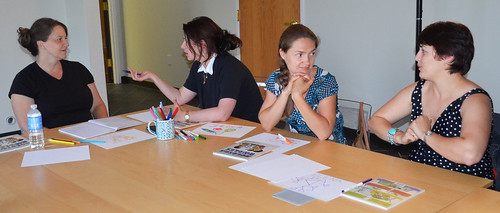
When we worked on questions that can help with dreams, it quickly became clear that what we want is still in the realm of sci-fi. This world is still far, far away from giving us ready answers for our questions, such as:
- Where do kids find help for THEIR math – art math, dump truck math, the math of infinity (when you are four)? Is there a system that can guide you from one concept to the next, given your interests, your learning history, and your favorite things in life?
- How come there are no “math play” or “math support” groups, and how do you form them?
- What about the epidemic of math anxiety?
- Is there an easy and quick way to find stuff rich in math and relevant to your passion – books, games, activities?
The above list is what people care about. Curriculum developers, take note! No math curricula even attempt to tackle such questions.
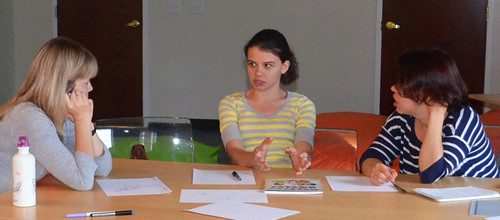
That’s why we have to take matters into our own hands. If we know what we want for our kids, it’s up to us to take steps toward it! A thoughtful discussion is a good beginning.
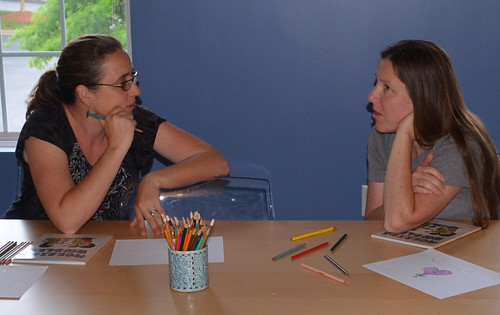
P.S. More good parent questions are at “Ask Moby Snoodles” – give it a try!
Posted in Grow


