- Home
- “Yes, And…” Improving Math Play with Improv
- Althea’s Math Mysteries
- Avoid Hard Work, the Workshop
- Avoid Hard Work! …And Other Encouraging Problem-Solving Tips for the Young, the Very Young, and the Young at Heart
- Blocks and Modeling: A Do-It-Yourself Guide to Exploring Geometric Objects – Online Workshop
- Blog
- Books and Goods
- Bright, Brave, Open Minds
- Bright, Brave, Open Minds: A Problem Solving Kaleidoscope. Open online course for parents and teachers
- Camp Logic
- Cart
- Checkout
- Citizen Science Station
- Consulting and Tutoring
- Courses
- Download File
- Easy Complexity and Special Snowflakes Online Math Circle
- Empires: Year-long prealgebra program in a game
- Expedition Everest
- Five Fabulous Activities for Your Math Circle
- Funville Adventures: Math Personified!
- Funville Web Tour
- Hacking Math
- Hiding in Plain Sight: Vyshyvanka Secret Codes
- Home
- HOW do they do it? Creating your own math puzzles
- Inspired by Calculus: Online course for parents, teachers, and their children ages 5-12
- Kingdom On A Wall
- Kingdom on the Wall
- Ko’s Journey Is Discontinued
- Lapware
- Math Books
- Math Cafe
- Math Circles
- Math Circles 1001 Leaders Course
- Math Future event registration
- Math Future: come and talk!
- Math Goggles Challenges
- Math Renaissance
- Math Trek
- Mathematics & Poetry for All
- Meet the authors
- MidSchool Math Digital Math Tools
- Moebius Noodles
- mpsMOOC13: Problem Solving for the Young, the Very Young, and the Young at Heart
- Multiplication Explorers FAQ
- Multiplication Explorers LIVE workshop
- Multiplication Explorers Online Course
- Multiplication Explorers Registration
- Multiplication Explorers, the book
- Multiplication Models Poster
- My Account
- Natural Math Multiplication Course
- Online Logic Summer Camp for Kids!
- Online Summer Calculus for Kids Camp!
- Pay Natural Math
- Playing with Math: Stories from Math Circles, Homeschoolers, and Passionate Teachers
- Reviews of the Moebius Noodles book
- September 25: Math Storytelling Day
- Socks Are Like Pants, Cats Are Like Dogs
- Speaking and events
- Start Here!
- test001
- The Art of Factorization Diagrams
- The Iditarod
- The seven principles of Natural Math
- Transformers: Matrices & Graphs!
- Veronica’s Multiplication: a Natural Math circle online
- WOW! Multiplication – an open course in September 2013
- Ying and the Magic Turtle
- About Natural Math
- Contact Us
- Get Involved
What Would You Rather Have – Commutative Property Game


Is 2*3 different from 3*2? My answer used to be “But of course! Don’t you know the commutative property?” Now, after following Malke Rosenfeld’s exploration of multiplication, I answer it with a lot more non-committal “it depends“. And I notice more and more examples when even though quantitatively, 3*2=2*3 and 8*1=1*8 and 3*5=5*3, qualitatively you sometimes get two distinctly different results.
Ironically, as I’m moving from quantity toward quality, my 6-year old is moving in the opposite direction. Consider these two examples:
Remember Maria’s review of Clap, Drum and Shake It by Marcia Daft? In particular, this part:
Do more multiplication. In particular, invite kids to multiply within pattern units. For example, how do you double the pattern unit “clap, clap, shake”? That is, how do you show 3×2 in the language of the book? “Clap, clap, shake; clap, clap, shake” is what the book does. You can also do “clap, clap, clap, clap, shake, shake”!

Two months ago I tried it with my son using 3 colors of PostIt notes instead of printed cards. He concentrated on the qualitative aspect (the patterns) rather than on the quantitative side (6 elements total) and insisted that the two strings had nothing in common.
Me: “But you said this one had 6 PostIts and the other one had 6 PostIts”.
Him: “But these are not the same 6s, Mom.”
Yesterday we finished listening to “Chitty Chitty Bang Bang” audio book. After giving the story some thought, my son asked me: “Do you know what it’d be if there were two Chitty Chittys?” He then explained that it’d be “Chitty Chitty Chitty Chitty Bang Bang Bang Bang”. He then went on to tell me what three Chitty Chittys would be like. You guessed it: “Chitty Chitty Chitty Chitty Chitty Chitty Bang Bang Bang Bang Bang Bang”.
Me: Can two also be “Chitty Chitty Bang Bang Chitty Chitty Bang Bang?”
Him:”Sure because you know, Mom, it’s the same thing”.
Which reminds me of a story we recently re-read. It was a chapter from the Karlson on the Roof by Astrid Lindgren. In it, a little boy says that he will have one birthday cake with eight candles on it (1*8); to which his friend adds that it would be a whole lot better to have eight cakes with one candle (8*1).
It also reminds me of a video in which Malke’s daughter is sharing her perspective on the quality vs. quantity issue.
What do you think? Share your examples of when you’d rather have a*b than b*a.


Posted in Grow
Newsletter March 30, 2013

Welcome to adventurous math for the playground crowd! I am Moby Snoodles, and I love to hear from you at moby@moebiusnoodles.com

Book news
We are polishing the book landing page. It will have a short Moebius Noodles declaration of principles, previews of pages, quotes from reviews, and so on. We need to find a balance between greeting newbies first coming upon Moebius Noodles – and displaying photos, questions and answers, and game ideas from people already involved with the project.
The book is a beginning. It is an invitation to join the Moebius Noodles movement!
How do you join? Questions are at the heart of learning mathematics. To join Moebius Noodles movement, ask a question!

The powerful enterprise software for questions and answers is provided to Moebius Noodles by DZone, a publisher and a community of software developers. The leaders of DZone believe in supporting excellent mathematics education for the next generation of technologists.

Blogs and networks
Math Goggles #9 invites you to seek math in your child’s favorite cartoons:
This week’s Math Goggles challenge is very simple – watch one of your child’s favorite cartoons and look for math in it. If it seems interesting, intriguing, strange, weird, and worth investigating, look further into it. Yep, that’s it! Here’s how it worked out for me…
Math Goggles #10 is a series of challenges about slicing bagels. It starts simple: can you slice into two pieces? Can you slice so that the cross-section is two circles? Then it gets involved, all the way to trefoil knots and mobius strips.

David Coffey started a meme on making every day mathematically special. Try it with your kids! Ask them for their favorite numbers, and celebrate when those days come up. Our examples are on the blog; here’s one for today, 3/30:

Sharing
You are welcome to share the contents of this newsletter online or in print. You can also remix and tweak anything here as you wish, as long as you share your creations on the same terms. Please credit MoebiusNoodles.com
More formally, we distribute all Moebius Noodles content under the Creative Commons Attribution-NonCommercial-ShareAlike license: CC BY-NC-SA

Talk to you again on April 15th!
Moby Snoodles, aka Dr. Maria Droujkova
Posted in Newsletter
Start with One Straight Line

 A few years ago I viewed “The Hundred Languages of Children,” a travelling exhibit about the Reggio Emilia approach to early childhood education. If you’re not familiar with this approach it, among other things, considers the environment (of the classroom and other spaces) as a “third teacher”.
Of course, I was drawn to the part of the exhibit that focused on movement and dance as one of the “hundred languages” with which children express themselves. There was a video that showed the children’s first experiences with an old factory space – a huge room empty except for two rows of large, white columns. The children were running around and between the columns, peeking around them, and interacting with their friends, all movements and ideas that eventually turned into a formal piece of choreography.
At the time I was just starting to think about creating a math/dance program for preschoolers and my biggest question was how could I encourage that kind of exploration? It seemed unlikely I would be able to find an empty factory or other interesting environment and get a bunch of preschoolers there on a weekly basis. And then it hit me – I could create an environment out of tape. I could define three-dimensional space using two-dimensional lines and colors.
After experimenting with my daughter’s preschool class, I came up with some starting points for parents and teachers who are interested in employing tape in the interest of math and kinesthetic exploration of space.
A simple straight line taped down a hallway becomes a pathway. It also divides the space in two, and provides a chance to walk on it or jump over it. Best of all, one can march (or walk, or skip, or slide, etc.) rhythmically down it singing “As I was marching down the street, down the street, down the street…” Or, tape two or more parallel lines down a space and see what happens when you sing “Down by the banks of the hankey pankey, when the bullfrogs jump from bank to bankey…”
A simple alteration of a child’s environment can deepen their experience and exploration of the space around them. When my daughter was three her teachers put down a straight line of tape to help the class ‘line up’ before leaving the classroom. It was a simple, visual learning strategy that appeared to work as envisioned by the teachers. Later in the year though, I saw pictures of what else the kids had done with the line. They had used their large blocks to build a wall the length of the tape and then lined up their animals and cars alongside it.
A simple taped perimeter can highlight empty space, as in “Find an empty spot inside the tape and make a shape.” Floor tape can define and redefine the space it’s in. Large open spaces encourage a lot of endless running. The minute you create a large rectangular box on the floor, with corners, you now have enough visual cues to focus a preschooler’s attention to IN (the box), OUT (of the box), AROUND (the sides of the box), CORNERS, and ACROSS, all age-appropriate math terminology.
Ultimately, I would love if every parent or preschool teacher would put down taped lines in their living and learning spaces then stand back to observe how the children interact with them.
Start with one straight line and go from there but don’t bring attention to it. Let your kids find it and interact with it on their own volition and let us know what you observe!
p.s. FYI, when I talk about ‘floor tape’ I am referring to two different products, both of them sticky. First, there’s painters tape which is blue and low tack so it can come up easily off both hard surfaces and carpet. There is also the floor tape that P.E. teachers use, which comes in lots of fabulous colors, the better to design with, my dear.
Posted in Grow
Math Goggles #10 – Bagel Math
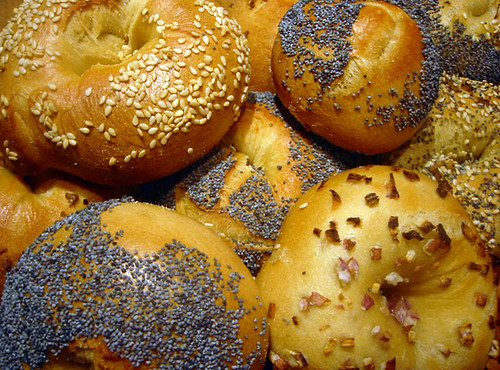
This week’s Math Goggles challenge is a perfect excuse to go out and buy a dozen of freshly baked bagels. At least it was for me. (If you are not sure what is a Math Goggles challenge, read about it here). So the question is what do you get when you slice a bagel.
The answer depends on how you slice it. That’s one reason you need several bagels. Begin by cutting the first bagel horizontally. What will the cross section look like when you finish slicing? Easy, right?
Next bagel! Instead of making a horizontal cut, slice this one in half vertically. Can you predict what the cross section will look like this time? Still easy-peasy! (And now you know the correct answer next time you see this little puzzle floating around on Facebook)
Time for bagel #3, inspired by James Tanton. Can you slice it in such a way (different from the first two) that the cross section will show two circles? Hint: choose your best-looking (most torus-like) bagel for this one.
The forth bagel can be cut into a trefoil knot which is super easy to do, but you sacrifice the ability to toast your bagel before putting cream cheese on, or rather in, it.
Four down, eight more to go. Time for the big one, George Hart’s interlocking bagel halves puzzle. I made a mistake of putting half my bagels into the freezer, so by the time I attempted this problem, I only had 2 bagels left. And I didn’t want to draw on any of them with a Sharpie. Let’s just say that I learned a few valuable lessons in the process and ended up with a failed, but perfectly edible experiment.
So, sharpen your knife, get out a tub of cream cheese, and keep your eyes open for math!
Posted in Grow


