- Home
- “Yes, And…” Improving Math Play with Improv
- Althea’s Math Mysteries
- Avoid Hard Work, the Workshop
- Avoid Hard Work! …And Other Encouraging Problem-Solving Tips for the Young, the Very Young, and the Young at Heart
- Blocks and Modeling: A Do-It-Yourself Guide to Exploring Geometric Objects – Online Workshop
- Blog
- Books and Goods
- Bright, Brave, Open Minds
- Bright, Brave, Open Minds: A Problem Solving Kaleidoscope. Open online course for parents and teachers
- Camp Logic
- Cart
- Checkout
- Citizen Science Station
- Consulting and Tutoring
- Courses
- Download File
- Easy Complexity and Special Snowflakes Online Math Circle
- Empires: Year-long prealgebra program in a game
- Expedition Everest
- Five Fabulous Activities for Your Math Circle
- Funville Adventures: Math Personified!
- Funville Web Tour
- Hacking Math
- Hiding in Plain Sight: Vyshyvanka Secret Codes
- Home
- HOW do they do it? Creating your own math puzzles
- Inspired by Calculus: Online course for parents, teachers, and their children ages 5-12
- Kingdom On A Wall
- Kingdom on the Wall
- Ko’s Journey Is Discontinued
- Lapware
- Math Books
- Math Cafe
- Math Circles
- Math Circles 1001 Leaders Course
- Math Future event registration
- Math Future: come and talk!
- Math Goggles Challenges
- Math Renaissance
- Math Trek
- Mathematics & Poetry for All
- Meet the authors
- MidSchool Math Digital Math Tools
- Moebius Noodles
- mpsMOOC13: Problem Solving for the Young, the Very Young, and the Young at Heart
- Multiplication Explorers FAQ
- Multiplication Explorers LIVE workshop
- Multiplication Explorers Online Course
- Multiplication Explorers Registration
- Multiplication Explorers, the book
- Multiplication Models Poster
- My Account
- Natural Math Multiplication Course
- Online Logic Summer Camp for Kids!
- Online Summer Calculus for Kids Camp!
- Pay Natural Math
- Playing with Math: Stories from Math Circles, Homeschoolers, and Passionate Teachers
- Reviews of the Moebius Noodles book
- September 25: Math Storytelling Day
- Socks Are Like Pants, Cats Are Like Dogs
- Speaking and events
- Start Here!
- test001
- The Art of Factorization Diagrams
- The Iditarod
- The seven principles of Natural Math
- Transformers: Matrices & Graphs!
- Veronica’s Multiplication: a Natural Math circle online
- WOW! Multiplication – an open course in September 2013
- Ying and the Magic Turtle
- About Natural Math
- Contact Us
- Get Involved
Newsletter February 28, 2013

Welcome to adventurous math for the playground crowd! I am Moby Snoodles, and I love to hear from you at moby@moebiusnoodles.com

Book news
We are almost done copy editing. What’s with the “almost” part, you ask? Turns out, it takes a lot of work to craft definitions so they come out just right. And by “just right” we mean both rigorous and accessible. Should we be so particular when defining math terms for little kids? We believe so. In fact, based on our experience playing and talking with children, we know that they are very keen observers who will spot inconsistencies, notice exceptions, and call you up on contradictions. This, combined with their curiosity and fearlessness of complex math ideas makes our task both exciting and challenging.
Last week we went through about a dozen versions of the definition of recursion. The notion appears in chapters on functions and fractals. We ended up with a version from computer science rather than math. We believe it makes the most sense. Check it out:
What do “This Is the House That Jack Built,” slicing pizza, and stacking up blocks have in common? They are all examples of recursion: applying the same operation to previous results. This produces patterns that change in a self-similar ways, much like fractals. You put the next block on top of all past blocks; you repeat – and an amazing block tower grows till the baby knocks it down. You slice each piece of your pizza in half; you repeat – until there are enough slices for everyone. You keep on adding verses – while keeping the entire previous rhyme, much like the block tower:
This is the dog that worried the cat
That killed the rat that ate the malt
That lay in the house that Jack built.
Bold words are also defined in the glossary. We hope our glossary will be a start of a stand-alone resource. There is a general lack of simple rigorous math definitions! For example, Wikipedia has several relevant articles: Yon Yonson and House That Jack Built and Cumulative tale. But click math links in the articles at your own risk, because the definitions assume very formal math background!
Blogs and networks
Our weekly Math Goggles series has two new activities out!
In #6 Yelena invites you to read math stories:
March is a great month for math holidays. First Wednesday of the month is the World Maths Day. Right after it comes the World Science Day. Then, of course, there’s the Pi Day. But first, at least this year, comes the Read Across America Day. So this week’s Math Goggles challenge is to pick up and read a fun math book. If you are not sure what Math Goggles Challenges are all about, check here first. If you are not sure how a math book can be fun, read on.
In #5 you can ascend from cleanliness to mathyness:
I imagined creating an algorithm for a robot to wash my dishes. My algorithm started with the robot checking whether there were any dishes in the sink. If no, it’d stand by or, ideally, switch to a different chore. If yes, then it would turn water on. Then it would soap up the scrubby and pick up the first dirty plate. Scrub, rinse, check, put on a drying rack. Repeat until the sink is empty. Are those the smallest steps that my dish-washing algorithm can be broken into? Of course, not…
Malke, meanwhile, is thinking in threes. Check out the gorgeous Sierpinski fractal made out of clover! Could you use four-leaf clover instead? How?

Sharing
You are welcome to share the contents of this newsletter online or in print. You can also remix and tweak anything here as you wish, as long as you share your creations on the same terms. Please credit MoebiusNoodles.com
More formally, we distribute all Moebius Noodles content under the Creative Commons Attribution-NonCommercial-ShareAlike license: CC BY-NC-SA

Talk to you again on March 15th!
Moby Snoodles, aka Dr. Maria Droujkova


Posted in Newsletter
Math Goggles #6 – Let’s Read Math Story


March is a great month for math holidays. First Wednesday of the month is the World Maths Day. Right after it comes the World Science Day. Then, of course, there’s the Pi Day. But first, at least this year, comes the Read Across America Day. So this week’s Math Goggles challenge is to pick up and read a fun math book. If you are not sure what Math Goggles Challenges are all about, check here first. If you are not sure how a math book can be fun, read on.
Math books can be boring, but so can non-math books. But just like non-math books can be fascinating, interesting, intriguing, beautiful, witty, uproariously funny, thoughtful, and in general unputdownable, so can many math books. The key is to find the book that speaks to you. Check out the LivingMath.net’s huge reading list, ask a librarian, do an online search or see what comes up on Amazon when you type in “math book” or “book about math” or search for a particular math term in their Books section.
Don’t limit yourself in your search. Don’t limit just to what you already know! In fact, there are some terrific books to be found if you search for “don’t know about math”. Most importantly, do not restrict your search to books for grown-ups. Why should you? Some of our most favorite and beloved books are the children’s books.
So what are you waiting for? This week, find your own great math book, enjoy it, and share with us! I’ll be reading Theoni Pappas “Fractals, Googols and Other Mathematical Tales“. And what about you?
Posted in Grow
Thinking in Threes

The more I learn about the exquisite connections between shape, number and nature, the more convinced I am that combining numbers and shapes is a win-win situation for building number sense in young children. For example, consider the benefits of exploring the basic, but charming, triangle. This mesmerizing video provides some exquisite, thought provoking examples of three-ness:
httpv://youtu.be/1ztfo5S5oL4
What three-ness did you notice? I noticed three colors, triangles with three sides and three corners, many different types of triangles and, best of all, a lovely waltz rhythm (1-2-3, 1-2-3)! The video is also a demonstration of the power of doubling – double 3 is 6 (a hexagon or a snowflake) and double 6 is 12 (a dodecagon). My seven-year-old watched the video all the way to the end the second time (the first time she was waltzing along to the music) and said: “T. [a friend] and I saw a big snowflake once – it looked like that!”
Back in November I read a Moebius Noodles post that mentioned ‘iconic numbers’ — numbers that are so ubiquitous in our daily lives that we don’t really notice them but are perfect for building number sense. One iconic number object is the clover.

I, for one, had never given its ‘three-ness’ much thought until the day my daughter brought me one with a clear triangle scribed on its leaves. As soon as I saw it I knew exactly what to do with it.
We picked more clovers, flattened and dried them in a sketchbook, and finally found some time (and a glue stick) to paste them down. Although my daughter sometimes eschews direct participation in the projects I think up, she is generally always around as I’m making something. In this particular case, I chatted with her about what I was doing while I glued and pasted, and she made a lot of observations, which is good enough for me.

Isn’t it cool?!? It’s a Sierpinski triangle fractal made out of clovers, a true monument to three-ness!
Prior to this we had constructed other Sierpinksi triangles out of candies, with a straight edge and ruler, with colored pencils, and with money. Now that’s what I call ‘thinking in threes’.
It is fun to find math wherever we go and it’s even more fun to make math out of the things we find. What other three-ness will you find today? Here are a few ideas to get you started: tricycles; three little kittens who lost their mittens; morning, noon and night; a triple junction created when three bubbles come together and, as a final adieu…
…perhaps my favorite example of three-ness so far: This one I made out of a little circular piece of cookie divider paper. Presenting the teeny, tiny, translucent tetrahedron!

Posted in Make
Math Goggles #5 – From Cleanliness to Mathyness
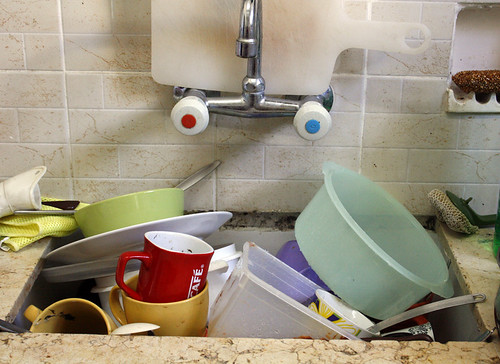
What’s washing dishes got to do with math? The answer is in this week’s Math Goggles. Oh, and you get a chance to get your home cleaner and mathy-er. If you are new to Math Goggles and not sure what to do and why do it, check out this page first.
Ever since my dishwasher broke, I’ve been washing a whole lot of dishes. Doing dishes by hand is not especially complicated and leaves plenty of time for thinking about math and other things. But don’t worry, I’m not going to talk about counting dishes, estimating the per-plate cost of detergent or calculating the volume of water in the sink given the rate of inflow and outflow. What I was thinking about was one of the games in our upcoming book, the game we call Silly Robot. Particularly, I imagined creating an algorithm for a robot to wash my dishes.
My algorithm started with the robot checking whether there were any dishes in the sink. If no, it’d stand by or, ideally, switch to a different chore. If yes, then it would turn water on. Then it would soap up the scrubby and pick up the first dirty plate. Scrub, rinse, check, put on a drying rack. Repeat until the sink is empty.
Are those the smallest steps that my dish-washing algorithm can be broken into? Of course, not. Next time I do a sink-full of dishes, I’ll work on refining it. Besides, I might be able to re-use parts of this dish washing algorithm for another one of my “I wish I had a robot that would do this for me” dreams – doing laundry.
In the mean time, I invite you to join me. Think of a household task you do a lot and wouldn’t mind giving it to a robot. Next time you do it, pretend you are creating an algorithm for it. So what’s your robot going to help you with?
Posted in Grow


