- Home
- “Yes, And…” Improving Math Play with Improv
- Althea’s Math Mysteries
- Avoid Hard Work, the Workshop
- Avoid Hard Work! …And Other Encouraging Problem-Solving Tips for the Young, the Very Young, and the Young at Heart
- Blocks and Modeling: A Do-It-Yourself Guide to Exploring Geometric Objects – Online Workshop
- Blog
- Books and Goods
- Bright, Brave, Open Minds
- Bright, Brave, Open Minds: A Problem Solving Kaleidoscope. Open online course for parents and teachers
- Camp Logic
- Cart
- Checkout
- Citizen Science Station
- Consulting and Tutoring
- Courses
- Download File
- Easy Complexity and Special Snowflakes Online Math Circle
- Empires: Year-long prealgebra program in a game
- Expedition Everest
- Five Fabulous Activities for Your Math Circle
- Funville Adventures: Math Personified!
- Funville Web Tour
- Hacking Math
- Hiding in Plain Sight: Vyshyvanka Secret Codes
- Home
- HOW do they do it? Creating your own math puzzles
- Inspired by Calculus: Online course for parents, teachers, and their children ages 5-12
- Kingdom On A Wall
- Kingdom on the Wall
- Ko’s Journey Is Discontinued
- Lapware
- Math Books
- Math Cafe
- Math Circles
- Math Circles 1001 Leaders Course
- Math Future event registration
- Math Future: come and talk!
- Math Goggles Challenges
- Math Renaissance
- Math Trek
- Mathematics & Poetry for All
- Meet the authors
- MidSchool Math Digital Math Tools
- Moebius Noodles
- mpsMOOC13: Problem Solving for the Young, the Very Young, and the Young at Heart
- Multiplication Explorers FAQ
- Multiplication Explorers LIVE workshop
- Multiplication Explorers Online Course
- Multiplication Explorers Registration
- Multiplication Explorers, the book
- Multiplication Models Poster
- My Account
- Natural Math Multiplication Course
- Online Logic Summer Camp for Kids!
- Online Summer Calculus for Kids Camp!
- Pay Natural Math
- Playing with Math: Stories from Math Circles, Homeschoolers, and Passionate Teachers
- Reviews of the Moebius Noodles book
- September 25: Math Storytelling Day
- Socks Are Like Pants, Cats Are Like Dogs
- Speaking and events
- Start Here!
- test001
- The Art of Factorization Diagrams
- The Iditarod
- The seven principles of Natural Math
- Transformers: Matrices & Graphs!
- Veronica’s Multiplication: a Natural Math circle online
- WOW! Multiplication – an open course in September 2013
- Ying and the Magic Turtle
- About Natural Math
- Contact Us
- Get Involved
Newsletter February 15, 2013

Welcome to adventurous math for the playground crowd! I am Moby Snoodles, and I love to hear from you at moby@moebiusnoodles.com

Book news
Carol Cross, our awesome copy editor, is finishing the work this weekend. We should have the printed book pre-order form up in the next few days, as well. The first print run will be for those people who crowd-funded the project at the level of paper book copies, as well as the pre-orders.
Blogs and networks
School your kids (and yourself) in the art of asking questions, build chains of attributes, and study home patternomics with our new series of mini-games called Math Goggles.

Want some sage advice from a ten-year-old math club leader? Check out the guest blog post by Marie!
My name is Marie, and I am ten years old. Since I was six years old, I have attended a math circle. Last year I started to help out with the class for little kids. This year, I decided that I could start teaching a math circle on my own. Now, I am teaching a Pre-K math circle for little kids that are about four or five years old. The kids are used to me now, and I am really enjoying the teaching experience.
Kids are much more involved in the class when:
- The problems involve them
- They get to choose what the problems are about, or at least change the details of the problems
- The problems involve real-life situations, especially if they have to do with their life
- The problem has a fairy tale, or some other kind of story woven into it.

Sharing
You are welcome to share the contents of this newsletter online or in print. You can also remix and tweak anything here as you wish, as long as you share your creations on the same terms. Please credit MoebiusNoodles.com
More formally, we distribute all Moebius Noodles content under the Creative Commons Attribution-NonCommercial-ShareAlike license: CC BY-NC-SA

Talk to you again on February 28th!
Moby Snoodles, aka Dr. Maria Droujkova


Posted in Newsletter
Math Goggles #4 – Art of Asking Questions

The first few Math Goggles challenges were all about noticing math around us. Let’s do something different today. Today, join me in the game of asking questions. If you are new to Math Goggles and not sure what to do and why do it, check out this page first.
How hard could it be, to ask questions? Well, it depends on the types of questions and why you are asking them. We are pretty good about asking practical question such as “How to remove grass stains from shirts?” or “How to fix a leaky faucet?” We are also very good at “How many times have I told you?” and “When are you going to clean up your toys?” Another category we excel at are questions that we already know the answers to, such as “How much is 8+3?” or “What are the colors of the rainbow?”
This time around, we will try to ask very different questions:
- Specific questions – Ask, “Is there some kind of a hidden pattern here?” instead of “Where is math in this?” or “What parts do you see on this device?” instead of a “What is it?”
- Questions for which you don’t have an answer – If you look at a yellow circle, do not ask “What shape is this?” and “What color is this?” You already know that much. Ask, “What other things of that color do you see?” or “Does this shape remind me of anything?”
- Personal questions – Questions can be about anything, including math, as long as they are also about the person you are asking, yourself. The previous example, “What other things of that color do I see?” is even stronger if you ask, “What other things of that color do I like?”
You are not being evaluated. It is not a test of your creativity, intelligence, math skills or anything like that. So here is an even more important rule:
- In this game, there are no wrong or stupid questions.
One final thing before we get started. Sometimes we are afraid to ask questions because we think we will end up having to figure out answers to them. Not in this game. Sure, some questions you come up with, you might want to investigate further. But there is no requirement or expectation to do so. So, the last rule of the game is
- Ask without worrying about answering.
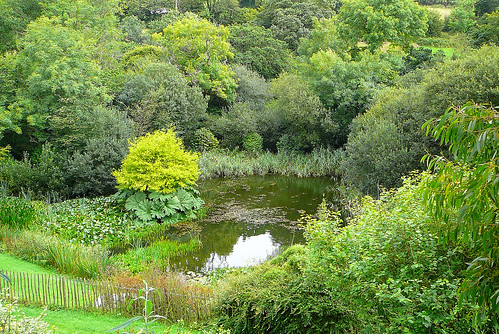
Here’s how to play this week’s challenge. Find a beautiful image (in a magazine, online or just look out of a window) that makes you feel good – energized, relaxed, entertained, curious, so on. Come up with just one question about what you see. If you feel like coming up with more than one question, do it. If you want to try asking questions about another image, do it. If you want to stop and investigate possible answers, do it. If you want to play this game online, check out Dan Meyer’s 101 Questions.
The question I asked myself is “how many shades of green exist and how many of those can I notice around my house?”
Posted in Grow
Marie: Leading Math Circles at 10?
My name is Marie, and I am ten years old. Since I was six years old, I have attended a math circle. Last year I started to help out with the class for little kids. This year, I decided that I could start teaching a math circle on my own. Now, I am teaching a Pre-K math circle for little kids that are about four or five years old. The kids are used to me now, and I am really enjoying the teaching experience.
This is what I observed during one of the classes; it’s very funny. When I told the kids that the problem they were solving was a game, even if it was a just an ordinary problem, the kids started getting much more involved in it, because they thought that they weren’t actually solving a problem, but that they were playing a game! An example of when this happened was when we were using the board and pieces of the game, “Othello” (we weren’t actually playing the game though). The kids were reluctantly solving geometric problems using Othello pieces, until I told them that we were playing a game. “A game? Let’s play!” yelled the kids, excitedly going back to the exact same problems they were solving before.
Kids are much more involved in the class when:
- The problems involve them
- They get to choose what the problems are about, or at least change the details of the problems
- The problems involve real-life situations, especially if they have to do with their life
- The problem has a fairy tale, or some other kind of story woven into it.
For example, when the class was doing Venn diagrams, I made the diagrams about who in the class had sisters, brothers, or both. The kids were delighted with the very idea that they would be inside a mathematical problem!
I observed that warm-ups and easy problems that kids can solve on their own, correctly, help the kids relax and build more confidence in themselves, when encountering harder problems later in the lesson. Discussions and introductory examples to the topic are a good way to start a lesson. DO NOT start a lesson with a game! Kids will lose their attention, become over-excited, and be unable to return to the topic.
Teaching a math circle turned out being much more fun and interesting than I expected. I enjoy listening to the kids’ ideas and thoughts, and observing how they react. The kids consider me adult enough that they listen to me, but they see that I am still a child, so they are not afraid to share their ideas, and make mistakes.
If you would like to see the lessons of the math circle, and more details, please visit my blog at:
http://trickyprekmath.blogspot.com/
Thank you.
Posted in Grow
Math Goggles #3 – Ch-ch-chain… of Attributes
Have you ever played a rhyming game? If not, join me for this week’s Math Goggles challenge. If you are new to Math Goggles and not sure what to do and why do it, check out this page first.
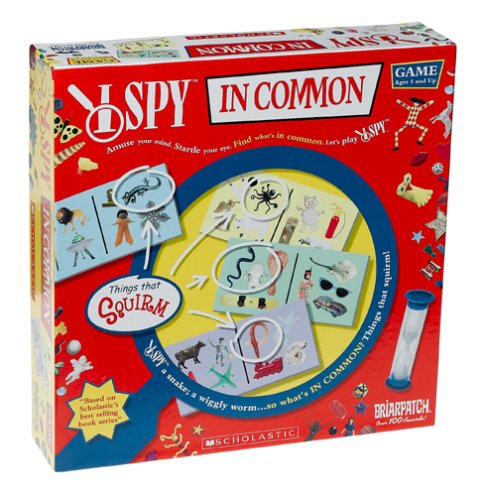
The inspiration for this week’s game comes from Malke Rosenfeld who sent me the I Spy in Common board game. The game has lots of tiles with seemingly unrelated pictures on them. That is, unrelated, until you start thinking creatively and finding common attributes on the different tiles.
We are going to play a grown-up version of this terrific game and we won’t need game tiles either. Here’s how – look around the room and choose any object. Now, look around some more and choose another object that shares at least one common attribute with the first object. Next, look for object #3 that has something in common with the object #2. And so on. How many objects can you chain together? For an extra challenge, can you loop back to the object you started with without repeating the attributes?
Here’s what my living room ch-ch-chain looks like:

My phone has lots of buttons and so does my…

… which is also rectangular in shape, just like…

… the bricks on my fireplace which, as you can see, are laid in a very simple pattern that reminds me of…

… this old wooden typeset drawer which is on the wall next to the fireplace and opposite…

this wooden bowl. This is the first non-rectangular object in my chain, so I’m going to add my…

… this round chair that sits next to it. The chair is made of woven rattan…

… which is different from the bamboo used in the blinds except that they are also woven. And you see this thin cord for pulling the blinds up? It brings me back to…

… my laptop and all the cords sticking out of it. And guess what? Since my ThinkPad is black, it shares that in common with… drum roll…
… my phone! (both the buttons and the plastic back)
Ok, so maybe my pictures aren’t all that inspiring (naturally, I blame it on my cheap point-and-shoot camera). In which case, check out the Rhyming Pics project archives (unfortunately, the project is no longer active) for some beautiful pictures. Can you follow the chains and guess the shared attributes in those images?
If you play this game and post it to your blog, Flickr!, Facebook, etc, let me know in the comments.
Posted in Grow


