- Home
- “Yes, And…” Improving Math Play with Improv
- Althea’s Math Mysteries
- Avoid Hard Work, the Workshop
- Avoid Hard Work! …And Other Encouraging Problem-Solving Tips for the Young, the Very Young, and the Young at Heart
- Blocks and Modeling: A Do-It-Yourself Guide to Exploring Geometric Objects – Online Workshop
- Blog
- Books and Goods
- Bright, Brave, Open Minds
- Bright, Brave, Open Minds: A Problem Solving Kaleidoscope. Open online course for parents and teachers
- Camp Logic
- Cart
- Checkout
- Citizen Science Station
- Consulting and Tutoring
- Courses
- Download File
- Easy Complexity and Special Snowflakes Online Math Circle
- Empires: Year-long prealgebra program in a game
- Expedition Everest
- Five Fabulous Activities for Your Math Circle
- Funville Adventures: Math Personified!
- Funville Web Tour
- Hacking Math
- Hiding in Plain Sight: Vyshyvanka Secret Codes
- Home
- HOW do they do it? Creating your own math puzzles
- Inspired by Calculus: Online course for parents, teachers, and their children ages 5-12
- Kingdom On A Wall
- Kingdom on the Wall
- Ko’s Journey Is Discontinued
- Lapware
- Math Books
- Math Cafe
- Math Circles
- Math Circles 1001 Leaders Course
- Math Future event registration
- Math Future: come and talk!
- Math Goggles Challenges
- Math Renaissance
- Math Trek
- Mathematics & Poetry for All
- Meet the authors
- MidSchool Math Digital Math Tools
- Moebius Noodles
- mpsMOOC13: Problem Solving for the Young, the Very Young, and the Young at Heart
- Multiplication Explorers FAQ
- Multiplication Explorers LIVE workshop
- Multiplication Explorers Online Course
- Multiplication Explorers Registration
- Multiplication Explorers, the book
- Multiplication Models Poster
- My Account
- Natural Math Multiplication Course
- Online Logic Summer Camp for Kids!
- Online Summer Calculus for Kids Camp!
- Pay Natural Math
- Playing with Math: Stories from Math Circles, Homeschoolers, and Passionate Teachers
- Reviews of the Moebius Noodles book
- September 25: Math Storytelling Day
- Socks Are Like Pants, Cats Are Like Dogs
- Speaking and events
- Start Here!
- test001
- The Art of Factorization Diagrams
- The Iditarod
- The seven principles of Natural Math
- Transformers: Matrices & Graphs!
- Veronica’s Multiplication: a Natural Math circle online
- WOW! Multiplication – an open course in September 2013
- Ying and the Magic Turtle
- About Natural Math
- Contact Us
- Get Involved
1+1=2 but Mostly it Doesn’t


Have you had a chance to look through the 1+1=5 and Other Unlikely Additions by David LaRochelle? If you (or your child) think that addition is booooring, make sure to get this book. Once you do, get all nice and cozy, but leave plenty of room for your child (and possibly yourself) to jump up and down from excitement. That’s how great this book is. Oh, and by the way, forget about learning how to add two numbers. That’s really not what this book is all about.
It’s a little bit about arithmetic, but mostly it is about iconic quantities and set theory. If you simply must have some counting thrown in for good measure, there’s that too.
A while ago we shared our Iconic Numbers Multiplication game. We also briefly mentioned that playing with iconic numbers helps children develop number sense. If you are interested in the how and why of this, check out this iconic arithmetic primer.
In that same post we also suggested a variation of the game in which you look for examples of iconic addition instead of multiplication. We also mentioned that iconic addition is harder to find than iconic multiplication. Except it’s not if you read 1+1=5! In fact, once we were done reading this book (and, at my son’s request, re-reading it several times), we started seeing iconic additions everywhere!
1+1=7 since both the dining room light fixture (6 bulbs) and the living room table lamp (1 bulb) were on while we read it
1+1=1 since I held the book with one right hand (0 band-aids) and one left hand (1 band-aid)
1+1=3 since Luke Skywalker fights with 1 light saber while General Grievous fights with 2 (ok, this doesn’t occur in the actual Star Wars story, but happens regularly in our family room)
This activity is very addictive and might lead to speaking in puzzles that are a blend of 1+1=5 and “I Spy”:
I spy with my little eye
One plus one now make a five
Ask that around the dinner table and see who’s the first to guess it right (just make sure to place a fork and a knife next to each plate).
Next thing you know, you’re raking your brain trying to come up with rhymes for other numbers. I quickly gave up on rhyming and switched to a simple “I see a one plus one that makes a ten. Do you see what I see?”
The book inspires kids (and adults) to see everyday objects as sets, or collections of other objects. For example, a triangle can be viewed as a set of 3 sides while a rectangle is a set of 4 sides. An octopus is an example of a set of 8 (arms) while a starfish hides a set of 5 (arms) in plain sight. If one set has 8 elements and another set has 5 elements, then when added, the two sets have 13 elements total. Hooray!
So yes, there’s some addition in the book. But again, it’s not central. So don’t worry if your child is not yet ready to add 100 and 10. The illustrations are wonderful and help even very young children enjoy the book.


Posted in Grow
Last-Minute Christmas Decorations and Tangled Lights

Days are flying by and everyone is busy preparing for the holidays. While you might not know what gift(s) you will be getting this year or whether the kids will catch the sniffles right before the party, one thing you can count on is tangled lights. Seriously, no matter how carefully we pack them, when we open the boxes next year, here they are, all knotted up. Turns out, it’s all about math and physics as opposed to our carelessness. Check out this NPR article for details. Here’s the best part – next time you have knotted up strings of lights, give them to your little one to undo and proudly tell your friends he was busy solving a knot theory problem.

In addition to tangled lights, another thing you can count on is a broken ornament or two or three. If your tree looks a bit bare, don’t rush to the store. Instead, consider some really cool last-minute DIY ornaments. Bonus is they are all about math. The easiest ones are paper chain garlands. This year, add a twist, (ok, half a twist) and turn them into Moebius chain garlands. Or bend pipe cleaners into shapes and grow Borax crystals on them. What shapes you choose is totally up to you. Inspired by Vi Hart’s Borromean Onion Rings video, we made this Borromean Rings ornament.
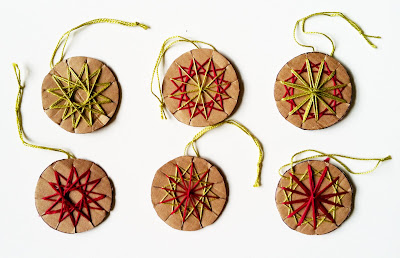
Or how about turning cardboard boxes you were about to throw away into star ornaments just like Malke and her daughter did on the Map is Not the Territory blog.
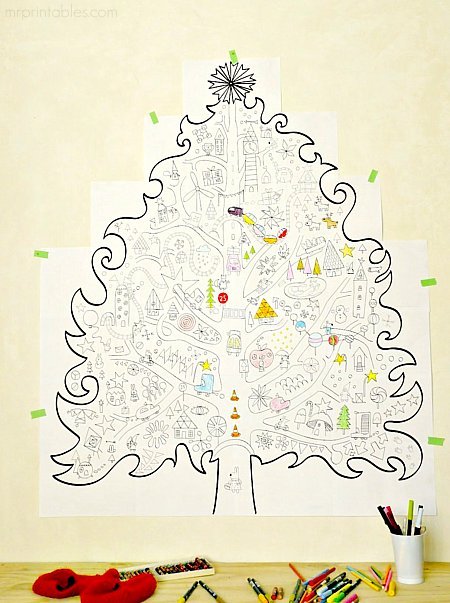
Finally, we’d like to share a holiday printable we found thanks to the link from one of the readers, Elena T. She printed it for her daughter to color days ago, but we just got around to it. This Christmas tree might seem like just a giant cute coloring page, but don’t let it fool you. It’s got lots of things going on, including some great math. Can you find examples of gradients, tessellations, pattern, rotational symmetry, radial symmetry, iconic quantities and a lovely Sierpinski triangle?
Share your holiday math with us on the blog and on our Facebook page.
Posted in Make
The Round Table Quest

A few days ago I decided to introduce my son to the first of the Sir Cumference books. The entire series is one of the most popular living math books and came highly recommended by quite a few of our math friends. So I sat my son on the couch and told him we were going to read the book about the Knights of the Round Table, something he previously heard about only in a Magic Treehouse story.
I am not sure what I wanted out of it, but a thought of my little one asking me to re-read the story before running off to his desk and feverishly drawing and cutting out shapes did cross my mind. So I was a bit disappointed when he did not ask and did not run off to try it all out with the compass and the triangle. Oh well, maybe he’s not yet ready, I thought.
Except later that day, as my son was playing with his toys on the kitchen table, he asked me “Mom, wouldn’t it be nice if we had a round table in our kitchen?” And that’s how it all started. For a while we talked about the benefits of a round table over our rectangular table. After all, we are a family of three, so we have plenty of room around our smallish table.
My son argued that when grandparents visit, there isn’t much room left and two people have to share one side. And he wanted to see if cutting our table into a circle would make things better.
First we needed to figure out how to find the center of our table which was a nice little geometry problem. It might had been too difficult for him to solve on his own. But I reminded him that he already knows how to find a center of a rectangle because that’s what we do when making origami jumping frogs.
Since we couldn’t fold the table, we had to simulate the folds with some yarn and tape. We then marked the center with a push-pin.
Next we had to figure out how to draw the largest circle we could. The terms we came across in the Sir Cumference story – diameter and radius – came in quite handy in this discussion. My son tried using our compass, but quickly realized it wasn’t big enough. And we didn’t have any round object big enough to be traced. So I showed him how to make a compass with a pushpin, yarn and a pencil. The first few circles we drew were not really circles since we were yet to learn the lesson of keeping the yarn stretched throughout the project.
In retrospect, this was the perfect time to stop and compare the lengths of yarn in taut and slack states.
Once we got a more or less acceptable circle drawn on the table, we needed to make its circumference more visible. I didn’t want to damage the surface any further, so I asked not to use markers or crayons. The only other option was blue painter’s tape. So we brought a roll of tape out, unrolled a long piece and tried marking circumference with it. Except it didn’t quite work.
Which meant we had to figure out how to solve the problem of marking something rounded with something straight. I didn’t think my son would figure it out, but almost immediately he suggested to tear off little pieces of tape instead of one long one. And so we did. We tested different lengths to find a good balance between accuracy and speed. Still, that was a lot of pieces of tape and after a while my son delegated the work to me and simply observed the process. But it was also a great opportunity to recall the Greedy Triangle story.
And then we looked at the finished project and compared the perimeter and area of our would-be round table to our existing rectangular one. It was still big enough for three people, but just about. Trying to fit grandparents was out of the question. So we took the tape off (turns out, it does leave marks on wood, so beware) and decided to leave our table as is.
Posted in Grow
Math Dictionary, Math App and Smarter Babies
There is so much math goodness on the web this week, that we are bursting at the seams and need to share our finds with the world!
First up, a math dictionary for kids (and adults). Now, we did mention in one of our newsletters that we were working on creating a math dictionary for the Moebius Noodles book. Our goal was to avoid formulas and connect rigorous and concise mathematical definitions to everyday experiences and objects. It was both difficult and fun.
This week we saw a post and a video on MathFour blog about an online math dictionary for kids. We checked it out and yes, it’s terrific! Instead of just reading, you get to take each definition for a spin, sometimes quite literally (as with “rotation” and “rotational symmetry”). It seems to be designed with older kids in mind, but pre-readers can explore it with your help. Ability to print out the results of your experiments is an added bonus.
httpvh://www.youtube.com/watch?v=Rm21wuVLB6E
If you have an iPad or an iPhone you are likely on the lookout for new math apps. Check out the freshly released and free MIT-P app. Designed by the Embodied Design Research Laboratory (EDRL) at UC Berkeley’s Graduate School of Education and built by Terasoft, the Mathematical Imagery Trainer for Proportion (MIT-P) is “designed to support discovery-based instruction of multiplicative concepts, primarily proportion.”

I’ll do a separate review of our experience with the MIT-P app next week. Even though this app is designed primarily with elementary- and middle-schoolers in mind, let your younger child try anyway. After all, babies are smarter than we think.
According to the 2009 NYT article by Alison Gopnik, “in some ways, [babies and very young children] are smarter than adults”. It’s a great article to keep in mind whenever we feel inclined to teach our young kids anything, including math. It explains why certain techniques that work with older kids will not and physically cannot work with younger ones. It also talks about the most effective way of teaching young kids and it is surprisingly simple.
Posted in Make


