- Home
- “Yes, And…” Improving Math Play with Improv
- Althea’s Math Mysteries
- Avoid Hard Work, the Workshop
- Avoid Hard Work! …And Other Encouraging Problem-Solving Tips for the Young, the Very Young, and the Young at Heart
- Blocks and Modeling: A Do-It-Yourself Guide to Exploring Geometric Objects – Online Workshop
- Blog
- Books and Goods
- Bright, Brave, Open Minds
- Bright, Brave, Open Minds: A Problem Solving Kaleidoscope. Open online course for parents and teachers
- Camp Logic
- Cart
- Checkout
- Citizen Science Station
- Consulting and Tutoring
- Courses
- Download File
- Easy Complexity and Special Snowflakes Online Math Circle
- Empires: Year-long prealgebra program in a game
- Expedition Everest
- Five Fabulous Activities for Your Math Circle
- Funville Adventures: Math Personified!
- Funville Web Tour
- Hacking Math
- Hiding in Plain Sight: Vyshyvanka Secret Codes
- Home
- HOW do they do it? Creating your own math puzzles
- Inspired by Calculus: Online course for parents, teachers, and their children ages 5-12
- Kingdom On A Wall
- Kingdom on the Wall
- Ko’s Journey Is Discontinued
- Lapware
- Math Books
- Math Cafe
- Math Circles
- Math Circles 1001 Leaders Course
- Math Future event registration
- Math Future: come and talk!
- Math Goggles Challenges
- Math Renaissance
- Math Trek
- Mathematics & Poetry for All
- Meet the authors
- MidSchool Math Digital Math Tools
- Moebius Noodles
- mpsMOOC13: Problem Solving for the Young, the Very Young, and the Young at Heart
- Multiplication Explorers FAQ
- Multiplication Explorers LIVE workshop
- Multiplication Explorers Online Course
- Multiplication Explorers Registration
- Multiplication Explorers, the book
- Multiplication Models Poster
- My Account
- Natural Math Multiplication Course
- Online Logic Summer Camp for Kids!
- Online Summer Calculus for Kids Camp!
- Pay Natural Math
- Playing with Math: Stories from Math Circles, Homeschoolers, and Passionate Teachers
- Reviews of the Moebius Noodles book
- September 25: Math Storytelling Day
- Socks Are Like Pants, Cats Are Like Dogs
- Speaking and events
- Start Here!
- test001
- The Art of Factorization Diagrams
- The Iditarod
- The seven principles of Natural Math
- Transformers: Matrices & Graphs!
- Veronica’s Multiplication: a Natural Math circle online
- WOW! Multiplication – an open course in September 2013
- Ying and the Magic Turtle
- About Natural Math
- Contact Us
- Get Involved
Newsletter October 30, 2012

Welcome to adventurous math for the playground crowd! I am Moby Snoodles, and I love to hear from you at moby@moebiusnoodles.com

Book news
All the games for our book are ready, including illustrations. And we are working on the cover design. What else does our book need then? One thing we added in this development cycle is our special dictionary. We strive to be very correct mathematically. This means using a lot of beautiful math words, like fractal or exponentiation, which some readers may not know. Moreover, like every other big project, Moebius Noodles adds specific metaphors and meanings to terms. Thus even the readers who know the beautiful math words may find our definitions interesting.
For example, here are a few definitions that have to do with functions.
Function
Function is a machine that converts values to other values, or finds correspondences between values. Function machines work by rules people make up. The starting values are called input. The converted or corresponding values are called output. Your stove is a function machine: its input might be raw eggs, milk and spices, and its output – an omelet.

Transformation
When you change or combine rules, functions can be transformed. For example, you can turn your stove to the maximum setting and its timer to half an hour. Your input will stay the same – raw eggs, milk and spices; but your output will now be burned eggs and lots of smoke.
Inverse Function
What a function does, its inverse will undo. Of course, some deeds cannot be undone. A function of “baby drops a cup of grapes on the floor” has an inverse, “parental unit crawls around, searching for grapes and putting them back into the cup”. On the other hand, a function of “drop a cup of orange juice on the floor” or a function of “break an egg for the omelet” does not have an inverse.

Our blogs
Barbara of Numberland.net left us a note. Parents love their kids, so they create very lovely math projects for them – and then for the world! Numberland ideas, based on a University of Heidelberg research project parents and teachers have adopted, go with our chapter on intrinsic numbers.
Math is a wonderful, emotional, exciting and beautiful field and young children are more than open to dive into it. It is up to us to support them build their (individual) bridge from their inborn mathematical understanding to the abstract and formal language of math we developed. I very much like the approach of Moebius Noodles because it fits with the idea of a project I am involved in:
‘Let’s visit Numberland’ is a concept where we invite children to travel to a land where the numbers 1 to 10 live and where there is a lot to do, sing, find out… For example, we detect that Number 4 lives in a square garden, her house has four windows and she likes anything that is four times (…)

My daughter was three when she travelled to Numberland for the first time, and of course three was her favorite number. One day, at dinner table, she suddenly beamed: ‘We are sitting in a triangle!’ (Her, my son and me were sitting at the table) ‘And if Daddy was here we would sit in a quadrangle!’
Sharing
You are welcome to share the contents of this newsletter online or in print. You can also remix and tweak anything here as you wish, as long as you share your creations on the same terms. Please credit MoebiusNoodles.com
More formally, we distribute all Moebius Noodles content under the Creative Commons Attribution-NonCommercial-ShareAlike license: CC BY-NC-SA

Talk to you again on November 15th!
Moby Snoodles, aka Dr. Maria Droujkova


Posted in Newsletter
What is a Stupid Question

You know how they say there are no stupid questions? Except there are and my not yet 6 year old just explained to me what makes a question a stupid one.

Here’s the story…
We were doing some schoolwork. I read him a story and then asked him a few questions about it. Why did I do that? Well, because the language development book I’m using told me to do just that. My son, who was pretty interested in the story, became distracted and uncooperative during our little Q&A. I asked him what was wrong and here’s the conversation we had:
Me: Honey, what’s wrong? You don’t seem to like this work?
Him: No, I don’t like it.
Me: Why?
Him: It’s because of the questions. They are boring and silly.
Me: Why is that?
Him: Because you already know the answers to all of them. So why are you asking me?
Me: Why do you think I do this?
Him: You know the answer already, so you just want to test me if I know it. It is boring and silly.
Me (trying to hide my dismay): I see your point.
As serendipity would have it, I saw Beau Lotto and Amy O’Toole’s TED video later that same day. It is about science education, but I’m wondering (and this time I do NOT know the answer) if it is possible to teach math to young children through a similar play-based hands-on process without asking “stupid questions”.
Posted in Grow
Newsletter October 15, 2012
Welcome to adventurous math for the playground crowd! I am Moby Snoodles, and I love to hear from you at moby@moebiusnoodles.com
Moby’s mail
Bon “Math is not a four letter word” Crowder of, you guessed it, MathFour.com asks:
Hey Moby!
Can I post this picture on my site? The ant one? And to where should I link and attribute it if so?
Thanks!
Glad you asked! It reminded me I need to put a licence on the newsletters (see below) and the website. Yes, I am happy for you to use this or any other picture, with attribution to MoebiusNoodles.com

Dor Abrahamson of UC-Berkeley shares a lovely story about his family. Gabi is Dor’s wife and Neomi is their daughter. This story goes with our chapter on intrinsic multiplication! Do you have a Moebius Noodles story? Write me!
We were eating home-made Mexican food with my parents, who’re visiting here.
My dad asked why the brown paste is called ‘re-fried‘ beans.
Gabi said she’s not sure, but she guesses it’s cooked twice.
I said, “What if they cooked it yet again — they’d have to call it ‘re-re-fried‘ beans!”
Neomi said, “No, ‘re-re-fried beans’ would mean they cooked it four times.”
I asked, “How come?”
And Neomi said, “Because the ‘re’ at the beginning means you have to do the ‘re-fried’ over again, so that’s two times twice, so that’s four.”
I stammered something about sequences vs. nested structures, but that was where Neomi lost me and dug into the avocado.
The ant picture Bon liked is an example of a nested structure, too.
Book news
We’ve finished the first draft of illustrations and layouts for all chapters. In the coming weeks, we will put it all together as the finished book. It is a rather surprising amount of work, considering the writing and the illustrations are done! We need to figure out pages, introductions, covers and so on. At the same time, we will be discussing chapters with volunteer reviewers.
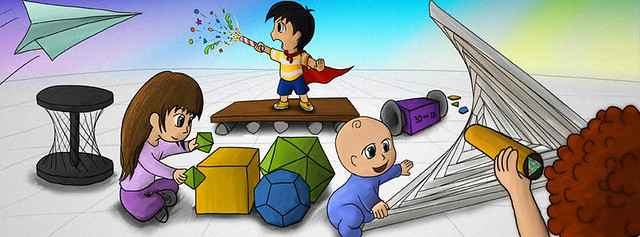
The cover is in the early stages of design. We know the elements we want on it, but not how they will come together – or their particulars! We want a big picture of kids, playing with complex math objects, and then some recognizable graphic elements that can be reused for other books in the Moebius Noodles series. Your ideas are very welcome. Here is an early draft.

Sharing
You are welcome to share the contents of this newsletter online or in print. You can also remix and tweak anything here as you wish, as long as you share your creations on the same terms. Please credit MoebiusNoodles.com
More formally, we distribute all Moebius Noodles content under the Creative Commons Attribution-NonCommercial-ShareAlike license: CC BY-NC-SA
Talk to you again on October 30th!
Moby Snoodles, aka Dr. Maria Droujkova
Posted in Grow
Newsletter September 30, 2012
Welcome to adventurous math for the playground crowd! I am Moby Snoodles, and I love to hear from you at moby@moebiusnoodles.com
Moby’s mail
Thank you for offers to help review the book before it goes out! And for kind words, like these:
Anna Weltman of the Math Munch crew – a group of bloggers who will review together – writes: “I’m really excited, too! I’ve been looking forward to reading your book ever since I found out about it.”
Brendan Murphy, of “Philosophy without a home” offers: “I’d love to help doing reviews.” I also could not help but steal (with attribution) a part of his signature: “You do not study mathematics because it helps you build a bridge. You study mathematics because it is the poetry of the universe. Its beauty transcends mere things.” – Jonathan David Farley, NY Times letter.
We only have two chapters left to lay out and to illustrate. Then we’ll work with reviewers. I am very much looking forward to discussions with all you fabulous math lovers!
Book news
I have to confess I love fractals. This is a bit trivial, as confessions go. It is like saying, “I love music, food and holidays.” So does everyone else! Even people who don’t know the word “fractal” have seen, and liked, the ubiquitous pretty pictures.
However, not all of us (humans or whales) realize that much of the math behind fractals is very intuitive. It is the basis of traditional storytelling and the crafts of many tribes. It is also accessible to young kids, even toddlers!
Last week our illustrator, Ever, worked on the chapter about iconic fractals. He wanted to make a tree-type fractal, based on 3 “branches” and made out of creatures:

However, the number 3 is not typically associated with worms. We wanted our 3 to be more iconic, so we used an ant! Ant bodies consist of three major parts. If you want to know, they are called head, thorax (the “chest”) and gaster (the “stomach”).

But wait, there are two “branches” of the tree fractal on the ant’s gaster and none on the head! The ant does have three parts, but they are not used, one-for-one, in the structure of the fractal! The artistic reason was the smallness of the head, which is correct anatomically. And the artistic solution was to “cartoon” the ant, making its head large. I think it’s cute. It also expresses the math we need.
This is the sort of conversation I often have with three- to six-year-old kids. They use stamps or stickers or their own hands to make fractals. What number goes with what image? Where do you “branch” your fractal? How do you keep the pattern? What sizes do you choose for different parts?
Fascinating! The same ideas and thoughts come up in the work of little ones and of grown-ups! These must be deep and lovable ideas. Like music, food and holidays.
Talk to you again on October 15th!
Moby Snoodles, aka Dr. Maria Droujkova
Posted in Newsletter


