- Home
- “Yes, And…” Improving Math Play with Improv
- Althea’s Math Mysteries
- Avoid Hard Work, the Workshop
- Avoid Hard Work! …And Other Encouraging Problem-Solving Tips for the Young, the Very Young, and the Young at Heart
- Blocks and Modeling: A Do-It-Yourself Guide to Exploring Geometric Objects – Online Workshop
- Blog
- Books and Goods
- Bright, Brave, Open Minds
- Bright, Brave, Open Minds: A Problem Solving Kaleidoscope. Open online course for parents and teachers
- Camp Logic
- Cart
- Checkout
- Citizen Science Station
- Consulting and Tutoring
- Courses
- Download File
- Easy Complexity and Special Snowflakes Online Math Circle
- Empires: Year-long prealgebra program in a game
- Expedition Everest
- Five Fabulous Activities for Your Math Circle
- Funville Adventures: Math Personified!
- Funville Web Tour
- Hacking Math
- Hiding in Plain Sight: Vyshyvanka Secret Codes
- Home
- HOW do they do it? Creating your own math puzzles
- Inspired by Calculus: Online course for parents, teachers, and their children ages 5-12
- Kingdom On A Wall
- Kingdom on the Wall
- Ko’s Journey Is Discontinued
- Lapware
- Math Books
- Math Cafe
- Math Circles
- Math Circles 1001 Leaders Course
- Math Future event registration
- Math Future: come and talk!
- Math Goggles Challenges
- Math Renaissance
- Math Trek
- Mathematics & Poetry for All
- Meet the authors
- MidSchool Math Digital Math Tools
- Moebius Noodles
- mpsMOOC13: Problem Solving for the Young, the Very Young, and the Young at Heart
- Multiplication Explorers FAQ
- Multiplication Explorers LIVE workshop
- Multiplication Explorers Online Course
- Multiplication Explorers Registration
- Multiplication Explorers, the book
- Multiplication Models Poster
- My Account
- Natural Math Multiplication Course
- Online Logic Summer Camp for Kids!
- Online Summer Calculus for Kids Camp!
- Pay Natural Math
- Playing with Math: Stories from Math Circles, Homeschoolers, and Passionate Teachers
- Reviews of the Moebius Noodles book
- September 25: Math Storytelling Day
- Socks Are Like Pants, Cats Are Like Dogs
- Speaking and events
- Start Here!
- test001
- The Art of Factorization Diagrams
- The Iditarod
- The seven principles of Natural Math
- Transformers: Matrices & Graphs!
- Veronica’s Multiplication: a Natural Math circle online
- WOW! Multiplication – an open course in September 2013
- Ying and the Magic Turtle
- About Natural Math
- Contact Us
- Get Involved
Knot Theory for Young Kids


A couple of weeks ago I discovered a wonderful math blog called Math Munch. Now, with a name like this, you know this is going to be good! And it is even for someone who is not a professional mathematician and who was pretty scared of math as a child (I’m pointing my finger at myself now, tsk-tsk-tsk). Basically, Math Munch is a weekly digest of the beautiful, surprising, strange, engaging, and fun math out there on the Internet.
As I was browsing the site, I came across a post about knots. I love knots because they are a) beautiful and b) because I have such a hard time following the instructions and learning how to tie them (something so simple, even a hagfish can do it). Well, I was in for a surprise – turns out, mathematically speaking, the knots we (hagfish and I) usually tie are not really knots at all since the knots we tie are not closed loops.
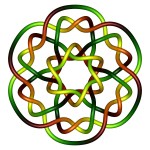
Intrigued, I followed up with Anna Weltman, who teaches math, folds paper, ties knots and co-authors Math Munch. I wanted to know what kind of activities can I do together with my 5-year old to further explore mathematical knots. Anna’s suggestions were so awesome, that I felt they needed to be shared with you. Note: I added names to each game just because bullet lists are boring. Feel free to rename the activities.
So here is Anna’s response to my question:
A big mathematical question that knot theory is really good for exploring is, “Can I turn this into that without breaking something about it that I think is important?” Another question that knot theory is good for is, “How can I make an object that will do this particular thing I want it to?” I’m not an expert on 5-year-olds, but here are some ideas I had for approaching those two questions through knots:
The Game of Moebius Strip
A fun way to make knots and links is to make moebius strips with different numbers of twists and cut them in half. You can make two different knots – a trefoil knot and a knot with 5 crossings – but cutting a 3-twist strip and a 5-twist strip in half, respectively. You can play with cutting differently twisted strips in half and describing the similarities and differences between the results.
The Game of Twisted Cords
Get some pretty slippery string – maybe lanyard/gimp, or headphones (though with only 1 phone would be best). Tangle it up – either haphazardly or methodically, your choice. Then, tape the ends together. Can you untangle it? Untangle it as much as you can and describe what you have in the end. You can do this a bunch of times and keep track of the untangled results. You can then try to make a tangle that you can untangle – ask, what should we do or not do with the ends of the string so that we are sure to be able to untangle it in the end?
The Game of Steer Roping
Get some string and a bunch of differently shaped objects – make sure some have at least 1 hole in them. Challenge your child to tie the string around the objects so that you can’t just slip it off. See if the child can describe what kinds of objects are tie-up-able and what kinds aren’t, and what kinds of tying are best for mastering the challenge. This is less knot theory than it is study of surfaces, but it involves knots!
The Game of Un-Twister
This game is really fun, but you need several people to play it. Stand in a circle. Everybody take hands, but not with the person standing next to you and not both hands with the same person. Then twist and climb and duck under each other’s arms – but don’t let go of each other’s hands! – until you’re standing in a circle again, completely untangled! If you have enough people, it sometimes happens that you end up in two circles. If you want to really analyze the game, you can make a sketch of how everybody took hands and map out the untangling process.
The Game of “I Am Knot Myself Today”
Another fun thing to do along those lines is to try to make a knot out of your arms, torso, and a stick that you can’t untangle without dropping the stick.
httpv://www.youtube.com/watch?v=4mdEsouIXGM
Oh, and Anna pointed me to this great Vi Hart video which seems like a perfect conversation starter.
Awesome applesauce! We’ve already tried the first game Anna suggested and it was a huge hit. I can’t wait to try the rest. Thank you so much, Anna!
If you haven’t done this yet, do check out Math Munch blog. Every single post is chock-full of links to beautiful and engaging math sites many of which could be explored with young children.


Posted in Make
Thank You for Voting

Turns out, we’ve been nominated on the Circle of Moms Top 25 Teacher Moms Sites! And we are in a great company too, including Kim and Amanda from The Educators’ Spin On It. You remember their fun grid art activity they shared on our blog, right?
We are a late entry (the voting ends on August 9), but better late than never. So please take a second and vote for us on the Circle of Moms site today and tomorrow (you can vote once daily through August 9). Thank you for your support of the Moebius Noodles blog!
Posted in Grow
Math Stories – Cut and Fold
I remember that when I was little, I derived a sort of enjoyment, a feeling of accomplishment, from doing math worksheets. For better or worse, my son is the exact opposite. Worksheets do nothing, but turn him off math. And so do most of the puzzles. But he loves stories. So a lot of what I do is tell stories.

The first time I told a cut-and-fold story was a long time ago. We were exploring symmetry, playing mirror games and building with blocks before. That first time I folded pieces of paper only 1 or 2 times before cutting while telling a story. My son really loved it, but then we moved on to other things…
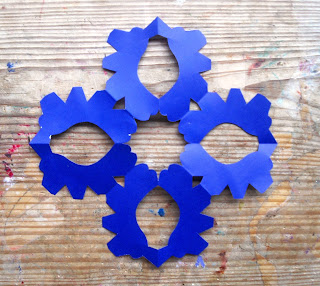
But a few weeks ago I read a wonderful post on the Map is Not the Territory blog. In her Scissor Stories post, Malke not just posted the pretty photographs of symmetry art (like the one above), but wrote a detailed script, a story she told to a group of children. While my stories were monologues, she conversed with children, asked them questions, and helped them notice the math in the story. I encourage you to read Malke’s post. It was so inspirational to me, that the very next day I tried our cut-and-fold stories again, this time in a way Malke’s done it.

The story I told my son was about three friends. He immediately made it about him and his two best buddies and how they were ninjas. Each friend was represented by a square of origami paper. We then folded each square, trying to predict what would happen to them after each fold. Then each square ninja had some adventures along the way and made some tough choices. In the end, we tried to predict what each square would look like. Typically, my son does not like guessing, but he was so into the story, that he kept offering his predictions throughout the game. And, unlike his usual answers of “I don’t know” and “A million” and “17 million and twenty five” the guesses he offered were well thought-out and he could usually explain how he arrived at them.

Unlike Malke, I totally forgot to take pictures throughout the game or record the narrative. But honestly, if you read Malke’s post, you will know exactly what to do and will see all the opportunities for improvisation.
I promise that next time I tell math stories to my son, I’ll keep a better record of them. Would you be interested in these stories? Do you tell math stories to your children? Would you like to share them on this blog? If yes, e-mail me at yelena(at)moebiusnoodles.com If you already have your stories posted on your own blog, please share a link in the comments!
Posted in Grow
Newsletter July 30, 2012

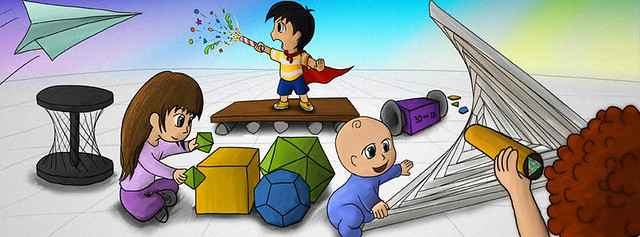
Welcome to adventurous math for the playground crowd! I am Moby Snoodles. Please write me – I reply to everyone! moby@moebiusnoodles.com
Book news
We are about half way through illustrating the book: a good time to pause for reflection. If math were a story, its genre would be action/adventure. Have someone convinced you math consists of facts, theorems, diagrams and formulas? They lied. These things – these static objects – are just snapshots of the dynamic experience of math. The real mathematics consists of actions: putting together data to dig up a new fact, postulating a theorem, building a diagram, manipulating a formula.
If this is so, we “Moebius Noodles” authors ask ourselves, why are we making a book rather than a playground, a virtual world, or at least a suite of interactive lapware? There are three reasons, we answer ourselves! First, while books are not adventures, historically they have been excellent social objects for inviting people and communities to have their own adventures. This still holds true circa 2012: we checked. Second, all of us, and our kids, love books of the sort we are making. You may laugh, but we will read and re-read “Moebius Noodles” ourselves when it is out. And third, we like strong challenges, such as the difficult task of evoking real math actions with mere text and pictures.
Speaking of challenges: the part of the book dealing with functions is especially action-oriented, so it’s particularly hard to capture in pictures. For example, little kids love doing something over and over again – say, iterating a function machine that doubles. One block, two blocks, four blocks, eight blocks, oh my! How do we show this excitement? Here are some of the many steps from an initial idea to the final version…
An early draft
This is a chain of identical function machines, each doubling the number of cubes. The perspective of the picture – the line of machines coming at you – adds drama and action. Problem: in reality, we only have one function machine, used again and again!

Problem solved?
To address the problem of multiple function machines, how about making a spiral going through the same machine? Check out how much better 3D modeling is for the purpose of showing action, compared to the 2D diagram.

The final version
Many versions later – it’s so hard to show 32 cubes in a row in a meaningful and beautiful way! – here is a peek at the current version of the front piece for the chapter on iterations. Being a static picture, it’s not math, but it’s a very lively portrait of math, if I say so myself. You can feel the action!

Our blogs
Our latest guest blogger is Patrick Honner of the lovely MrHonner.com math appreciation blog. As an excellent high school teacher, Patrick designs many of his activities in ways that provide on-ramps to complex math – from the very ground. This way, however much students have missed up to now, they can still find the current activity meaningful, accessible – and joyful. For Moebius Noodles, Patrick wrote a piece called “Weaving your way through mathematics.” It goes with the part of the book about grids. Here is a picture and a quote.

Once the basic techniques of simple two-color weaving are mastered, more interesting and challenging projects can be undertaken. Using more than one color in an alignment (horizontal or vertical) opens up new patterns, as does using more than two colors. More challenging patterns, tilings, and inversions can be attempted.
Talk to you again July 30th!
Moby Snoodles, aka Dr. Maria Droujkova
Posted in Newsletter


