- Home
- “Yes, And…” Improving Math Play with Improv
- Althea’s Math Mysteries
- Avoid Hard Work, the Workshop
- Avoid Hard Work! …And Other Encouraging Problem-Solving Tips for the Young, the Very Young, and the Young at Heart
- Blocks and Modeling: A Do-It-Yourself Guide to Exploring Geometric Objects – Online Workshop
- Blog
- Books and Goods
- Bright, Brave, Open Minds
- Bright, Brave, Open Minds: A Problem Solving Kaleidoscope. Open online course for parents and teachers
- Camp Logic
- Cart
- Checkout
- Citizen Science Station
- Consulting and Tutoring
- Courses
- Download File
- Easy Complexity and Special Snowflakes Online Math Circle
- Empires: Year-long prealgebra program in a game
- Expedition Everest
- Five Fabulous Activities for Your Math Circle
- Funville Adventures: Math Personified!
- Funville Web Tour
- Hacking Math
- Hiding in Plain Sight: Vyshyvanka Secret Codes
- Home
- HOW do they do it? Creating your own math puzzles
- Inspired by Calculus: Online course for parents, teachers, and their children ages 5-12
- Kingdom On A Wall
- Kingdom on the Wall
- Ko’s Journey Is Discontinued
- Lapware
- Math Books
- Math Cafe
- Math Circles
- Math Circles 1001 Leaders Course
- Math Future event registration
- Math Future: come and talk!
- Math Goggles Challenges
- Math Renaissance
- Math Trek
- Mathematics & Poetry for All
- Meet the authors
- MidSchool Math Digital Math Tools
- Moebius Noodles
- mpsMOOC13: Problem Solving for the Young, the Very Young, and the Young at Heart
- Multiplication Explorers FAQ
- Multiplication Explorers LIVE workshop
- Multiplication Explorers Online Course
- Multiplication Explorers Registration
- Multiplication Explorers, the book
- Multiplication Models Poster
- My Account
- Natural Math Multiplication Course
- Online Logic Summer Camp for Kids!
- Online Summer Calculus for Kids Camp!
- Pay Natural Math
- Playing with Math: Stories from Math Circles, Homeschoolers, and Passionate Teachers
- Reviews of the Moebius Noodles book
- September 25: Math Storytelling Day
- Socks Are Like Pants, Cats Are Like Dogs
- Speaking and events
- Start Here!
- test001
- The Art of Factorization Diagrams
- The Iditarod
- The seven principles of Natural Math
- Transformers: Matrices & Graphs!
- Veronica’s Multiplication: a Natural Math circle online
- WOW! Multiplication – an open course in September 2013
- Ying and the Magic Turtle
- About Natural Math
- Contact Us
- Get Involved
Newsletter June 30, 2012

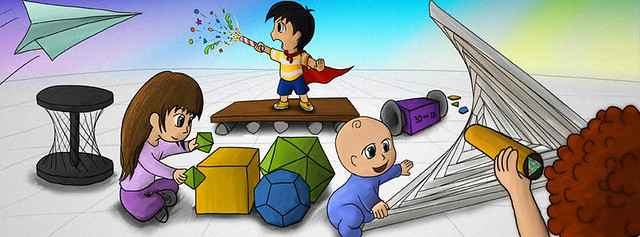
Welcome to adventurous math for the playground crowd!
I am Moby Snoodles, your friendly cetacean guide to the Moebius Noodles community. I love to receive mail at moby@moebiusnoodles.com

Book news
We created eighteen games for the book and now sixteen are ready to be illustrated. In addition to our own games, the book will have a few games designed by our supporters. Some of our supporters contributed at the chapter-making level during the crowdfunding campaign in September, so there will be a few more chapters for them.
We always knew how important illustrations are to a book. Yet knowing is one thing and actually coming up with ideas for illustrations is another. One of the Moebius Noodles main illustrating principles: the picture can’t be just a decoration! Each and every one must tell its own math story, strongly connected to its game. Fortunately, our illustrator, Ever, is as passionate about math as everybody else on the team.
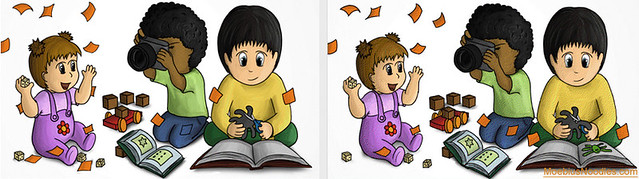
As Ever was working on the chapter on iconic quantities, he drew kids making a collection of sixes. Now, six is a good choice of a number for playing with iconic quantities. Six is even, so all our symmetry games work. Six is beyond the subitizing range (knowing a number at a glance), so it’s a fun challenge. Can you spot the changes Ever made between the old version (on the left) and the new one (on the right)?
Our blogs
We had two awesome guest stories since the last newsletter. Julia Brodsky from Art of Inquiry described a magic transformation game:
Prepare a big “wizard” hat and a “magic wand.” Prepare a set of small toy figurines (Safari Wild Tube, animal counters, matchbox cars, or something like that).
Show a toy to a child. Turn the hat upside-down. Put a toy under the hat. Say a spell and touch the hat with a magic wand. Put your hand under the hat and take what was hidden under the hat beforehand out of the hat. Voila – the toy turns into a different toy!
A family post from Dr. Richard Elwes and Haruka Elwes presented soft polyhedra for babies:

Our Facebook page just reached 200 fans. Head there to discuss media such as the TED talk on creativity and mathematics by Mr. Honner:
Research
The four basic operations used to be addition, subtraction, division and multiplication. This might have been sufficient in medieval times, but the world has changed considerably. Not to mention that the old system does not reflect how the mind of a toddler works.
In the last few decades, multiple studies confirmed that babies are born with the ability to subitize, that is, instantly recognize small quantities. While more studies are needed (and are being conducted), we now have data-based reasons to believe the baby’s brain comes with three more separate and related sets of math tools.
One set is for counting, addition and subtraction: the additive world. Another is for working with sets, units, collections, splitting, sharing, proportions and groups of groups: the multiplicative world. Yet another is for zoom, nested objects, fractals, self-similarity, recursion, powers: the exponential world.
All four worlds are available to babies, toddlers and young kids in playful, intellectually honest forms. We strongly suspect that lack of activities in any of these worlds leads to future difficulties with related parts of math. That is why in the Moebius Noodles book we have games that explore all four of these worlds.

Lapware
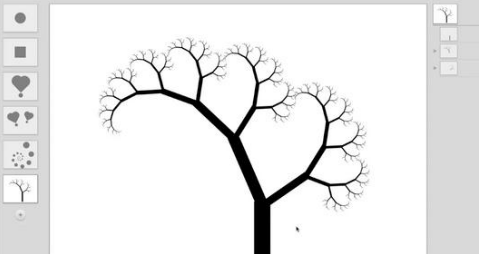
Discuss this software sent to us by Algot Runeman, a long-time supporter of Moebius Noodles. Even a baby can use the easy, beautiful RecursiveDrawing.com tool. Every mouse gesture or touch causes something fractally cool to happen! Yes, I just made up this phrase.
Talk to you again mid-July!
Moby Snoodles, aka Dr. Maria Droujkova


Posted in Newsletter
Different Perspective

Yesterday I chatted with a friend whom I haven’t seen in a while. Her child, a bright and energetic 8-year old, participates in quite a few extracurricular activities – ballet, gymnastics, tae kwan do, and art. Next year, music lessons might be added to the mix.
I asked my friend how they choose the activities for their daughter. Well, ballet was Mom’s choice since it was something Mom always wanted to do herself, gymnastics – Dad’s, since he was in gymnastics as a boy. Martial arts was a joint decision because it is known to improve child’s discipline. And art was the girl’s own choice.
Then I asked this question: if there was a math club or a math circle near you, would you consider signing up your daughter?
Her answer was “Absolutely! We are actually considering some extra math drills for her since she has some problems in school.”
This reminded me of another conversation, months ago, when another friend said that she wasn’t interested in a math club for her daughter because “she was doing well enough without it”. Yet another friend, this one with a preschooler, said that it was simply too early for her child to learn math.
I find it very interesting why there’s such a difference between attitudes towards, say, a dance class or an art class and a math club. Why the reactive attitude? I mean, why wait until a child falls behind in math class? Why math clubs are thought of as places for remedial math? Why sending a 3-year old to ballet classes is perfectly “normal” while playing advanced math games with her is not (“are you trying to raise a genius?”, “why are you torturing a child?”, “why don’t you let her enjoy childhood for now?”, and similar questions).
What if we looked at art, music, dance, gymnastics, LEGO and other children’s activities from a different perspective. Each and every one of these offers so many opportunities for mathematical discoveries! We just need to help our kids recognize and explore these opportunities. How can we do it? Where do we start?
Posted in Grow
Playing with Platonic Solids

There’s a lot of talk about how playing with building blocks helps children develop math skills. But what about children that are too young to even “tote and carry” blocks? Have you thought about introducing them to Platonic solids? Ok, here’s a little refresher about Platonic solids:
A Platonic solid is a 3D shape where each face is the same regular polygon and the same number of polygons meet at each corner.
If the idea of introducing this concept to a small child sounds a bit over the top, here’s a surprise – your infant might already be enjoying one. After all, a cube is a Platonic solid. But why leave out the other four – tetrahedron, octahedron, dodecahedron, and icosahedron? That’s exactly what British mathematician Richard Elwes and his wife Haruka have done. Here’s Richard’s story:
When some friends told us they were having a baby, Haruka set to work making a soft cubic toy to give the child, by sewing together square patches of colourful cotton cloth left over from other projects, and stuffing it with cushion-filler. Being a mathematician, Richard immediately suggested the set should be expanded to include all five Platonic solids. (One challenge was to make sure that no two adjoining faces were made of the same cloth.)
These toys are intended for very young children, so it cannot be expected that they will ‘learn geometry’ in the usual sense. Instead, what we hope is that they will begin to foster a geometrical aesthetic, enjoying the symmetries of the toys, and developing a familiarity with these five solids, which will remain throughout their lives.
As the children grow older, we hope they will keep revisiting the Platonic solids in other forms, perhaps as wooden or plastic toys, maybe as dice or puzzles, later making them themselves out of paper or card. But there is no need to stop with the Platonic solids! As soon as practical, why not introduce shapes like prisms, antisprisms, and Archimedean solids (along with their duals: bipyramids, trapezohedra, and Catalan solids)?
For a small child meeting the Platonic solids for the first time, there is is one potential problem: apart from the cube, the names of these shapes fail to reflect their elegant simplicity. For a toddler, the word “icosahedron” is surely a bridge too far. So why not reduce them to their initial syllables: tet, cube, ock, dode, & ike? This will allow the child to have fun identifying and comparing the shapes, without getting bogged down in unnecessary Greek verbiage.
Posted in Grow
Math Magic – Magic Transformations Game
 Today’s game comes from Julia Brodsky, the creative force behind The Art of Inquiry math circle in Maryland. Started several years ago by Julia as a thinking circle for her own children and their friends, it grew quickly. Julia teaches children the skills of solving non-standard open-ended problems using critical thinking.
While Julia’s thinking circle is for elementary school age children, she is sharing a game for younger children that she played when her kids were smaller. Without further ado, here’s the Magic Transformations game.
Key words
Pattern, prediction, transformation, unknown, input, output
How to Play
Prepare a big “wizard” hat and a “magic wand.” Prepare a set of small toy figurines (Safari Wild Tube, animal counters, matchbox cars, or something like that).
Show a toy to a child. Turn the hat upside-down. Put a toy under the hat. Say a spell and touch the hat with a magic wand. Put your hand under the hat and take what was hidden under the hat beforehand out of the hat. Voila – the toy turns into a different toy!
Ages and Stages
Baby: Start with just one item. The babies are just learning about the predictability of the events. They love when nothing new happens! The doggie goes in, the doggie gets out – let the baby watch it enough times, and watch the baby’s enjoyment. Just as the baby starts losing interest in the game, add another item – let the doggie turn into something else, different in size and color, and watch your baby’s reaction.
Toddler: Ask the toddler not to touch the hat – explain, that if the hat is touched, the magic will break. Decide on the rules of the transformation, but do not let your toddler know that rule – i.e the 4-legged animals always turn into 2-legged animals, and 2-legged animals always turn into toy cars. Make sure your hat has enough resources inside, and do not forget to “recharge” your hat after each manipulation, as needed. Ask your toddler to do something to distract his/her attention during this moment. See if your toddler will figure out the pattern, and will be able to predict the next transformation result.
Older child: Show the trick with the hat to an older child. Wait till the child figures out the transformation rule (you may come up with a 3- or 4-step rule). Now, ask the child to come up with another rule, and try to figure out that rule.
This is a perfect opportunity to use all those little toys children accumulate and love to play with. And how about using cartoon time to get inspired for more magic transformation play with this Moomin story?
If you haven’t yet, check out Art of Inquiry website, watch some math circle videos and try your hand at sample problems.
Posted in Make


