- Home
- “Yes, And…” Improving Math Play with Improv
- Althea’s Math Mysteries
- Avoid Hard Work, the Workshop
- Avoid Hard Work! …And Other Encouraging Problem-Solving Tips for the Young, the Very Young, and the Young at Heart
- Blocks and Modeling: A Do-It-Yourself Guide to Exploring Geometric Objects – Online Workshop
- Blog
- Books and Goods
- Bright, Brave, Open Minds
- Bright, Brave, Open Minds: A Problem Solving Kaleidoscope. Open online course for parents and teachers
- Camp Logic
- Cart
- Checkout
- Citizen Science Station
- Consulting and Tutoring
- Courses
- Download File
- Easy Complexity and Special Snowflakes Online Math Circle
- Empires: Year-long prealgebra program in a game
- Expedition Everest
- Five Fabulous Activities for Your Math Circle
- Funville Adventures: Math Personified!
- Funville Web Tour
- Hacking Math
- Hiding in Plain Sight: Vyshyvanka Secret Codes
- Home
- HOW do they do it? Creating your own math puzzles
- Inspired by Calculus: Online course for parents, teachers, and their children ages 5-12
- Kingdom On A Wall
- Kingdom on the Wall
- Ko’s Journey Is Discontinued
- Lapware
- Math Books
- Math Cafe
- Math Circles
- Math Circles 1001 Leaders Course
- Math Future event registration
- Math Future: come and talk!
- Math Goggles Challenges
- Math Renaissance
- Math Trek
- Mathematics & Poetry for All
- Meet the authors
- MidSchool Math Digital Math Tools
- Moebius Noodles
- mpsMOOC13: Problem Solving for the Young, the Very Young, and the Young at Heart
- Multiplication Explorers FAQ
- Multiplication Explorers LIVE workshop
- Multiplication Explorers Online Course
- Multiplication Explorers Registration
- Multiplication Explorers, the book
- Multiplication Models Poster
- My Account
- Natural Math Multiplication Course
- Online Logic Summer Camp for Kids!
- Online Summer Calculus for Kids Camp!
- Pay Natural Math
- Playing with Math: Stories from Math Circles, Homeschoolers, and Passionate Teachers
- Reviews of the Moebius Noodles book
- September 25: Math Storytelling Day
- Socks Are Like Pants, Cats Are Like Dogs
- Speaking and events
- Start Here!
- test001
- The Art of Factorization Diagrams
- The Iditarod
- The seven principles of Natural Math
- Transformers: Matrices & Graphs!
- Veronica’s Multiplication: a Natural Math circle online
- WOW! Multiplication – an open course in September 2013
- Ying and the Magic Turtle
- About Natural Math
- Contact Us
- Get Involved
Moebius Noodles Newsletter is Live


Have you seen our first newsletter? Then you are familiar with our mascot, Moby Snoodles, the math whale. If not, here is the link and don’t forget to sign up through the form in the side bar or here. You might be wondering why do we need a newsletter. Or you might be wondering why would you read it. So here are some answers:
1. Book Updates
Thanks to many of you, this project, a book of advanced math games for very young children, has become a reality. We are working on putting it all together and would like to keep you informed of our progress. Plus, we want to share with you not just the finished and polished book, but take you on behind-the-scenes tour of its development.
2. Stories
If math is indeed all around us, then why is it oftentimes so hard to notice? Maybe it’s exactly because math is all-pervasive, woven into the fabric of our daily lives. We think of math as numbers. Yet our daily life is not expressed in numbers, but rather a narrative, a story. Stories fascinate, surprise, delight us, adults and children alike. We think sharing math stories, ours and our friends, will help us get better at recognizing math in our daily experiences.
3. Beautiful Lapware
Do you know what else is fascinating, surprising and delightful? Toys! We can’t bring you regular toys, so instead we find free online activities and games that help your children create beautiful math in a matter of seconds. We call them lapware. We usually post links to them on our Facebook page. Once in a while we find a particularly engaging lapware which we will highlight in the newsletter.
Of course, we would love to hear your feedback. How can we improve our newsletter to make it even more interesting and helpful for you? Remember, you can always Reply to our newsletter via e-mail (Moby has his own e-mail box moby@moebiusnoodles.com), leave a comment on our Facebook page or on this blog. And don’t forget to subscribe to our newsletter if you haven’t done so yet.


Posted in Newsletter
Small Moments of Math
 Today’s post comes from the wonderful Malke Rosenfeld of Map is Not the Territory blog. Malke combined her background as a percussive dancer with her love of math in a unique Math in Your Feet program. It is a fusion of math, dance, rhythm and the creative process that helps children build deeper understanding of mathematics.
Malke: On my blog I often write about the times when mathematical inspiration hits but, most of the time, our daily lives are made up of smaller, less dramatic math moments. It’s during these lovely transient events where I really get a good glimpse at how my daughter is thinking, mathematically speaking, and how she is applying her understanding in a number of different contexts.
How we play:
My approach to math exploration at home has been hands-off, necessitated by a child who likes to captain her own ship. Math generally happens in bite-sized pieces around here. While I do influence the process, I hardly ever make formal plans. Instead, I am always looking for new games, thinking about what she might need or want to learn next and also how to introduce new things in a way that has the appearance of being at least 50% her idea. I also leave stuff lying around to be ‘discovered’ or engage in my own pursuits, which inevitably leads to some curious inquiries from the wee bystander.
Here are some examples of the small moments of math that have been happening around our house lately, all symmetry related.

This originally started as a whole lunch, but when the kid saw the design with a whole tomato in the center she insisted in cutting it in half before eating:
I am a big fan of the Reggio Emilia approach, particularly, of a belief that the child’s environment can and does influence children’s learning in very powerful ways. This includes meal time! I like to arrange meals in a pleasing manner and this plate lent itself wonderfully to creating a rotation design of four pieces of a whole, round chicken patty alternating with the tomatoes.
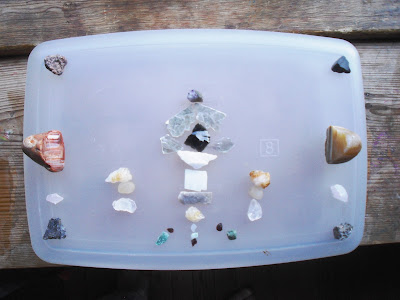
You can also use any items that interest your child to make spontaneous symmetry designs, anywhere you are. One morning I noticed my daughter creating a reflection design after breakfast, utilizing her rock and mineral collection.
This kind of activity can be initiated by anyone, though, as long as it’s done with a playful spirit. The main point is that balance and symmetry are pleasing to look at but also a joy to create. As a parent, you are in the best position to model the spirit of discovery through these playful moments. Often, all I have to do is start an inquiry with blocks, tangrams or other shapes and the kid takes over within minutes. Little jewels of math are all around us just waiting to be discovered at unexpected moments!
Key words that you can introduce during such activities are
- Whole
- Half
- Opposite
- Center
- Turn
- Reflect
- Balance/Balanced
Additionally, you can offer these activities, suggestions or make observations during and after play time:
- “Look! I can turn your lunch on this plate and it looks the same no matter how far it turns around!”
- “We’ve got five on one side and only four on the other – let’s balance out our design by making them the same on both sides. How can we do that?”
Symmetry is something that even the very young children can joyfully explore as long as you modify the activities to match your child’s age and developmental stage.
Baby: Cut out large symmetrical shapes to hang above the baby’s changing table or crib. Add a mirror (safe non-breakable) to your baby’s selection of toys and place objects in front of the mirror forming simple designs.
Toddler: Use larger items, model making simpler designs while offering child a chance to help you.
Young Child: Observe child as they play and find those ‘small moments’ as they happen. Initiate reflection and rotation designs at a playful moment – sidewalk chalk at the park (make a chalk outline of your child, have them draw a line down the center of their body) or be on the lookout for examples of symmetry as you go about your day. Take a look at the ‘symmetry finder’ game on Yelena’s blog which is easy to do anywhere and anytime you notice reflection symmetry happening.

Some more ideas for exploring symmetry through playful activities and art include
Butterfly designs using cut paper (Adult narrates while folding and cutting):
“Let’s make a butterfly! What color paper should we use?”
“I’m going to fold this paper in half. I’m cutting out the butterfly shape.”
“Here is what it looks like when the wings are folded. Let’s open it up and see the whole butterfly!”
“Let’s decorate our butterfly! I’ll color a spot on one wing and you draw the same spot in the same place on the opposite wing.” [Or, you could pre-cut some paper shapes – circles, stripes – and glue them on with gluestick.]
Line Designs (Adult says, drawing a line down the center of a piece of paper):
“Let’s make a design on either side of this line using our Cuisenaire rods (or pattern blocks, or legos…)”
“When I put down a blue rod next to the line on my side, you put your blue rod next to the line on your side.”
Adult leads for a while then asks child to lead. You can alternate turns. Try to keep all block placements in relation to the line or other blocks already placed. For older kids, you could use graph paper to position your blocks. (“How many squares is this block from the line?”)
Be My Mirror
Even toddlers would love a chance to be your mirror! Notice your reflections in the mirror with your child. Give your reflection a (gentle) ‘high five’. Notice how your reflection’s thumb and fingers match your own. Use this idea at other times to initiate a Mirror Game with your child. Start by saying, “Can I be your reflection? Let’s face each other and you make a slow movement and I’ll try to copy it.” If your child is ready, see if they can mirror/reflect your movements as well. Use all parts of your body, including your tongue (!), eyes, eyebrows, elbows, knees, etc.
If you haven’t had a chance to check out Malke’s blog, you are going to love it. Not only does it have lots of ideas for exploring math all around us, but also wonderful stories that, like “Small Moments of Math” and “Small Moments of Geometry” help us, parents, notice the rich mathematical opportunities in our children’s lives.
Posted in Grow
Mr Potato Head Is Good At Math

I recently borrowed a large basket full of Mr. and Mrs. Potato Head parts and my son and I played a fun game with lots of math in it. It went something like this:
Step 1 – I taped out a small grid on the floor using blue painters tape – this was Mr. Potato Head’s apartment building
Step 2 – I placed different elements in the cells in the column and row headers – different types of hats, shoes, different noses
Step 3 – I asked my son to put together a Mr. Potato Head that lived in a particular cell apartment.
I explained how a Mr. Potato Head in each cell would have a combination of two elements from a row and a column that, intersecting, form his apartment. Once these two elements were in place, my son could choose whatever other parts he wanted to complete a Potato Head (the funnier, the better).

Once all apartments were occupied, we took a few Potatoes out of their cells (the more active and adventurous few since the rest turned out to be couch potatoes). Naturally, after a while they had to be returned to their exact apartments. It was like playing the game in reverse and it was much harder (to simplify the task, make sure that the rest of the Mr Potato Head’s parts are the same – same eyes, ears, arms, etc).
This game can be played with just a couple of Mr. Potato Heads (you can change the scenario to Mr. Potato Head has to wear a disguise as he moves around the grid). Even if you only have 1 Potato Head and not enough accessories, you can still play this game by drawing the grid and the elements on paper.
Posted in Make
Peas and Carrots Math

A few days ago my 5-year old and I were busy picking peas in our vegetable garden. The 30 or so pea pods looked so delicious, that we decided to eat them right away. And since shelling pea pods takes some time, we had a moment or two for the all-about-peas math:

- Each pod snaps into two halves length-wise. Let’s count how many peas are in each half?
- How many peas are altogether in each pea pod? Let’s count them to make sure.
- Can you see without counting how many peas are in each half?
- Can you tell how many peas are in a pod without counting? (this can be done either with subitizing or by adding peas from the two halves)
- Which half has more peas in it?
- Does this pea pod have more peas in it than the one before?
- Can you divide peas from this pod between the two of us so we both get the same number of peas? Why? Why not?
- How many peas do you think will be in this pod? (keep track of this data; we found out that most of the time we had pea pods with 7 peas in it; 5 was also pretty common; only a few pods had 3 peas in them; just one had 8 peas; there were several pods that appeared to have 6 peas, but on closer examination we would always fine the 7th tiny pea at the tip of the pod)
- Do you think we will get a pea pod with no peas in it? With 100 peas in it?
- What do we find more often – pea pods with odd or even number of peas?
Now summer carrots are almost ready for picking. I’m thinking we might explore gradients (length, thickness, weight, taste), fractals (carrot leaves), measurements (including how tall are you measured in carrots).
Have you tried garden math? Share your story in the comments or link to your blog post.
Posted in Make


