- Home
- “Yes, And…” Improving Math Play with Improv
- Althea’s Math Mysteries
- Avoid Hard Work, the Workshop
- Avoid Hard Work! …And Other Encouraging Problem-Solving Tips for the Young, the Very Young, and the Young at Heart
- Blocks and Modeling: A Do-It-Yourself Guide to Exploring Geometric Objects – Online Workshop
- Blog
- Books and Goods
- Bright, Brave, Open Minds
- Bright, Brave, Open Minds: A Problem Solving Kaleidoscope. Open online course for parents and teachers
- Camp Logic
- Cart
- Checkout
- Citizen Science Station
- Consulting and Tutoring
- Courses
- Download File
- Easy Complexity and Special Snowflakes Online Math Circle
- Empires: Year-long prealgebra program in a game
- Expedition Everest
- Five Fabulous Activities for Your Math Circle
- Funville Adventures: Math Personified!
- Funville Web Tour
- Hacking Math
- Hiding in Plain Sight: Vyshyvanka Secret Codes
- Home
- HOW do they do it? Creating your own math puzzles
- Inspired by Calculus: Online course for parents, teachers, and their children ages 5-12
- Kingdom On A Wall
- Kingdom on the Wall
- Ko’s Journey Is Discontinued
- Lapware
- Math Books
- Math Cafe
- Math Circles
- Math Circles 1001 Leaders Course
- Math Future event registration
- Math Future: come and talk!
- Math Goggles Challenges
- Math Renaissance
- Math Trek
- Mathematics & Poetry for All
- Meet the authors
- MidSchool Math Digital Math Tools
- Moebius Noodles
- mpsMOOC13: Problem Solving for the Young, the Very Young, and the Young at Heart
- Multiplication Explorers FAQ
- Multiplication Explorers LIVE workshop
- Multiplication Explorers Online Course
- Multiplication Explorers Registration
- Multiplication Explorers, the book
- Multiplication Models Poster
- My Account
- Natural Math Multiplication Course
- Online Logic Summer Camp for Kids!
- Online Summer Calculus for Kids Camp!
- Pay Natural Math
- Playing with Math: Stories from Math Circles, Homeschoolers, and Passionate Teachers
- Reviews of the Moebius Noodles book
- September 25: Math Storytelling Day
- Socks Are Like Pants, Cats Are Like Dogs
- Speaking and events
- Start Here!
- test001
- The Art of Factorization Diagrams
- The Iditarod
- The seven principles of Natural Math
- Transformers: Matrices & Graphs!
- Veronica’s Multiplication: a Natural Math circle online
- WOW! Multiplication – an open course in September 2013
- Ying and the Magic Turtle
- About Natural Math
- Contact Us
- Get Involved
Grids – Making Art with Math

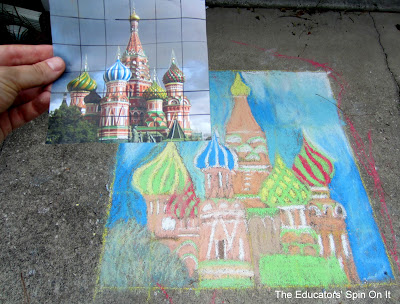
As we are getting ready for the Moebius Noodles display, we continue to be on high alert for great ideas that introduce grids to children. So I was really excited to see an art through math activity for young children on one of my favorite blogs, The Educators’ Spin On It.
The idea is to use grids to help make a copy of a picture. Inspired by a local chalk art festival, Amanda of the Educators’ blog decided to create chalk art with her children. The results are beautiful and Amanda documents the entire process with wonderful photographs (which she so generously allowed me to use in this post).
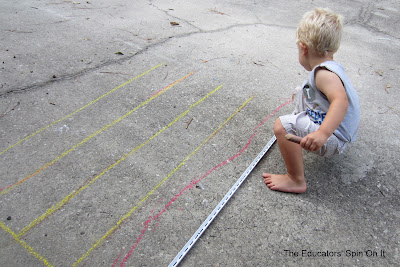
Amanda notes that even toddlers can participate in this activity. And the idea lends itself easily to customization based on your child’s interests. Amanda chose a picture of the beautiful St. Basil’s Cathedral in Moscow to reproduce. Your child might be more interested in something else (I’m pretty sure that mine is going to ask for either WALL-E or a Star Wars clone trooper).
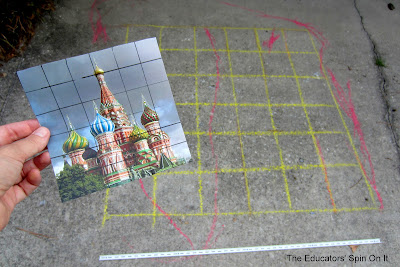
You can also choose a different art medium – paints, crayons, markers, even thumb prints (hey, that would be a fun idea to try). Or, if your child has a favorite picture that’s very large (say, poster-size), you can try making a smaller version of it.
Thank you, Amanda!
If you haven’t yet, do read Amanda’s entire post, get inspired and try it this weekend! When you do this activity with your children, take pictures. You can upload them to Facebook and share them on our page. Or you can post them to your blog and link to the post on our Facebook page or in the comments.


Posted in Make
Turn Your Child’s Bed Time into Fun Math Time

If you are like me, you are frequently short on time. And when we finally get an unexpected spare moment, we are so tired and so caught off guard, that it’s hard to figure out a fun math activity to do with our children. Yet even in the busiest household, there is that most structured time of the day, bedtime, when we and the kids are winding down and getting ready for the nightly bedtime story.
Laura Overdeck shows how to add a few moments of math to our children’s bedtime routines with her daily Bedtime Math Problems.
YELENA: How did Bedtime Math get started? Why bedtime?
LAURA: My husband John and I have been giving fun, mildly mischievous bedtime math problems to our kids for 6 years. When I started mentioning our habit to friends, many said it had never even occurred to them to do math alongside reading a story. People started saying I should write a book or a blog. I’d never written down our math problems, but decided to try emailing them out. And now here we are, exactly three months later, with thousands of people reading them!
I think it’s catching on because we hooked it to a daily routine: bedtime. Interestingly, there’s a whole crowd that instead does it at dinnertime, another regular ritual. There’s also a bathtime crowd.
YELENA: You have been doing bedtime math with your children since they were very young. How do parents know when their children are “ready” for bedtime math?
LAURA: I don’t think there’s any such thing as not being ready for math. No one says it’s harmful to read a story to a 3-month-old, right? So why not count with them? Why do we feel different about it? Society has a real bias on this that we hope to undo. Kids love attention from their parents, and they find counting entertaining even before they understand what numbers are. When they eat Cheerios off the high-chair tray, or you spoon them into their little mouths, you can count to them. They love it.
YELENA: What are your tips for parents of children who are afraid of or bored with math?
LAURA: Wow. It’s such a common problem with so many causes. One, of course, is that the parents are afraid of math, so parent job #1 is to avoid saying “I just can’t do math” or “I always hated math.” It’s so important for kids not to hear that!!
Many kids are also turned off by math at school, because the materials are incredibly dry and sanitized. So the best thing is to show your kids that math is a part of things they already love to do. Unless you point it out, they often don’t notice. It’s good to start with simple numbers, too, so they immediately feel confident and are open to more. Some great activities:
- Baking: Doubling recipes requires multiplying; cutting in half requires dividing; measuring 1/4-cups or 1/4-tsps uses fractions. At a more basic level, kids love counting out chocolate chips.
- Building: Anything that involves measuring gets kids counting, adding, and multiplying. My daughter (now age 8 ) still loves taping together squares and rectangles of cardboard to make houses and furniture for her doll. Lego and other building toys revolve around numbers, too.
- Planning: For example, setting up party favors. They’re all sold in different quantities: 10 in one pack, 24 in another, 18 in a third. If there are 16 kids coming over, how many packs of each do you need, and what’s left over? Even putting out breakfast or dinner takes some planning and counting.
YELENA: It is no secret that many parents experience math anxiety themselves. How can they overcome it?
LAURA: That brings us right to Bedtime Math. I’ve always known that the first audience we have to reach is the parents. That’s why the topics often have a more grown-up spin, so they hook the adults. Parents – particularly moms, since unfortunately there’s a gender gap – have said how much they appreciate a fun and real-world thing that involves math. To beat down that anxiety, parents can also delve into the same activities listed above to hook kids.
YELENA: Bedtime Math’s daily math problems have variations for children with different skill levels. How should parents choose which level of difficulty to offer to their children? And how can parents help a child to move to the next level while maintaining interest?
LAURA: We purposefully don’t assign age ranges or grade levels to the levels, so parents don’t get anxious about their children’s progress. Bedtime Math is all meant to be fun.
From what I hear, most kids start at the wee-one level no matter what their age, and work their way up until they get stuck. But even a little kid who’s only adding can tackle the big-kid problems with help, if the parent takes the time. A 5-year-old might not know how to multiple 6 x 8, but if you count on fingers.
YELENA: What other math activities do you do with your children? What are some of your favorite math books, games and/or toys?
LAURA: Interestingly, we don’t have a lot of formal math toys or flash cards in our house – I‘m having trouble thinking of any! Math is simply a quiet undercurrent in everything we do. Our kids have played mostly with dice, coins (once we knew they wouldn’t swallow them), cups of water or sand, stopwatches, and food. We do like counting books: our favorites include Dorling-Kindersley’s My Little Counting Book; Curious George’s 1 to 10 and Back Again; for wee ones, How Many Hearts?; and for older ones, Math Curse. On the game front, Scrabble is an awesome way to teach math, just picking out the “easy” letters and making words on the board. That’s great for reading, too.
YELENA: Your daily math questions always start with a little story or some interesting facts. How can parents learn this skill – to see math opportunities in everyday experiences?
LAURA: I think the best starting point is to look at your favorite objects and activities, and your kids’ favorites. Anything that involves quantities is an opportunity to count: Lego blocks, stuffed animals, candy. Anything that involves motion is a chance to measure time, distance and speed. And absolutely any object can be measured with a ruler, or weighed on a scale. It’s mindblowing to find out what some things actually weigh: a cubic foot of wet sand weighs 100 pounds! (I didn’t believe it till I weighed it myself). Numbers are everywhere, and favorite objects are a great jumping-off point.
YELENA: One of your hobbies is Lego Mindstorms. Have you tried programming your Mindstorms with your children? What are some of your favorite resources for introducing programming concepts to young children?
LAURA: Yes, I got into Mindstorms because my 6-year-old son desperately wanted them! He can now build and program his own simple robots. Robotics propel kids’ skills on so many levels: logic and process, spatial relations, fine motor skills…and best of all, math. You need to set how many times the motors turn the wheels, for how many seconds, and so on. We also like MIT’s Scratch as a fun, kid-friendly environment to learn programming.
YELENA: Thank you so much, Laura! Bedtime Math problems have quickly become a fun addition to our daily routine. The way you tie math to real life situations through short stories and trivia makes it easy to weave math into our dinner-time and bedtime conversations.
If you haven’t had a chance to visit Laura’s blog and sign up for daily problems to be sent straight to your email, check it out!
Posted in Make
Let’s Brainstorm!

We are getting ready to present MoebiusNoodles (the book, the site, and the concept) at a brick-and-mortar showcase on June 2. And we need your help brainstorming ideas for our table.
This year we decided to make Grids our theme. So our entire display will be about grids in math, science, life, universe and everything.
Right away we knew we wanted people who stopped by our table to walk away not just with our cards and basic information about Moebius Noodles, but with a tangible mathematical “thing” (a toy or a craft) that they could make themselves in just a couple of minutes. Another important idea is to show the connection between math and everyday life, especially outside of science and engineering.
Our space at the showcase will be pretty small, 4 linear feet or so. So we have to be mindful of that (of course, we can get creative and use the space under the display table, creating some kind of hide-away grid cave, hmmm). Finally, we’d like to stay low-tech and allow visitors to our display (both kids and adults) to touch, try and explore everything they see.
Some ideas we thought about include:
- Images of grids in art (beautiful), in engineering (i.e. map of Manhattan – a grid that, due to its scale, is not easily noticed by children), and in everyday life (household experiences or items).
- Grid games – Chocolate Fix by ThinkFun, Battleships, one or two of our own grid games, including Multiplication Towers and Make Your Own Grid activity.
- Examples of how a grid can be added to a non-grid game or activity and how that creates a different dynamics and introduces important math concepts (as in the photo above when we used a chess board in the “drive around town” pretend game)
- And somewhere there we’d like to have matryoshka dolls and a Star Wars alignment chart too!
What do you think? What would you suggest we add or remove? If you have activities and games that you created or played with your children that use grids, do let us know. If you have a post on your blog about grid math, post a link in the comments. And if you want to share images of grids, do post a link in the comments.
Posted in Grow
Rube Thursday

Happy Rube Thursday, a day to celebrate Rube Goldberg machines, the over-engineered contraptions that perform a very simple task.
Did Hogwash inspire you to think up or build crazy contraptions? Here’s another book we recently found, Lights Out by Arthur Geisert. This story is about a little piggy who doesn’t want to sleep in the dark. So he comes up with a plan and builds a very complicated machine that turns the lights back on.


As we talked through this book (there is no text other than on the first page), several interesting questions emerged:
- Before building his machine, the little piggy drew blueprints and schematics. Why?
- Do all the parts really work? What would had happened if a curious squirrel picked up one of the pieces and put it down in a different spot? What if the strong gust of wind blew? What if an elephant stomped in the yard?
- The machine takes so long to produce the result (turn the lights on), that the little piggy falls asleep. What can the piggy do differently?
- If you were to build a machine, what would it do?
Have you read this book? What do you think about it?
Posted in Make


