- Home
- “Yes, And…” Improving Math Play with Improv
- Althea’s Math Mysteries
- Avoid Hard Work, the Workshop
- Avoid Hard Work! …And Other Encouraging Problem-Solving Tips for the Young, the Very Young, and the Young at Heart
- Blocks and Modeling: A Do-It-Yourself Guide to Exploring Geometric Objects – Online Workshop
- Blog
- Books and Goods
- Bright, Brave, Open Minds
- Bright, Brave, Open Minds: A Problem Solving Kaleidoscope. Open online course for parents and teachers
- Camp Logic
- Cart
- Checkout
- Citizen Science Station
- Consulting and Tutoring
- Courses
- Download File
- Easy Complexity and Special Snowflakes Online Math Circle
- Empires: Year-long prealgebra program in a game
- Expedition Everest
- Five Fabulous Activities for Your Math Circle
- Funville Adventures: Math Personified!
- Funville Web Tour
- Hacking Math
- Hiding in Plain Sight: Vyshyvanka Secret Codes
- Home
- HOW do they do it? Creating your own math puzzles
- Inspired by Calculus: Online course for parents, teachers, and their children ages 5-12
- Kingdom On A Wall
- Kingdom on the Wall
- Ko’s Journey Is Discontinued
- Lapware
- Math Books
- Math Cafe
- Math Circles
- Math Circles 1001 Leaders Course
- Math Future event registration
- Math Future: come and talk!
- Math Goggles Challenges
- Math Renaissance
- Math Trek
- Mathematics & Poetry for All
- Meet the authors
- MidSchool Math Digital Math Tools
- Moebius Noodles
- mpsMOOC13: Problem Solving for the Young, the Very Young, and the Young at Heart
- Multiplication Explorers FAQ
- Multiplication Explorers LIVE workshop
- Multiplication Explorers Online Course
- Multiplication Explorers Registration
- Multiplication Explorers, the book
- Multiplication Models Poster
- My Account
- Natural Math Multiplication Course
- Online Logic Summer Camp for Kids!
- Online Summer Calculus for Kids Camp!
- Pay Natural Math
- Playing with Math: Stories from Math Circles, Homeschoolers, and Passionate Teachers
- Reviews of the Moebius Noodles book
- September 25: Math Storytelling Day
- Socks Are Like Pants, Cats Are Like Dogs
- Speaking and events
- Start Here!
- test001
- The Art of Factorization Diagrams
- The Iditarod
- The seven principles of Natural Math
- Transformers: Matrices & Graphs!
- Veronica’s Multiplication: a Natural Math circle online
- WOW! Multiplication – an open course in September 2013
- Ying and the Magic Turtle
- About Natural Math
- Contact Us
- Get Involved
Silly Robot Math


Robots are cool! Just ask any 5-year old (I just did a quick survey of 3 5-year olds and they confirmed it). So let’s play a game that is all about robots, math and silliness.
httpv://www.youtube.com/watch?v=nQtwV0Atzdc
Objectifying people is dangerous, but math entities – operations, functions, algorithms – love to be objectified! “Function machine” metaphor helps kids to see actions as objects or things. This allows kids to progress to the next level: that is, to perform math actions on functions. When functions are objects, kids can act on them: sort, improve, analyze, compose, reverse, loop and so on.
Algorithm is a very curious thing indeed: it’s an objectified sequence of many action, or a Rube Goldberg machine composed of many functions. The usual developmental wisdom is that kids can deal with algorithms with as many steps as their age, for example, a two-year-old can (1) take socks (2) from top drawer but forgets to (3) put them on. However, repeated, fun, meaningful algorithms kids care about work well at earlier ages.
Algorithm is one of the BIG Concepts that children can learn in the Silly Robot game. Other BIG Concepts include
- Command
- Function
- Loop
- Cycle
So let’s play! Here’s HOW
“Silly robot” turns familiar, everyday task into funny and quirky “Wonderland” games. Choose a simple task, such as filling a glass with water, or putting on shoes. “The silly robot” should be someone who knows the game well. Robots only understand simple, one-step commands, such as “move forward” or “pick up the glass.” They make silly noises if the command is wrong or they can’t do it.
The robot is trying as hard as he can to mess up the task without actually disobeying directions. For example, kids say, “Put the shoe on” and the robot puts it on his head. Kids say, “Put the glass down” and the robot does, except the glass is sideways and all the water spills out! The goal for the robot is to find funny loopholes, and the goal for the team is to give commands without loopholes. Only the robot (the game leader) needs to know this at first – kids discover how the system works! Then they want to play the role of silly robots – analyzing actions as they try to mess up on purpose.
Reusing and improving algorithms is a huge value of mathematicians. Another value is the precision of language and action. One way to be a good “silly robot” is to take commands literally, which helps kids to pay attention to details of actions and their descriptions. The task of playing the robot is difficult, because the robot needs to be slightly annoying, for laughs, but not too annoying.
Infants – Use “mix-up” gags about routine tasks. I think every parent of a baby I know has at least one photo with underpants on the head, done for the baby’s amusement. Tell the baby the dog goes “Meow” and point at the belly button after asking, “Where is the baby’s nose?”
Toddlers – Even before kids are verbal, they use gestures to tell parents what to do and what they want. You can play silly robot games around these commands. Just make sure to laugh with the kid, not at the kid.
Older Children – Progress to more complex tasks and those that involve repetition, such as cutting several tomatoes for a salad, or decorating a room with several pictures. This promotes reuse of algorithms and their parts (cycles or loops). Use computer algorithms.
Other ways to explore algorithms are
- Story ideas: A storyboard is an algorithm for a movie or a game. Look at favorite books, movies, games, jokes to analyze their algorithms and their parts, such as plots or motifs. For example, knock-knock jokes and “Why did the chicken cross the road?” jokes have distinctive algorithms. Fairy tales and stand-up gags often feature two repetitions and the third action breaking the pattern, for example, “Three little pigs” or “Three billy goats gruff.” Check out this huge depository of story algorithms.
- Show kids computer tools for capturing algorithms, such as concept mapping or diagramming software.
- Play “Silly Robot” with math computations. How many mistakes can you make in one problem? Making mistakes on purpose is hugely therapeutic!
- The game can help with the annoying, persistent issue: kids not remembering some steps in everyday tasks, such as putting lids back on food. After playing for a while, the algorithms are not only laughed at, but also debugged, and everybody is in a better mood.
- The clearest, easiest programming software, accessible even to toddlers (with parents helping) is Scratch from MIT. It presents steps in algorithms as Lego pieces you put together.
Do you like robots? Does your child? Share your experience playing this game.


Posted in Make
Rube Thursday
Happy Rube Thursday, a day to celebrate Rube Goldberg machines, the over-engineered contraptions that perform a very simple task.
We haven’t built any new machines in a while. Instead we’ve been leafing through a couple of books, talking about complicated and funny contraptions found in them and creating no less complicated drawings for our future machines.

Hogwash by Arthur Geisert is a funny story about a whole lot of little pigs going out to play, first in the mud

And then at what appears to be an old paint factory.

As you can see, the piggies’ parents have a whole lot of cleaning up to do. And here I was thinking bath time at our house was tough. So what do mommy pigs and daddy pigs come up with? They do quite a wonderful job cleaning and drying the piggies.

Don’t you love the contraption? We read through this simple, yet charming story and looked through illustrations several times, each time noticing something new. A perfect activity to go along with this book, as we found out, is a water wall, such as this one

Source: afamilythatbirdstogether.blogspot.com via Hailey on Pinterest
Or this one

Source: artbeaststudio.com via Rachel on Pinterest
Or this water wall that looks like a marble run (it’d probably work with small marbles too).

Source: shareandremember.blogspot.com via Amanda on Pinterest
Posted in Grow
Subscribe to Newsletter

Sign up for twice-a-month newsletter. It has Natural Math games for kids, questions and answers, child-friendly math art and photography, open course information, and stories of math adventures. Send us your questions, comments, and stories. Join the Natural Math community!
Posted in Newsletter
Press Here
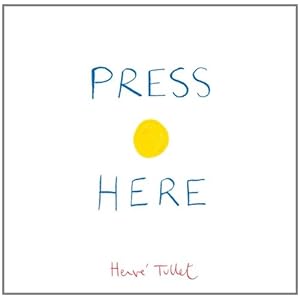
Have you read this book? Maybe “read” is not exactly the word here. Have you played this book yet? If not, go ahead and give it a try. The idea is simple – each page of the book tells you what to do, but doesn’t tell you why you are doing it or what to expect. You discover what has happened only after you flip the page.


This is not a math book. Yet there is a lot of fun math hidden in it. In just a few pages you play with iterative functions, several function machines and a fun pattern.
Even better, the book ends with an invitation to play it again, looping back to the first “press here” page.
This book gives a child a perfect opportunity to figure out patterns of action and to predict outcomes. “What do you think is going to happen now?” is a question that is ingrained into the book.
After going through it a few times, children might feel inspired to create their own books similar to “Press Here”. All it takes is a few sheets of paper, stickers and markers.
One thing I haven’t tried yet, but that sounds intriguing is to see what happens if you stop in the middle of the book and go back to beginning and repeat the instructions. For example, what if we stop on this page with a pattern and then go back to the beginning, follow the instructions and press yellow dots only. I think it would be a fun way to explore algorithms with nothing but a large piece of paper and a few Dot Dot markers (or regular markers or stickers).
httpv://youtu.be/Kj81KC-Gm64
Have you played this book? Share your ideas and experience with us!
Posted in Grow


