- Home
- “Yes, And…” Improving Math Play with Improv
- Althea’s Math Mysteries
- Avoid Hard Work, the Workshop
- Avoid Hard Work! …And Other Encouraging Problem-Solving Tips for the Young, the Very Young, and the Young at Heart
- Blocks and Modeling: A Do-It-Yourself Guide to Exploring Geometric Objects – Online Workshop
- Blog
- Books and Goods
- Bright, Brave, Open Minds
- Bright, Brave, Open Minds: A Problem Solving Kaleidoscope. Open online course for parents and teachers
- Camp Logic
- Cart
- Checkout
- Citizen Science Station
- Consulting and Tutoring
- Courses
- Download File
- Easy Complexity and Special Snowflakes Online Math Circle
- Empires: Year-long prealgebra program in a game
- Expedition Everest
- Five Fabulous Activities for Your Math Circle
- Funville Adventures: Math Personified!
- Funville Web Tour
- Hacking Math
- Hiding in Plain Sight: Vyshyvanka Secret Codes
- Home
- HOW do they do it? Creating your own math puzzles
- Inspired by Calculus: Online course for parents, teachers, and their children ages 5-12
- Kingdom On A Wall
- Kingdom on the Wall
- Ko’s Journey Is Discontinued
- Lapware
- Math Books
- Math Cafe
- Math Circles
- Math Circles 1001 Leaders Course
- Math Future event registration
- Math Future: come and talk!
- Math Goggles Challenges
- Math Renaissance
- Math Trek
- Mathematics & Poetry for All
- Meet the authors
- MidSchool Math Digital Math Tools
- Moebius Noodles
- mpsMOOC13: Problem Solving for the Young, the Very Young, and the Young at Heart
- Multiplication Explorers FAQ
- Multiplication Explorers LIVE workshop
- Multiplication Explorers Online Course
- Multiplication Explorers Registration
- Multiplication Explorers, the book
- Multiplication Models Poster
- My Account
- Natural Math Multiplication Course
- Online Logic Summer Camp for Kids!
- Online Summer Calculus for Kids Camp!
- Pay Natural Math
- Playing with Math: Stories from Math Circles, Homeschoolers, and Passionate Teachers
- Reviews of the Moebius Noodles book
- September 25: Math Storytelling Day
- Socks Are Like Pants, Cats Are Like Dogs
- Speaking and events
- Start Here!
- test001
- The Art of Factorization Diagrams
- The Iditarod
- The seven principles of Natural Math
- Transformers: Matrices & Graphs!
- Veronica’s Multiplication: a Natural Math circle online
- WOW! Multiplication – an open course in September 2013
- Ying and the Magic Turtle
- About Natural Math
- Contact Us
- Get Involved
Paper Plate Geometry


Can your little one say “icosahedron”? He will by the time you’re done with this easy-peasy project.
It all started with me buying way too many paper plates for a picnic party. After the party was over, I ended up with too many paper plates on my hands. I did my best trying to use them up in various arts and crafts projects, but unfortunately my son wasn’t big on arts and crafts at that time.
That’s when I came across this Paper-Plate Polyhedron activity in an issue of the Family Fun magazine. It sounded a bit advanced for a not-quite-3-year-old, but I decided to give it a try anyway, mostly because we had no other plans.
First, we counted out 20 plates – 2 sets of 10 and lined them up neatly on the floor. Then I showed my son how we were going to fold the plates. He was eager to try, but lost interest after the first plate was done. Fortunately, I discovered a trick to keep his attention – I simply talked through the process and asked him questions along the way:
“See this plate? What shape is it? Yes, I’m going to take this circular plate and I’m going to fold it. Guess how many times? Nope, not one. I will fold it 3 times. Now look, what shape can you see on the plate now? Do you want to try turning this circle into a triangle yourself?” and on and on it went.
If your child is more into doing things, then you can set him to work decorating the plates while you’re folding them. It’s just as I said, my child wasn’t much into art at the time.
After all the plates were folded, it was time to staple them together. I’m yet to see a 3-year old who doesn’t want to operate a stapler and staple everything to everything else. Well, this project requires so much stapling, that by the end of it your little one might get the stapling urge out of his system. And if he doesn’t, just let him put some extra staples here and there in the plates.
And so we were stapling… And I was talking: “You see, here we have to staple two plates together. We’ll need to staple these plates in three places – at one end, at another end and in the middle. Can you help me figure out where the middle is? Ok, now we need 3 more plates. Can you pass 3 more plates to me? Ok, so now we have how many plates? 1,2,3,4,5. 5 plates now. You see this new shape? It is called a pentagon. What do you think it looks like? Yes, I also think it looks like a flower…”
That was also a point at which my son noted that the shape wasn’t flat, but instead was “like a hat” and demonstrated how he could wear the pentagon like a hat.
We then made a chain out of 10 more plates. By now my son was a bit bored with the stapler and was playing with the “hats”, trying to fit them together. So I finished the chain and then called him over for a very exciting part – stapling the chain into a ring. Actually, I didn’t think it was going to be exciting, but my little one loved the transformation. So he played with a ring for a little bit.
Finally, we attached the first pentagon to the ring: “Look, Mama, it’s a bowl! It’s a helmet! It’s a dome! It’s a house like a dome!” I then attached the second pentagon to the ring to an exciting “Wow! It’s a ball! I’m going to bounce it”. He then tried to play with it the way he’d play with a ball – throwing, rolling, trying to bounce it.
Which gave me an idea to do a side-by-side comparison of the icosahedron with one of the larger balls we had. We checked which one was bigger, smoother, rolled better, bounced better and such. And we learned to pronounce the name of this new toy – eye-cos-a-HEE-dron.
All in all, what started off as a boring afternoon turned into a fun math craft and an even more fun icosahedron tossing game. The icosahedron stayed with us for several weeks and was played with many times.
Have you tried making geometric shapes and playing with them? We’d love to hear your stories.


Posted in Make
Mathematical Faces 07/01/2011

It is often said that mathematical values, mastery and flow transform people who practice math. The transformations are reflected in children’s faces. Look at mathematical faces for inspiration, and share them with your kids. This is what it’s all about!
Submit your photos of mathematical faces for future posts.
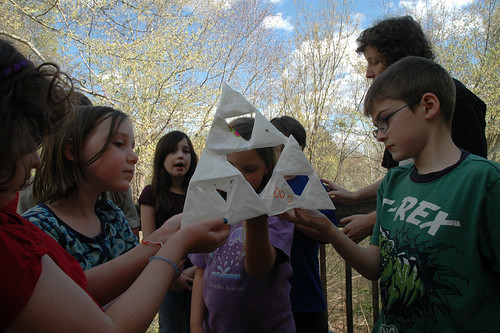
This is a very flimsy Sierpiensky Gasket that took kids quite a while to make. They are loving and treasuring it.
Natural Math club, Cary, NC, Spring 2011
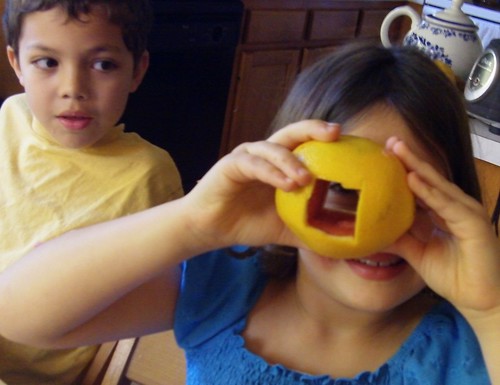
“Can you cut an orange so there are two pieces of the insides, but three pieces of the skin?” We looked at the answer a week after asking the question. There were a lot of hypothesis and suspense! Two kids are fascinated – in different ways, one more exuberantly and one more contemplatively.
Natural Math club, Cary, NC, Fall 2010
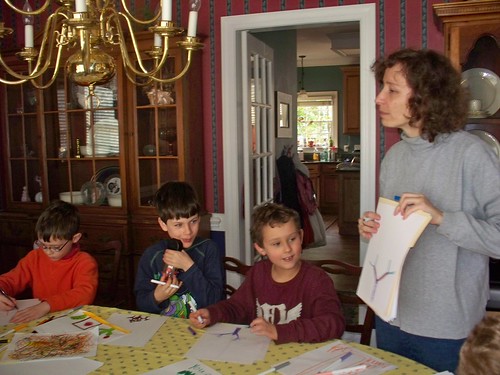
Kids find it intellectually amusing that this is a portrait of infinity. After all, the binary tree only has two three levels drawn. But they claim they can see the infinity in it – after all, they know it can keep growing forever – and it cracks them up.
Natural Math club, Cary, NC, Fall 2010
Posted in Grow
Knitting Math
 I have a long list of things I’d love to learn in life, like knitting. I have an even longer list of things I’d love to teach my son. Yes, knitting is on that list too. Or crocheting, whatever is more to his liking.
I’m not going to go over all the benefits of teaching a child (or self) to knit. Sharpened fine motor skills and improved concentration are just two of the more obvious outcomes.
The no-less important benefit is that knitting and crocheting produce tangible outcomes. And these tangible outcomes can be re-used as beautiful math toys or math art that will teach advanced math concepts.
If you are too busy and your children are too young to pick up yarn arts, you can browse knitted math-y objects on Etsy, like this dodecahedron. I showed it to my son and asked him what he thought of it. He said that he thought it was an emblem, possibly for a robot. He also pointed out all the triangles he saw.
Next I showed him this fractions afghan. We tried figuring out the pattern – rectangles divided into 1, 2, 3, 4 and more parts. We also counted to see how in some rectangles there was the same number of yellow and green elements while in others there were more green elements.
But don’t get too hard on yourself for not creating something just as beautiful for your child. Instead, stick around to find out how you can create no less stunning geometric shapes for and with your child. Hint – you’ll need to stock up on paper plates.
Posted in Make
Mathematical Faces 06/24/2011
It is often said that mathematical values, mastery and flow transform people who practice math. The transformations are reflected in children’s faces. Look at mathematical faces for inspiration, and share them with your kids. This is what it’s all about!
Submit your photos of mathematical faces for future posts.
This blog post starts a series showing kids and teens doing mathematics. We would like to thank Alexandre Borovik for the idea.
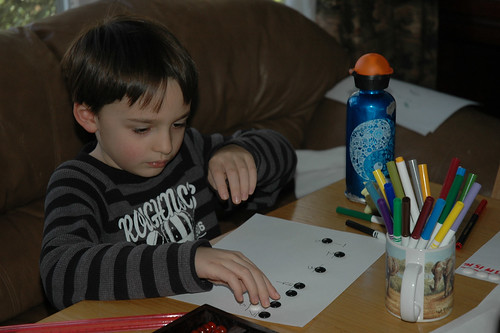
The task requires precision, and the boy’s face shows quiet, prolonged concentration, while his motions are fluid, confident and exact.
Natural Math club, Cary, NC, Spring 2011
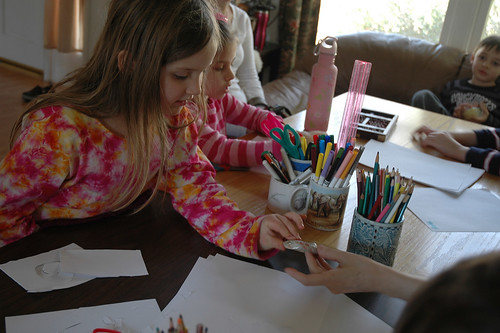
The girl has found a mathematical idea in a shell, and now touches it to appreciate the beauty even more. She often draws and diagrams shells mathematically, and she looks inspired and happy.
Natural Math club, Cary, NC, Spring 2011
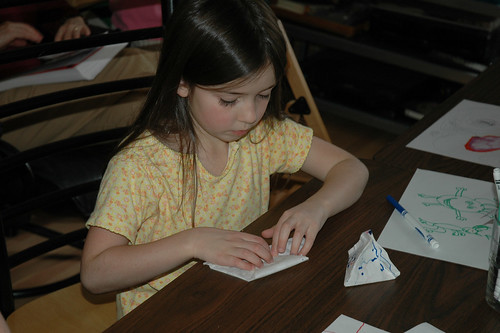
This kid is in the state of flow – her hands and shoulders are relaxed enough for precise, smooth movements… And her the face looks peaceful and meditative.
Natural Math club, Cary, NC, Spring 2011
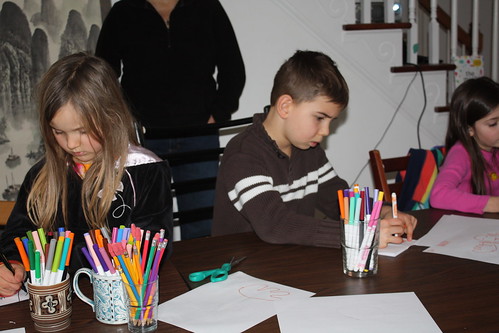
The task is tough, and kids look serious and powerful. They managed it!
Natural Math club, Cary, NC, Spring 2011
Posted in Grow


