- Home
- “Yes, And…” Improving Math Play with Improv
- Althea’s Math Mysteries
- Avoid Hard Work, the Workshop
- Avoid Hard Work! …And Other Encouraging Problem-Solving Tips for the Young, the Very Young, and the Young at Heart
- Blocks and Modeling: A Do-It-Yourself Guide to Exploring Geometric Objects – Online Workshop
- Blog
- Books and Goods
- Bright, Brave, Open Minds
- Bright, Brave, Open Minds: A Problem Solving Kaleidoscope. Open online course for parents and teachers
- Camp Logic
- Cart
- Checkout
- Citizen Science Station
- Consulting and Tutoring
- Courses
- Download File
- Easy Complexity and Special Snowflakes Online Math Circle
- Empires: Year-long prealgebra program in a game
- Expedition Everest
- Five Fabulous Activities for Your Math Circle
- Funville Adventures: Math Personified!
- Funville Web Tour
- Hacking Math
- Hiding in Plain Sight: Vyshyvanka Secret Codes
- Home
- HOW do they do it? Creating your own math puzzles
- Inspired by Calculus: Online course for parents, teachers, and their children ages 5-12
- Kingdom On A Wall
- Kingdom on the Wall
- Ko’s Journey Is Discontinued
- Lapware
- Math Books
- Math Cafe
- Math Circles
- Math Circles 1001 Leaders Course
- Math Future event registration
- Math Future: come and talk!
- Math Goggles Challenges
- Math Renaissance
- Math Trek
- Mathematics & Poetry for All
- Meet the authors
- MidSchool Math Digital Math Tools
- Moebius Noodles
- mpsMOOC13: Problem Solving for the Young, the Very Young, and the Young at Heart
- Multiplication Explorers FAQ
- Multiplication Explorers LIVE workshop
- Multiplication Explorers Online Course
- Multiplication Explorers Registration
- Multiplication Explorers, the book
- Multiplication Models Poster
- My Account
- Natural Math Multiplication Course
- Online Logic Summer Camp for Kids!
- Online Summer Calculus for Kids Camp!
- Pay Natural Math
- Playing with Math: Stories from Math Circles, Homeschoolers, and Passionate Teachers
- Reviews of the Moebius Noodles book
- September 25: Math Storytelling Day
- Socks Are Like Pants, Cats Are Like Dogs
- Speaking and events
- Start Here!
- test001
- The Art of Factorization Diagrams
- The Iditarod
- The seven principles of Natural Math
- Transformers: Matrices & Graphs!
- Veronica’s Multiplication: a Natural Math circle online
- WOW! Multiplication – an open course in September 2013
- Ying and the Magic Turtle
- About Natural Math
- Contact Us
- Get Involved
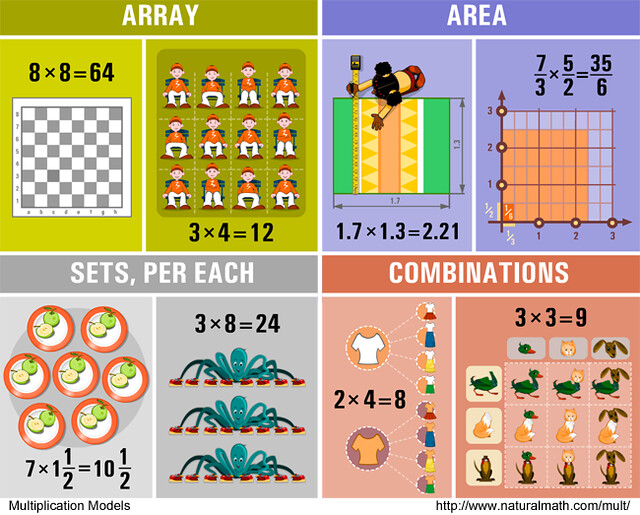
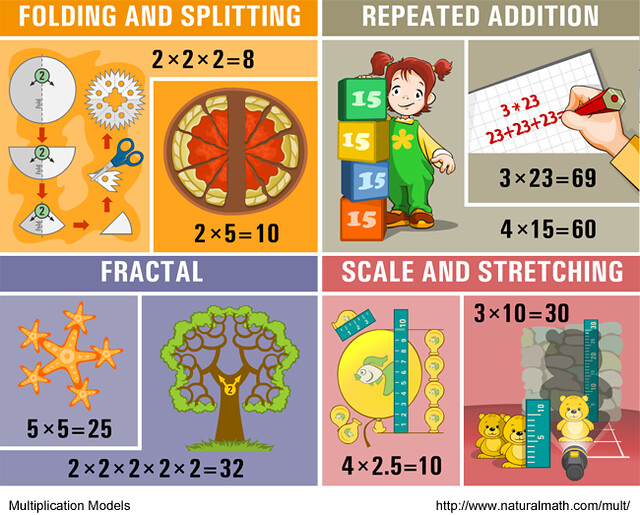
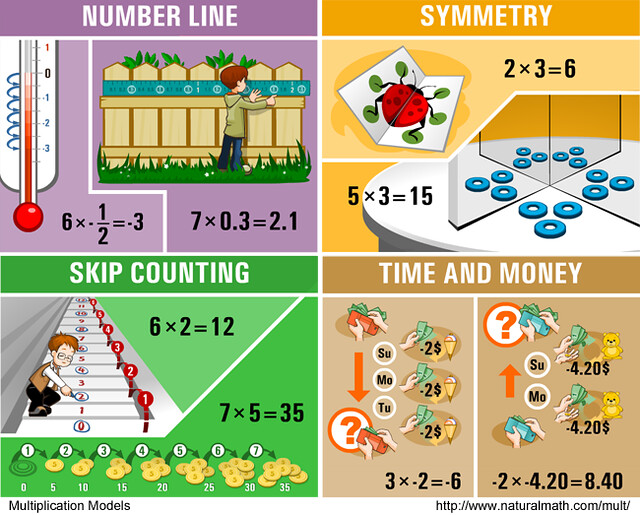
12 models of multiplication




Posted in Grow
9 comments on “12 models of multiplication”
2 Pings/Trackbacks for "12 models of multiplication"
[…] see what multiplication looks like in real life, explore the multitude of Multiplication Models collected at the Natural Math website. Also available as a poster for easy […]
[…] a model as fragile as “repeated addition.” Instead, explore the many real-life Multiplication Models collected at the Natural Math […]


I was wondering if I need to purchase or somehow print the 12 models of multiplication?
Thank you
Shannon, we will refer to the models in a few activities in the course. You are welcome to print these pictures, or look at them on the screen – this page will stay up! There is a big paper poster with the models for sale, as well. Whichever option makes more sense to you!
Is it possible to purchase an electronic version of the poster and then I could print one copy for myself? Shipping to Canada is $10. Thank you.
Kristina, we took the poster apart into the three sheets you see in the page above – http://www.moebiusnoodles.com/2013/09/12-models-of-multiplication/
They fit on the regular printer paper. Here is a one-page version of the whole poster, if you want the whole thing for the reference https://farm3.staticflickr.com/2828/9712680940_7e56d54951_o.png
Let me know if this helps, or if you need something else.
The original paper poster is 18 by 24 inches, more than half as tall as I am!
I’m delighted to say that I can add another model of multiplication to your list: prime factor concatenation.
For example, 6 = 2 * 3 and 10 = 2 * 5, so 6* 10 = 2*2*3*5 = 60
This was inspired by the game Prime Climb, so I really can’t take much credit for it. They use this to build a pretty multiplication table which illustrates the model nicely.
Unfortunately, this makes 13 models of multiplication, which we know doesn’t allow us to create a nice array of models.
Joshua, thank you for your comment! I have good news and more good news :-)
First, we do have plan to redesign the poster, something like “Even more models of multiplication” (since people suggested new ones since it came out). And the structure will be different – clustered by types of models and their relationships. I think it will come out first in our book on multiplication.
Second, we need to separate “models and models” so to speak, and find good terms for them. What we have in that poster are bridges to the physical world: how objects (arrays, reflections, stretchy things) represent multiplication. What we need to have, separately, is how we can represent multiplication by other symbolic mathematics. Repeated addition will leave the original poster and go into that second collection. So will your concatenation.
Do you know a good physical model of concatenation?
We are a team of volunteers and beginning a new plan in our group. Your web website provided us useful information to perform on. You’ve conducted a formidable process and our whole neighborhood might be thankful to you.|
This collection of models for multiplication remains one of my all-time favorite webpages for elementary school math. Taking a look again, I have the inkling of a pedagogical structure, so I am curious to hear other people’s thoughts:
Models that can substitute for knowing multiplication facts: skip counting, repeated addition, array (maybe sets?). These are models where, if the student doesn’t know a multiplication fact, they can use the model to calculate a fact.
Models that extend multiplication beyond positive integers: sets (one factor non-integer), number line (one factor non-integer), area (fractions and decimals, neither factor needs to be an integer, but both positive), scale (fractions and decimals, at least one positive factor), time and money (fractions, decimals, negatives).
Models that connect multiplication to other math: combinations (combinations), fractals (exponentiation), symmetry (geometry), scaling (geometry), area (geometry), sets (division), splitting (fractions, division).
Any thoughts?
Joshua, this is a good way to organize the poster. We are thinking of reprinting it, with a better organizational structure. Would you be interested in discussing it with me? If so, write reach.out@naturalmath.com and we can talk.